Sow organic peas as soon as the soil reaches 10 °C. According to the University of Saskatchewan (2026), you can sow 1 to 2 weeks before the expected last spring frost, provided the soil is at least 10 °C at that time. Peas go directly into the garden bed rather than being transplanted, and fall sowing is not suitable. Because the right date depends on your region and local soil conditions, the soil temperature is a more reliable signal than the calendar.
When to Plant Organic Peas in Canada?
Spring Sowing Window
- Sow when the soil reaches 10 °C, typically 1 to 2 weeks before the last expected spring frost.
- Do not sow in autumn. Peas are not suited to autumn sowing, and most cultivars need 56 to 80 days from sowing to harvest.
Succession Sowing
Sow in batches every 2 weeks, up to mid-June, to extend the harvest. Late sowings are more exposed to powdery mildew, so choose resistant cultivars for these batches. In northern regions, early varieties that mature in under 55 days are the practical choice.
Soil Temperature and Germination
| Soil temperature | Expected result |
|---|---|
| Below 5 °C | Seeds may rot in the ground |
| 5 to 10 °C | Emergence in about 14 days |
| About 15 °C | Emergence in about 9 days |
Sowing Technique
- Sow seeds directly at a depth of 2.5 to 5 cm, spaced 5 to 7 cm apart, in rows about 45 cm apart.
- Do not soak seeds before sowing. In cold, wet soil they are more likely to rot.
- Choose a sunny spot and water without waterlogging the bed.
Limiting Powdery Mildew Without Chemicals
Peas fix nitrogen, and leaving the roots in the soil after harvest adds nutrients for the next crop. To limit powdery mildew, the University of Saskatchewan (2026) recommends mulching, good air circulation, staking, and watering in the morning. The Rhizobium inoculant is mainly useful in a new garden or where peas have never been grown before.
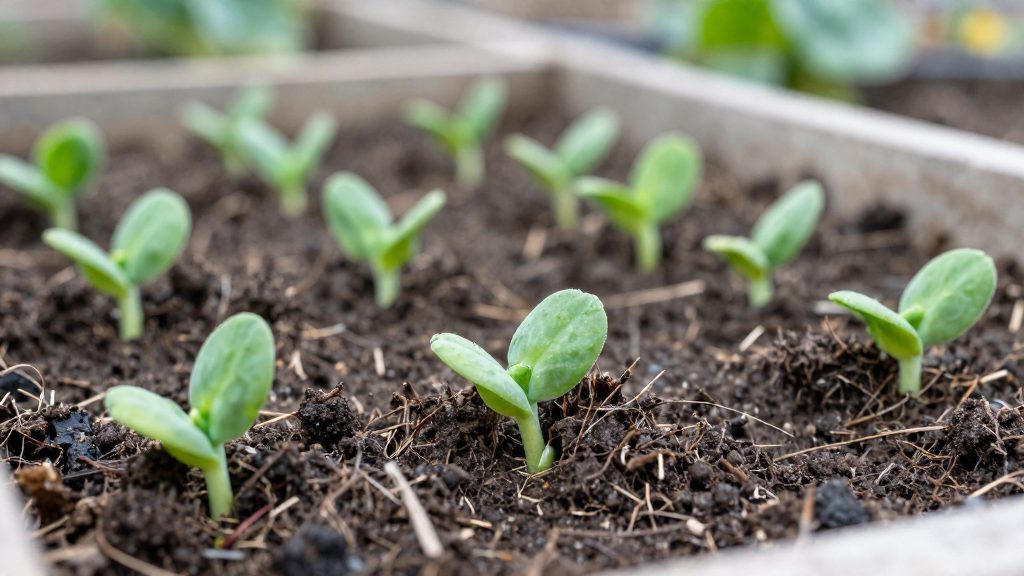
Soil Temperature: The Real Benchmark
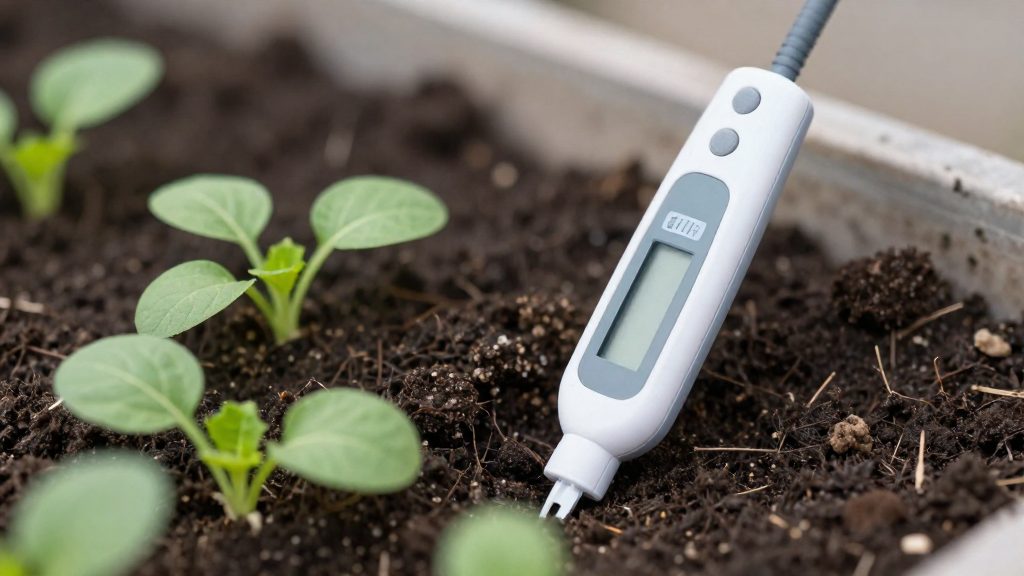
Peas are best sown by soil temperature rather than by calendar date. According to the University of Saskatchewan (2026), peas can be sown as soon as the soil reaches 10 °C, and they can go in 1 to 2 weeks before the expected last spring frost, provided the soil is at least 10 °C at that point. Spring weather varies from year to year and from region to region, so a soil thermometer checked at sowing depth gives a more reliable signal than a fixed date on the calendar.
Soil temperature also determines how long the seeds take to emerge and whether they survive. The same source gives these figures:
| Soil temperature | Effect on pea seeds |
|---|---|
| Colder than 5 °C | Seeds may rot in the ground |
| 5 to 10 °C | Emergence in about 14 days |
| 15 °C | Emergence in about 9 days |
How to Sow Peas Once the Soil Is Ready
- Check the soil at the depth where the seed will go. Wait until it reaches 10 °C.
- Sow directly into the bed. The University of Saskatchewan (2026) advises against transplants for peas.
- Plant at 2.5 to 5 cm deep, with 5 to 7 cm between seeds, in rows about 45 cm apart.
- Do not soak the seeds before sowing. In cold, wet soil they are at risk of rotting.
- Stagger sowings every 2 weeks until mid-June to spread the harvest.
Timing Constraints to Keep in Mind
- Autumn sowing is not suitable for peas.
- Most cultivars need 56 to 80 days from sowing to harvest.
- Late sowings are more prone to powdery mildew. Choose resistant cultivars for these plantings, and support the plants with a trellis, keep air moving between them, and water in the morning. Mulch also helps limit the disease, according to the same source.
- Peas fix nitrogen. Leaving the roots in the ground after harvest returns nitrogen to the soil. Rhizobium inoculant is mainly useful in a new garden or where peas have never been grown.
Adapting sowing dates to your local frost dates
Peas are sown when the soil reaches 10 °C, not on a fixed calendar date. According to the University of Saskatchewan (2026), you can sow peas 1 to 2 weeks before the expected last spring frost, as long as the soil is at least 10 °C. Last frost dates differ widely across Canada, from the Prairies to the Atlantic provinces and the north, so a soil thermometer reading is a more reliable guide than the date alone. The official sources consulted do not specify exact sowing dates for individual provinces or cities, so use local frost dates and soil readings to adjust the timing.
Soil temperature as the trigger
Check the soil temperature at sowing depth before planting. Sowing into soil colder than 5 °C risks seed rot. The University of Saskatchewan (2026) reports that seeds emerge in about 14 days at 5 to 10 °C and in about 9 days at 15 °C, so cold soil also means a longer wait before seedlings appear.
Staggered sowing through spring
Rather than sowing one large block, sow in successive rows every 2 weeks. This spreads the harvest over several weeks. According to the University of Saskatchewan (2026), staggered sowing can continue until mid-June. Late sowings are more prone to powdery mildew, so choose resistant cultivars for these later rows.
Northern gardens
In the north, the growing season is shorter. The University of Saskatchewan (2026) advises choosing early varieties that mature in under 55 days. Most cultivars need 56 to 80 days from sowing to harvest, so this difference matters when frost arrives early in autumn.
Key sowing parameters
| Parameter | Value (University of Saskatchewan, 2026) |
|---|---|
| Start sowing | Soil at 10 °C or higher, 1 to 2 weeks before expected last spring frost |
| Staggered sowing window | Every 2 weeks, up to mid-June |
| Sowing depth | 2.5 to 5 cm |
| Spacing in the row | 5 to 7 cm |
| Row spacing | About 45 cm |
| Emergence time | About 14 days at 5 to 10 °C; about 9 days at 15 °C |
| Days from sowing to harvest | 56 to 80 for most cultivars; under 55 for early northern varieties |
Autumn sowing
Peas are not suited to autumn sowing. Plant in spring only, as the timing described above allows.
How to Sow Peas in Organic Cultivation
Peas are sown directly into the garden bed, not as transplants. According to the University of Saskatchewan (2026), sowing can begin once the soil reaches 10 °C, and it can take place 1 to 2 weeks before the expected last spring frost, as long as the soil is at least 10 °C. Sowing in soil colder than 5 °C risks rotting the seed.
Key sowing parameters
| Parameter | Value (University of Saskatchewan, 2026) |
|---|---|
| Soil temperature for sowing | At least 10 °C |
| Timing | 1 to 2 weeks before the expected last spring frost |
| Sowing depth | 2.5 to 5 cm |
| Spacing within the row | 5 to 7 cm |
| Spacing between rows | About 45 cm |
| Germination time | About 14 days at 5 to 10 °C; about 9 days at 15 °C |
| Days from sowing to harvest | 56 to 80 days for most cultivars |
| Early cultivars for northern gardens | Mature in under 55 days |
Step-by-step method
- Check the soil temperature before sowing. Wait until it reaches 10 °C.
- Open shallow furrows at the depth given above, and space the seeds 5 to 7 cm apart.
- Do not soak the seeds beforehand. In a cold, wet bed, soaked seeds are more likely to rot.
- Space the rows about 45 cm apart to allow air to move between the plants.
- Stagger sowings every 2 weeks until mid-June to extend the harvest.
Succession and late sowings
Late sowings are more prone to powdery mildew. The University of Saskatchewan (2026) recommends choosing resistant cultivars for these. Peas are not suited to autumn sowing.
Limiting powdery mildew organically
The same source lists several non-chemical measures:
- Mulch the soil.
- Keep air circulating by spacing plants properly.
- Stake or trellis the plants.
- Water in the morning so foliage dries during the day.
Nitrogen and inoculation
Peas fix nitrogen. Leaving the roots in the soil after harvest, rather than pulling them out, returns nitrogen to the bed as they decompose. The Rhizobium inoculant is most useful in a new garden or where peas have never been grown before.
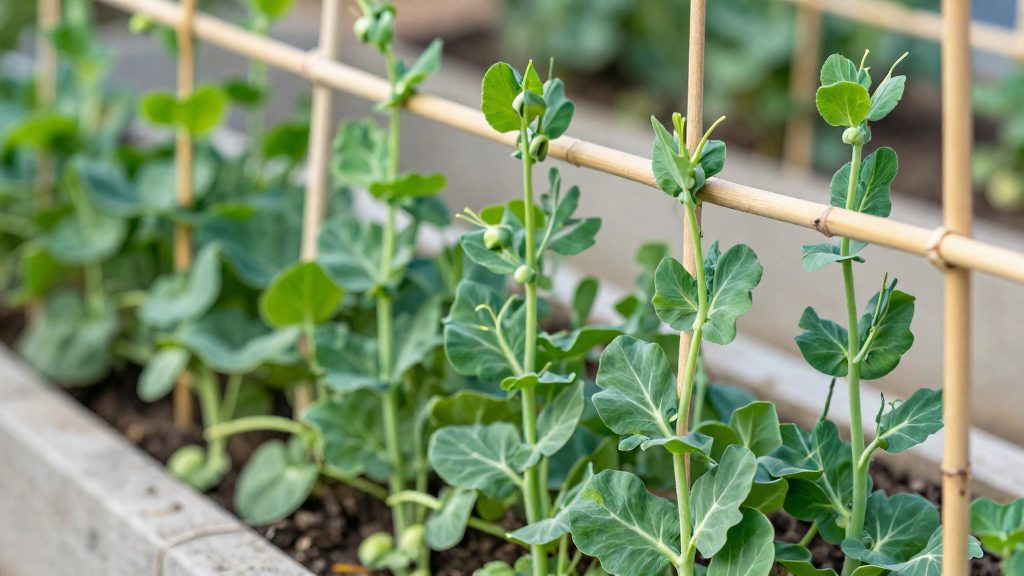
Can You Sow Peas in Succession or in Autumn?
Succession sowing is the most practical way to extend a pea harvest. According to the University of Saskatchewan (2026), sowings can be staggered every 2 weeks until mid-June. Each batch goes directly into the bed, without transplants, at 2.5 to 5 cm deep and 5 to 7 cm apart, in rows about 45 cm apart. Staggering spreads the picking window across several weeks instead of concentrating it in one.
Later sowings carry a trade-off. The same source notes that late-sown peas are more prone to powdery mildew, so cultivars with resistance should be chosen for the June batches. Preventive practices help limit the disease:
- Mulch around the plants.
- Keep air moving through the row by trellising and respecting spacing.
- Water in the morning so the foliage dries during the day.
Autumn sowing is not suitable for peas. Most cultivars need 56 to 80 days between sowing and harvest. In the north, gardeners should choose early varieties that mature in under 55 days.
Germination speed depends on soil temperature:
| Soil temperature | Approximate emergence time |
|---|---|
| 5 to 10 °C | about 14 days |
| 15 °C | about 9 days |
Leaving the roots in the ground after harvest returns nitrogen to the soil, since peas fix nitrogen. This makes it easier to follow a pea bed with another crop. Rhizobium inoculant is mainly useful in a new garden or in a bed where peas have never been grown, according to the University of Saskatchewan (2026).
Pea varieties suited to the Canadian climate
Variety choice in Canada depends mainly on the length of the growing season and on the timing of your sowings. According to the University of Saskatchewan (2026), most pea cultivars need 56 to 80 days between sowing and harvest. Gardeners in northern regions with short summers should select early-maturing cultivars that reach harvest in under 55 days.
Sowing timing also affects which cultivars to pick:
| Situation | Recommended cultivar type | Reason given by the source |
|---|---|---|
| Short season, northern gardens | Early varieties, harvest in under 55 days | Allows the crop to mature before cool weather ends the season |
| Most climates, spring sowing | Standard cultivars, 56 to 80 days to harvest | Matches the typical maturity range of most pea cultivars |
| Successive sowings until mid-June | Cultivars with powdery mildew resistance | Late sowings are more prone to powdery mildew |
| Autumn sowing | Not recommended | Peas are not suited to fall sowing |
Successive sowing extends the harvest. Sow every 2 weeks until mid-June, and check the seed catalogue description for mildew resistance before buying, since the risk rises with later sowings.
Soil temperature determines when each sowing can go in, regardless of variety. The University of Saskatchewan (2026) notes the following germination timing and risks:
| Soil temperature | Expected result |
|---|---|
| Below 5 °C | Seeds may rot |
| 5 to 10 °C | Emergence in about 14 days |
| 15 °C | Emergence in about 9 days |
Pea seeds should be sown directly into the ground, without transplants, at a depth of 2.5 to 5 cm, with 5 to 7 cm between seeds in rows about 45 cm apart.
For organic growers, the same source notes that peas fix nitrogen, and leaving the roots in the soil after harvest adds fertility. To limit powdery mildew without chemical fungicides, use mulch, keep good air circulation, stake the plants, and water in the morning. The University of Saskatchewan (2026) also indicates that a Rhizobium inoculant is mainly useful in a new garden or where peas have never been grown before.
Preventing powdery mildew without synthetic products
According to the University of Saskatchewan (2026), late sowings are more prone to powdery mildew, so timing and cultivar choice matter. The official sources consulted do not specify treatment products for powdery mildew on peas, so the approach below relies on cultural practices that limit the conditions the disease needs. These methods fit an organic garden without synthetic fungicides.
Timing and cultivar choice
- Sow in staggered batches. Sowings every 2 weeks are possible until mid-June. Batches sown later in that window carry a higher mildew risk.
- Choose resistant cultivars for late sowings. The same source recommends this specifically for late-season plantings. The sources consulted do not name particular cultivars, so check seed catalogues for mildew resistance before buying.
- Avoid sowing in autumn. Peas are not suited to autumn sowing, so the spring and early summer windows are the ones to plan around.
Airflow, mulch and watering
| Practice | Effect on powdery mildew | Source |
|---|---|---|
| Support plants with a trellis | Improves air circulation around the plants | University of Saskatchewan (2026) |
| Apply mulch | Listed among measures that limit powdery mildew | University of Saskatchewan (2026) |
| Water in the morning | Lets foliage dry during the day | University of Saskatchewan (2026) |
Tie plants to supports as they grow, so the stems and leaves stay lifted and the air moves between them. Spread mulch around the plants to protect the soil. Water early in the day and avoid waterlogging, since soaked soil can also cause problems for pea seeds.
Combining these steps (timely sowing, resistant cultivars, trellising, mulch and morning watering) addresses the factors the source identifies, without relying on chemical treatments.
Frequently asked questions
How do I know if the soil is ready for pea seeds?
Measure the soil temperature rather than relying on the calendar alone. According to the University of Saskatchewan (2026), the soil should be at least 10 °C at sowing, since seeds in soil colder than 5 °C can rot.
Can I sow peas in autumn to get an earlier harvest?
No. According to the University of Saskatchewan (2026), peas are not suited to autumn sowing, and most cultivars need 56 to 80 days between sowing and harvest. The official sources consulted do not specify the reason.
What should I grow if my region has a short, cold season?
Choose early-maturing varieties that finish in under 55 days, as recommended by the University of Saskatchewan (2026). Combine them with sowings every 2 weeks until mid-June, and pick resistant cultivars for the later batches, which are more exposed to powdery mildew.