Perennial Vegetables: Long-Term Crops for the Permaculture Garden
Perennial vegetables regrow each year from the same roots, rhizomes or crowns, so one planting can supply food for many seasons instead of being resown every spring. According to Garden Myths (2023), asparagus stays productive for about 15–20 years after a couple of years of establishment. Georgian Bay News (2026-03-16) reports that rhubarb lasts 10–15 years before it needs dividing. In a permaculture garden, this long-term structure means less soil disturbance and a more predictable harvest calendar.
Why plant perennial vegetables in a permaculture garden?
A perennial vegetable bed that is not re-dug or resown each spring keeps its soil structure intact and spreads the work of planting over many years. The trade-off is patience. Most perennials need an establishment phase before they yield well, so the first harvests come later than with annual crops.
Comparison of common perennial vegetables
| Crop | Timing or habit | Key point |
|---|---|---|
| Asparagus | Full harvests from year 3; productive for 15–20 years | Zones 2–8 |
| Egyptian walking onion | Greens in spring, top bulbs in midsummer, underground bulbs in late summer or fall | Zones 3–10; three edible stages from the same plant |
| Sunchokes | Spreads rapidly | Zones 3–8 |
| Rhubarb | First harvest after 1 year; lasts 10–15 years before dividing | — |
| Honeyberry (haskap) | Production starts after 2–3 years | — |
Sources: Garden Myths (2023); Georgian Bay News (2026-03-16).
Planting and establishment
Asparagus is the clearest example of why planning matters. According to Georgian Bay News (2026-03-16), asparagus crowns go in a permanent bed that will not be dug up or rotated, and the harvest is delayed while the plants establish:
- Year 1: skip harvesting.
- Year 2: harvest lightly.
- Year 3 onward: expect full harvests.
Asparagus roots reach about 60 cm, so amend the soil deeply before planting, not just the top layer. Asparagus does poorly in containers, so plant it in an in-ground bed.
Managing spread and foraging
Some perennial vegetables spread by themselves. Non-chemical containment, such as root barriers or regular digging to remove runners, keeps them in check without herbicides.
Earth Undaunted (Erin Alladin, 2021-11-28) notes that ostrich fern fiddleheads are edible only before they uncurl, and that no more than half the shoots should be harvested. Garden sorrel contains oxalic acid, so people with kidney or liver problems should ask a health professional before eating it.
Asparagus planting and rhubarb harvest and lifespan
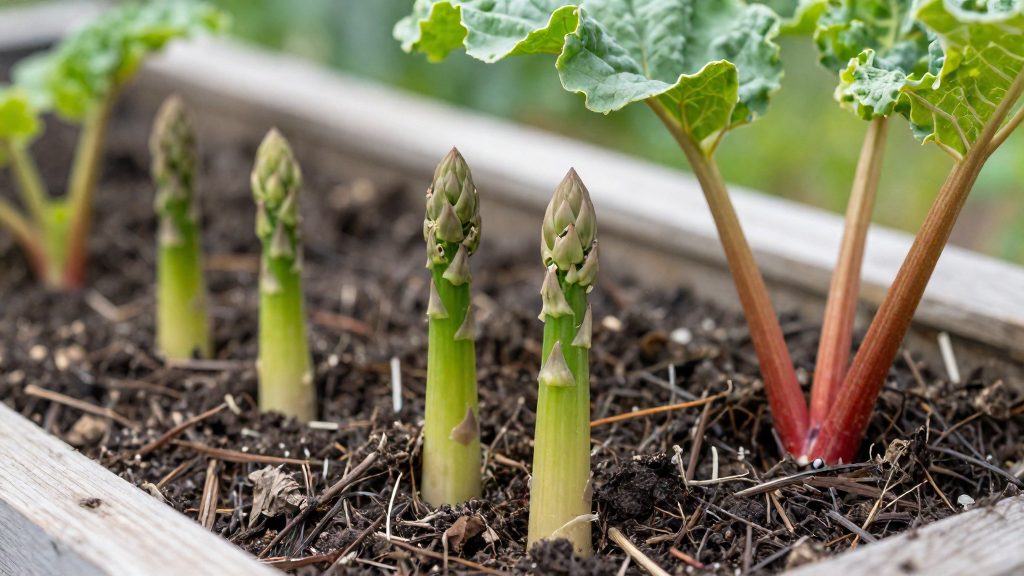
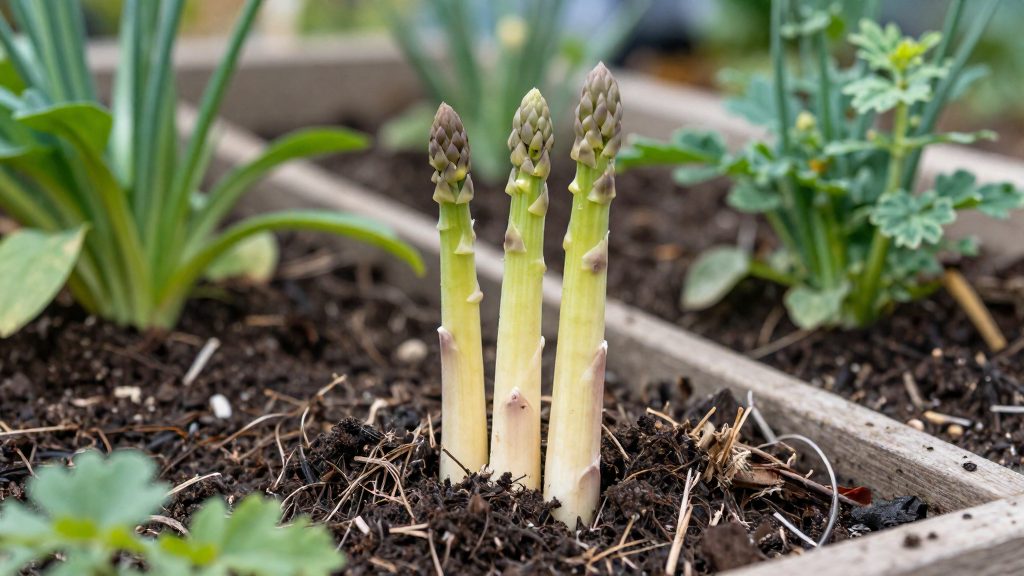
Asparagus and rhubarb are the two perennial vegetables that anchor a permaculture bed. Once established, they return every spring with little intervention. Asparagus is rated for zones 2–8 and stays productive for about 15–20 years after a couple of years of establishment, according to Garden Myths (2023). Both crops are planted once and stay in place for many seasons, so the site and soil preparation matter more than they do for annual vegetables. The sources consulted give no rhubarb planting details, so this section covers asparagus planting and rhubarb harvest and lifespan.
Asparagus: planting for the long term
- Permanent bed: plant the crowns in a bed that will not be dug up or rotated. Asparagus is productive for many years in the same spot.
- Deep soil preparation: asparagus roots reach about 60 cm, so amend the soil deeply before planting, not just the top layer.
- Cultivar choice: ‘Guelph Millennium’ suits long, harsh winters. Male-only cultivars such as the ‘Jersey’ series are recommended, according to Garden Myths (2023).
- Ground beds only: asparagus does poorly in containers, so reserve it for in-ground beds.
Harvest must be delayed. According to Georgian Bay News (2026-03-16), the plants need time to establish before they are cut:
| Year after planting | Harvest approach |
|---|---|
| Year 1 | Skip harvesting |
| Year 2 | Harvest lightly |
| Year 3 onward | Expect full harvests |
Rhubarb: harvesting without damaging the plant
Rhubarb gives a first harvest after 1 year and remains productive for 10–15 years before the clump needs dividing, according to Georgian Bay News (2026-03-16). Good harvesting habits extend its life:
- Pull the stalks: pull them rather than cutting them (Georgian Bay News, 2026-03-16).
- Plan to divide the clump after about 10–15 years (Georgian Bay News, 2026-03-16).
Hardiness zones of asparagus, Egyptian walking onions and sunchokes
Check the hardiness zone range before choosing a perennial vegetable, because it tells you whether a plant can survive your winters in the ground. Garden Myths (2023) rates asparagus for zones 2–8, Egyptian walking onions for zones 3–10, and sunchokes for zones 3–8. Compare these ranges with your local zone before buying crowns, bulbs, or tubers.
| Plant | Hardiness zones | Key points |
|---|---|---|
| Asparagus | 2–8 | Productive for about 15–20 years after establishment |
| Egyptian walking onion | 3–10 | — |
| Sunchoke | 3–8 | — |
Among the three plants in this table, asparagus has the lowest zone minimum (zone 2), so it is rated for the coldest winters.
Earth Undaunted (Erin Alladin, 2021-11-28) notes that ostrich fern fiddleheads are edible only before they uncurl, and no more than half the shoots should be harvested. Garden sorrel contains oxalic acid, so people with kidney or liver problems should ask a health professional before eating it. Goutweed is edible but invasive, so keep it contained.
Egyptian Walking Onions: One Plant, Three Harvests
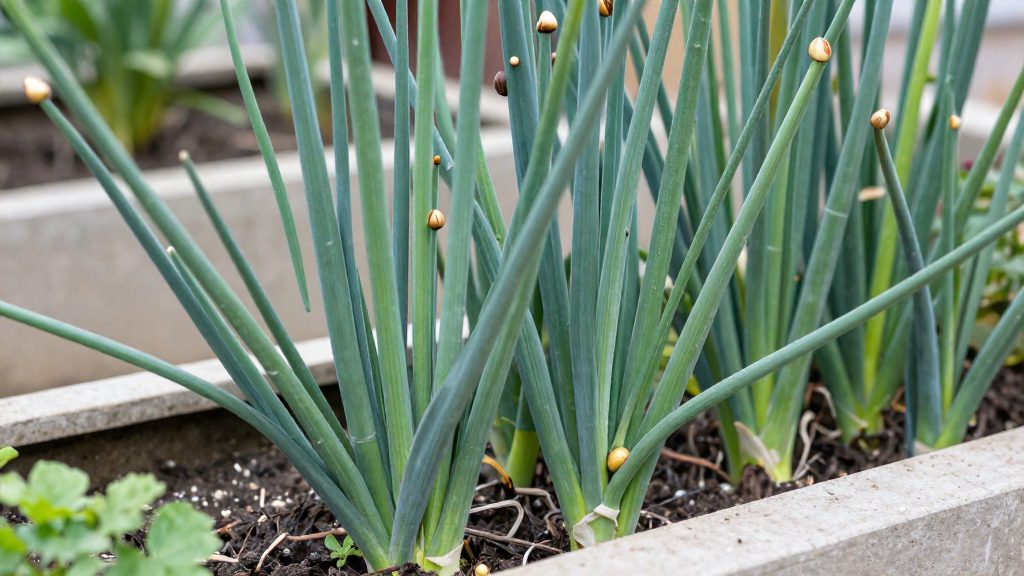
Egyptian walking onions are the perennial allium with the most detailed harvest guidance in the sources consulted for this guide. According to Garden Myths (2023), they are rated for zones 3–10, so check your local hardiness zone before planting. A single planting can be harvested at three different stages, which spreads the harvest across spring, midsummer and late summer or fall instead of taking everything at once. The official sources consulted do not specify cultivation details for ramps (wild leek) or other perennial alliums, so this section focuses on the Egyptian walking onion.
Harvest stages
| Harvest stage | Part to harvest | Timing |
|---|---|---|
| Greens | Leaves | Spring |
| Top bulbs | Bulbs formed at the top of the stalk | Midsummer |
| Underground bulbs | Bulbs below ground | Late summer or fall |
Planting and care
- Planting: The sources consulted give no cultivation details beyond hardiness zones and harvest stages.
- Harvest planning: Decide in advance which stage you want, as each one uses a different part of the plant.
Sunchokes and American groundnut: managing their spread
Sunchokes and American groundnut are perennial tubers that produce food for years, but both need containment from the start. According to Garden Myths (2023), sunchokes (zones 3–8) spread rapidly and can become invasive, while American groundnut vines grow about 3 m per year. Sunchokes spread by underground tubers, so tubers left in the soil can regrow the following season.
| Plant | Hardiness zones | Growth habit | Key point from Garden Myths (2023) |
|---|---|---|---|
| Sunchoke | 3–8 | Spreads rapidly, can become invasive | Its inulin may cause gas |
| American groundnut | Not specified in the consulted source | Vines grow about 3 m per year | Tubers need at least 2 years to reach cooking size |
Contain the plant before planting
- Give each plant a dedicated bed or a large container, away from slower crops such as perennial herbs or asparagus.
- Install a rigid root barrier around the bed, sunk deep enough to stop horizontal rhizomes and tubers.
- Keep sunchokes at the edge of the plot where possible, so their spread is easier to control.
Harvest thoroughly every year
- Dig out the tubers at the end of the season, sifting the soil to recover small pieces.
- Replant only the tubers you want to keep, and compost or eat the rest.
- For American groundnut, wait at least 2 years before the first harvest so the tubers reach cooking size, and avoid disturbing the roots in the meantime.
Control unwanted shoots without chemicals
- Pull emerging shoots by hand while they are young, before they establish a network of roots.
- Mulch bare soil around the bed with straw or chopped leaves to limit new sprouting.
- Use mechanical removal and mulching instead of herbicides. Mechanical removal and mulching avoid the need for herbicides.
Watch digestive effects
- Sunchokes contain inulin, which may cause gas (Garden Myths, 2023). Start with small portions and increase gradually.
Haskap, Currants and Small Fruits as Complements
Haskap (honeyberry) and currants add fruit to a Canadian permaculture bed that otherwise produces stems, roots and shoots. Haskap has one firm planting requirement: it needs a partner plant to set fruit. Plan that layout before buying plants, and count the multi-year wait before the first harvest.
Haskap: plan for pollination
Cross-pollination is the main requirement. According to Georgian Bay News (2026-03-16), haskap needs at least two varieties planted close together so they can pollinate each other. A single plant on its own is unlikely to give a dependable crop.
The same source states that haskap starts producing after 2–3 years. Place the plants where they can stay for many seasons, since they are a long-term investment rather than a first-year harvest.
Currants: a shrub layer for food forests
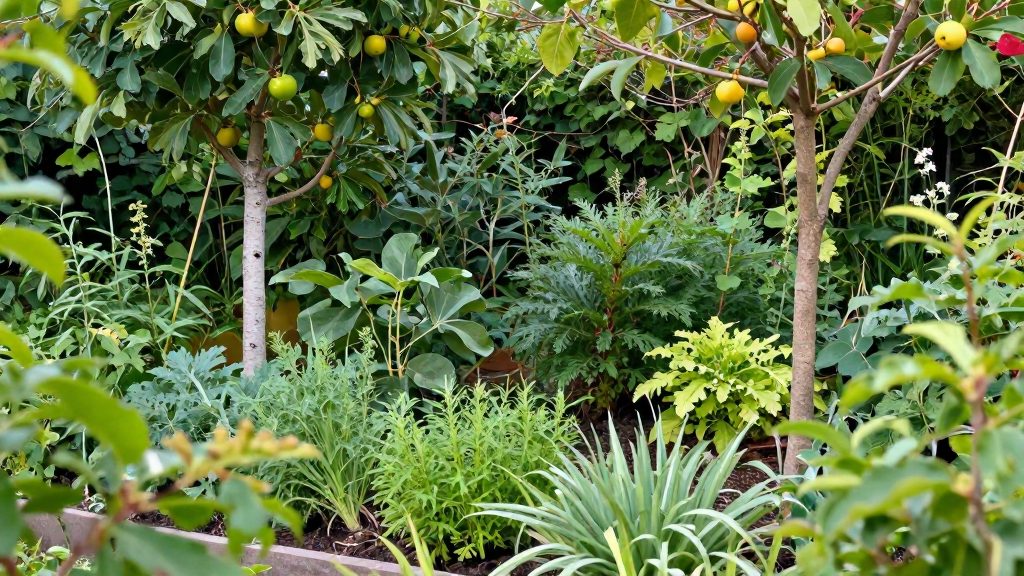
Earth Undaunted (Erin Alladin, 2021-11-28) reports that currants thrive in an Ontario food forest in zone 4b. In a food forest, currants fill the shrub layer between taller trees and the ground cover of perennial vegetables. Check the light and soil needs of your chosen variety before planting.
Small fruits among perennial vegetables
| Plant | Documented point | Source |
|---|---|---|
| Haskap (honeyberry) | Needs at least two varieties planted close together for cross-pollination | Georgian Bay News (2026-03-16) |
| Haskap (honeyberry) | Starts producing after 2–3 years | Georgian Bay News (2026-03-16) |
| Currants | Thrive in an Ontario food forest (zone 4b) | Earth Undaunted (Erin Alladin, 2021-11-28) |
| Rhubarb | First harvest after 1 year; lasts 10–15 years before dividing | Georgian Bay News (2026-03-16) |
How to Lay Out a Perennial Bed
A perennial bed stays in the same place for years, so the layout needs to be settled before planting. Asparagus is the clearest case.
Key steps:
- Choose a permanent, sunny site that you will not need to dig up for annual crops.
- Prepare the soil to depth. Work in organic matter well below the surface for deep-rooted crops such as asparagus.
| Plant | First harvest | Lifespan or key note | Placement note |
|---|---|---|---|
| Asparagus | — | Productive about 15–20 years (Garden Myths, 2023) | Permanent bed with deep soil |
| Egyptian walking onion | — | Hardy in zones 3–10 (Garden Myths, 2023) | Suits a permanent edge |
Before finalizing the layout, check each plant’s hardiness zone. Asparagus is rated for zones 2–8.
Frequently asked questions
Which perennial vegetable gives the first harvest soonest?
Rhubarb gives its first harvest after one year, according to Georgian Bay News (2026-03-16). Asparagus takes longer: skip harvesting in year 1, harvest lightly in year 2, and expect full yields from year 3.
Can asparagus be grown in a container?
Asparagus does poorly in containers, so it needs a permanent bed that will not be dug up or rotated, according to Georgian Bay News (2026-03-16). Its roots reach about 60 cm, so the soil should be amended deeply before planting.
Are fiddleheads and sorrel safe to forage?
Ostrich fern fiddleheads are edible only before they uncurl, and no more than half the shoots should be harvested, according to Earth Undaunted (Erin Alladin, 2021-11-28). Garden sorrel contains oxalic acid, so people with kidney or liver problems should ask a health professional before eating it, and fiddleheads must be correctly identified as ostrich fern before harvesting.