Growing zucchini organically means relying on cultural practices instead of synthetic fertilizers, pesticides, and fungicides. The sources consulted describe the growing conditions that matter most: organic matter in the soil, steady moisture, mulch, row covers, and good pollination. Scotts Miracle-Gro (2026) and Epic Gardening (2026) give practical methods for these conditions but do not quantify health, soil, or taste benefits of organic production.
Why grow organic zucchini?
Organic growing starts from the plant’s own needs. Meeting them with compost, mulch, and careful watering lets the gardener avoid synthetic inputs while still producing a healthy crop.
Benefits without synthetic inputs
Most of the practices recommended for zucchini are mechanical or cultural, so they apply directly in an organic garden:
| Practice | Effect stated in the sources |
|---|---|
| Mulching or trellising | Keeps vines off the ground (Scotts Miracle-Gro, 2026) |
| Avoiding overhead watering | Reduces fungal disease (Epic Gardening, 2026) |
| Planting alyssum and calendula | Attracts pollinators (Epic Gardening, 2026) |
Each of these is a method the gardener controls directly, which reduces reliance on purchased products. Where the sources mention alternatives to chemical treatments, they are biological or physical, such as row covers and diluted neem (Epic Gardening, 2026).
Soil life and long-term fertility
The sources do not describe soil life or long-term fertility gains specifically for zucchini. Their advice points to a practical principle: keep the soil rich in organic matter and keep it moist (Scotts Miracle-Gro, 2026). Mulching supports this by covering the soil, and the sources name it as a standard method for keeping vines off the ground. Maintaining the soil’s organic matter season after season is the main way an organic gardener keeps the bed productive for zucchini and for other crops that follow it.
Taste and freshness compared with supermarket fruit
None of the sources consulted compares the flavour of home-grown zucchini with supermarket fruit, so no difference can be quantified here. What the sources do link to fruit quality is consistent watering: steady moisture helps prevent blossom end rot (Scotts Miracle-Gro, 2026). A home garden also lets the gardener choose when to pick.
Site and soil preparation
Zucchini needs 6 to 8 hours of full sun daily and soil with a pH between 5.8 and 6.8, rich in organic matter. According to Scotts Miracle-Gro (2026), the plant needs full sun and consistently moist soil enriched with organic matter. Epic Gardening (2026) gives the pH range. Preparing the bed around these three conditions gives the roots warm, fertile, well-structured ground to establish in.
Choosing the sunniest spot
- Pick a location that receives 6 to 8 hours of direct sun per day, measured during the growing season.
- Observe the site at different times of the day, since shade from fences, hedges or buildings can reduce the sunlight a plant receives.
- Keep in mind that zucchini vines spread widely, so plan for space as well as light.
Testing and adjusting soil pH
Test the soil before planting with a pH test kit or a laboratory analysis. Zucchini grows in soil between pH 5.8 and 6.8. If results fall outside this range, correct the soil gradually with organic amendments and retest in a later season. The official sources consulted do not specify product names or application rates for pH correction.
| Factor | Target | Source |
|---|---|---|
| Soil pH | 5.8 to 6.8 | Epic Gardening (2026) |
Building organic-rich soil
- Incorporate organic matter before sowing or planting. Spread well-decomposed compost over the bed and work it into the top layer with a fork or spade so it mixes evenly with the existing soil.
- Choose a bed with loose, well-drained structure, since this allows roots to spread and keeps moisture consistent.
- Avoid compacting the bed by walking on it once it has been dug and enriched.
- Refresh the organic matter in the bed each season to maintain fertility, and rotate zucchini to a different bed.
When should you plant zucchini?
Plant zucchini outdoors after the last spring frost, once the soil has reached at least 65–70°F, according to Scotts Miracle-Gro (2026). Seeds germinate best at 70–90°F and will not germinate below 60°F, according to Epic Gardening (2026). The calendar date for your garden depends on your region and local climate, and the sources consulted do not give a single date for all areas, so use soil temperature and frost timing together rather than a fixed day on the calendar.
Two conditions to meet before sowing
- Last spring frost has passed. Zucchini should go into the ground only after this point. Check the local last-frost date for your area, since it varies widely with altitude, latitude, and coastal or inland position.
- Soil has warmed to at least 65–70°F. Frost-free weather alone is not enough. The soil itself needs to reach this range before planting.
Temperature thresholds at a glance
| Stage | Temperature | Source |
|---|---|---|
| Best germination range for seeds | 70–90°F | Epic Gardening (2026) |
Why soil temperature matters more than air temperature
Air temperature can rise quickly during a warm spell, while soil stays cool for longer, especially in spring after heavy rain. Sowing based only on a warm afternoon can place seeds in soil that is still below the germination threshold.
Practical sequence
- Confirm the last spring frost date for your area.
- Measure soil temperature at sowing depth before planting.
- Sow seeds about 1 inch deep, as Scotts Miracle-Gro (2026) recommends.
- Sow 2–3 seeds per hole and thin to one plant once seedlings are 4–5 inches tall (Scotts Miracle-Gro, 2026).
- Keep the soil consistently moist during germination, since the plants need steady moisture to establish.
How much water and space does zucchini need?
The way water is applied matters as much as the amount. According to Epic Gardening (2026), zucchini needs 1 to 3 inches of water per week, delivered at the base of the plant rather than over the foliage. Scotts Miracle-Gro (2026) adds that keeping moisture steady helps prevent blossom end rot, so irregular watering is one problem to avoid. Spacing completes the setup: wide enough apart that each plant gets its own root zone and air moves between leaves.
Watering schedule
Check the soil before watering rather than following a fixed calendar:
- Push a finger into the soil near the base of the plant.
- Water only when the top inch of soil is dry, as recommended by Scotts Miracle-Gro (2026).
- Aim for a total of 1 to 3 inches per week, adjusting within that range for weather and soil type, according to Epic Gardening (2026).
| Parameter | Guideline | Source |
|---|---|---|
| Watering trigger | Top inch of soil is dry | Scotts Miracle-Gro (2026) |
| Weekly volume | 1 to 3 inches | Epic Gardening (2026) |
| Delivery method | Drip irrigation or soaker hose | Epic Gardening (2026) |
| Spacing between planting holes | 3 feet apart | Scotts Miracle-Gro (2026) |
Delivery method
A soaker or drip system places water directly into the root zone and keeps the leaves dry. Epic Gardening (2026) names drip irrigation and soaker hoses as suitable methods, and Scotts Miracle-Gro (2026) advises watering at the base of the plant.
Spacing between plants
Space planting holes 3 feet apart, according to Scotts Miracle-Gro (2026). This distance gives the vines room to spread and keeps the foliage from crowding together, which helps the plants dry out between waterings.
How do you get good pollination?
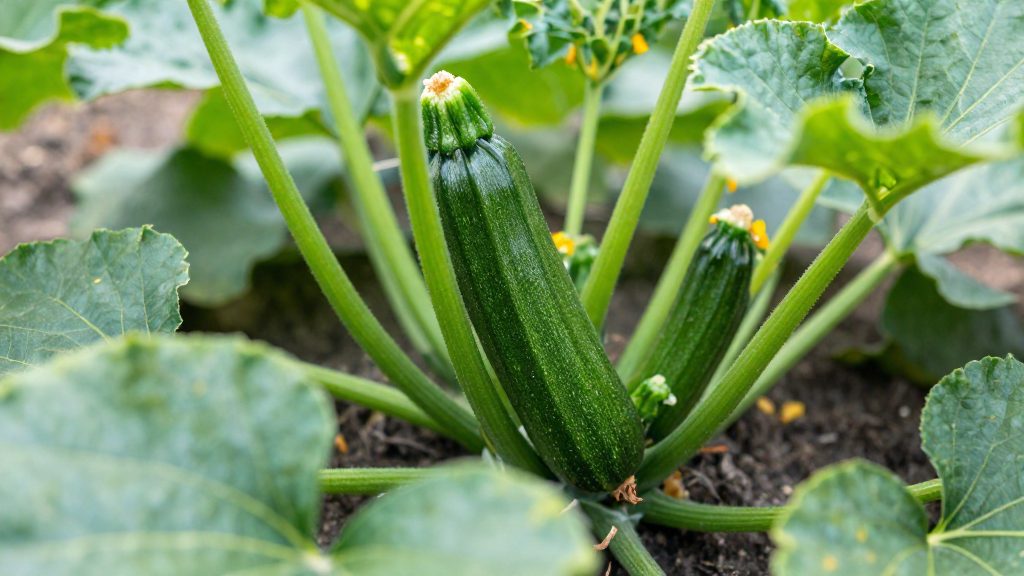
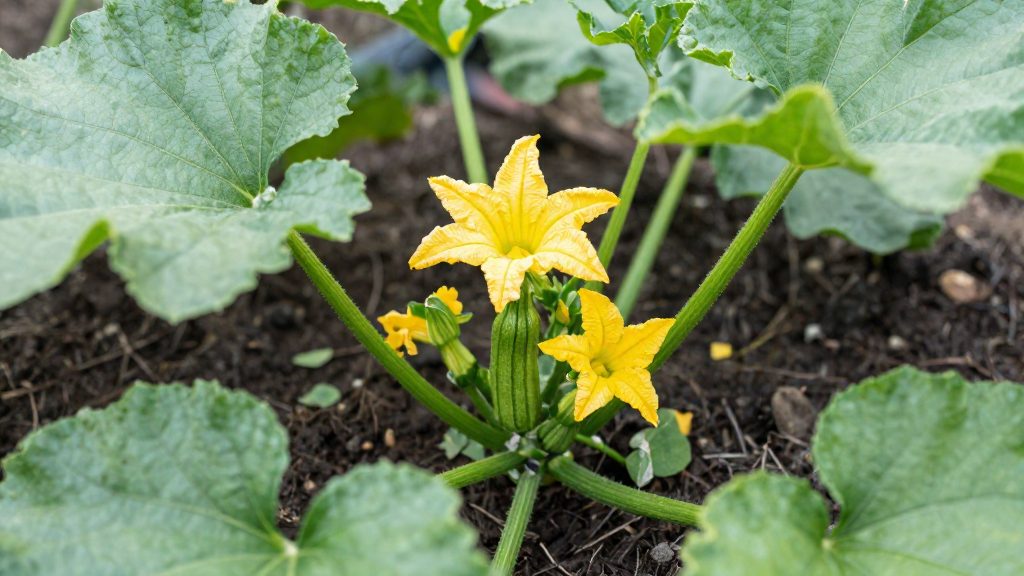
Good pollination depends on moving pollen from male flowers to female flowers and on drawing pollinators into the planting. According to Epic Gardening (2026), when pollination is poor, you can hand-pollinate early in the morning by moving pollen from male flowers to female flowers. Poor pollination causes small, misshapen fruit, so checking flower set is a practical part of growing zucchini organically.
Hand-pollinating zucchini
Hand pollination is the fallback when pollinators are scarce, for example during a cold or rainy spell or in a small planting with few insects. The method is simple:
- Identify the male flowers (those carrying pollen) and the female flowers (those with a small fruit forming at their base).
- Gently collect pollen from a male flower, using a small brush or a cotton swab.
- Transfer the pollen to the stigma of a female flower.
- Repeat across several female flowers over the flowering period.
Why pollination affects the fruit
Each fruit needs to be pollinated to develop fully. When pollen transfer is incomplete, the fruit that forms is small and misshapen, according to Epic Gardening (2026). Regular checks during flowering help you spot this early and act on it before the harvest is affected.
Flowers that attract pollinators
Planting pollinators-friendly flowers near zucchini encourages insects to visit the garden naturally, which is an organic alternative to relying on hand work alone. Epic Gardening (2026) names two examples:
| Companion plant | Role in the planting |
|---|---|
| Alyssum | Attracts pollinators |
| Calendula | Attracts pollinators |
Place these flowers near the zucchini bed so that visiting insects move between the blooms. This approach supports pollination without synthetic inputs, and it complements hand pollination when weather or pollinator numbers are limiting.
Natural pest and disease control
Three hands-on methods cover the main organic controls for squash bugs, cucumber beetles and vine borers on zucchini: hand removal of pest eggs, row covers on young plants, and crop rotation. Epic Gardening (2026) lists these as organic alternatives, and Scotts Miracle-Gro (2026) recommends covers against squash bugs and vine borers. None of them requires a synthetic insecticide.
Hand removal of squash bug egg clusters
Epic Gardening (2026) recommends removing squash bug egg clusters by hand as an organic control.
- Inspect the plants regularly, since the clusters are easy to miss under large leaves.
- Remove each cluster as soon as you find it, by scraping it off or crushing it.
- Work early in the season, before the population grows.
Row covers on young plants
Scotts Miracle-Gro (2026) advises using row covers on young plants against squash bugs and vine borers, then removing them once flowering starts.
- Cover seedlings after planting, and secure the edges so pests cannot slip underneath.
- Lift the cover when the first flowers appear.
- Keep covers in place only while the plants are young and before flowering.
Crop rotation against cucumber beetles
Epic Gardening (2026) names crop rotation as the organic control against cucumber beetles. Do not plant zucchini in the same bed each season. The official sources consulted do not specify a required rotation interval, so choose the length of the break based on your garden layout and your regional climate.
| Pest | Organic control | Source and date |
|---|---|---|
| Squash bugs | Hand removal of egg clusters | Epic Gardening (2026) |
| Cucumber beetles | Crop rotation | Epic Gardening (2026) |
When to harvest zucchini
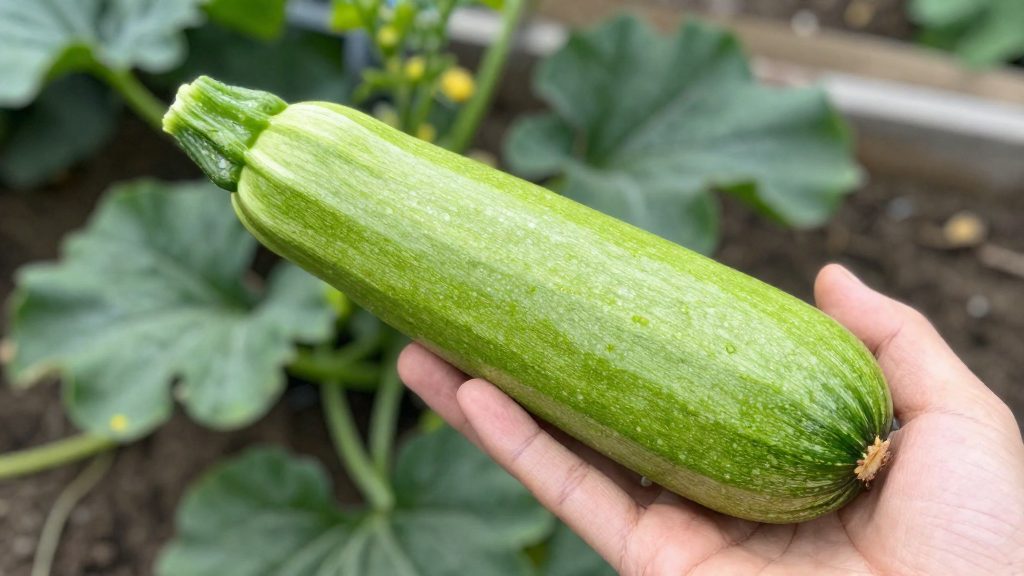
Zucchini is best picked while the fruit is still young. According to Epic Gardening (2026), the harvest target is fruit at about 4 to 8 inches long. Within that range the flesh stays tender and the flavor stays mild, so size is the main signal for when to cut.
| Fruit length | Result according to Epic Gardening (2026) |
|---|---|
| About 4 to 8 inches | Recommended harvest window |
| Beyond about 8 inches | Flesh becomes tougher and more bitter |
Picking size
Use length as your guide rather than the appearance of the plant. Fruit inside the 4 to 8 inch range is ready to pick. Waiting for a larger fruit does not improve it, because the source reports that growth past this range reduces quality rather than adding to it.
Inspection frequency
Check the plants every few days during the fruiting period. Zucchini fruit can grow quickly, so a fruit missed during a long gap between checks may pass the target size before it is noticed. A regular inspection schedule keeps most fruit within the harvest window.
How oversized fruit affects taste and texture
Fruit left on the plant beyond about 8 inches becomes tougher and more bitter, according to Epic Gardening (2026). Both changes affect eating quality, so an oversized fruit is less pleasant to cook and eat even though it is still the same plant. Picking on schedule is the simplest way to avoid this decline.
Frequently asked questions
When should beginners plant organic zucchini, and how deep should the seeds go?
Plant once the last spring frost has passed and the soil has reached 65–70°F, according to Scotts Miracle-Gro (2026). Sow 2–3 seeds per hole, 1 inch deep, with holes 3 feet apart, then thin to one plant when seedlings are 4–5 inches tall.
How much water does zucchini need, and how can I prevent disease?
Epic Gardening (2026) recommends 1–3 inches of water per week, delivered by drip irrigation or a soaker hose. Avoiding overhead watering reduces the risk of fungal disease, and Scotts Miracle-Gro (2026) advises watering at the base of the plant when the top inch of soil is dry.
Why do my zucchini fruits stay small or misshapen?
Small, misshapen fruit usually points to poor pollination, according to Epic Gardening (2026). If pollinators are scarce, you can hand-pollinate early in the morning by moving pollen from male flowers to female flowers. Planting alyssum and calendula nearby can also attract pollinators to the garden.