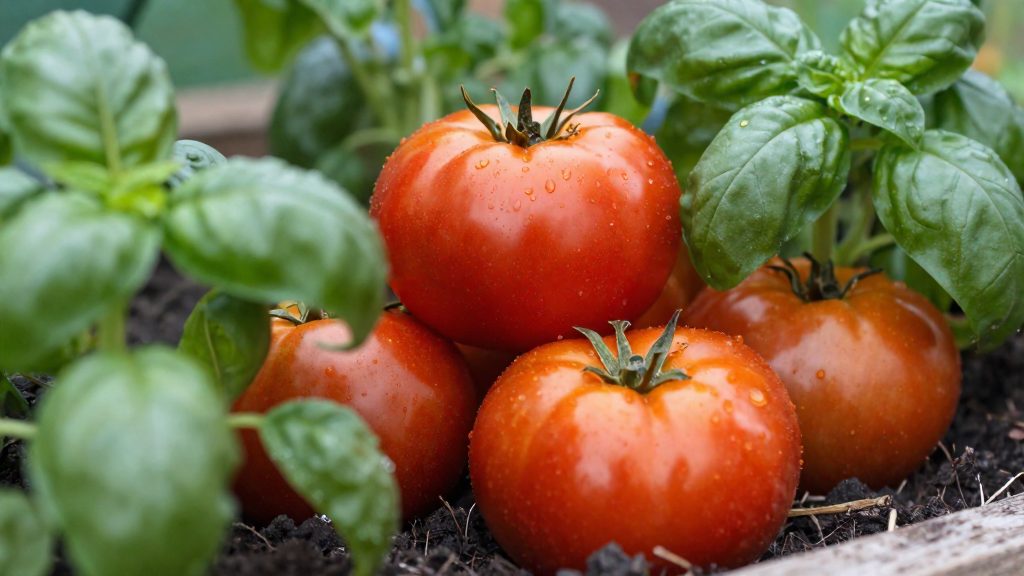
Companion planting for tomatoes has some reported support, but this article relies on a single gardening guide, and that guide does not give the study details. Epic Gardening’s tomato guide lists 27 companion plants and singles out marigolds as one of the best-researched options, citing studies on whitefly protection and yield increases of up to 50%. The same guide does not present every companion with that level of support, so each claim should be checked before you rely on it.
Does companion planting really work for tomatoes?
What the marigold evidence covers
Marigolds are the clearest case in the guide. Epic Gardening cites research on whitefly protection in tomato beds and reports yield increases of up to 50%. Two limits apply to both points:
- The available information does not specify the conditions under which the whitefly results or the up-to-50% yield figure were measured.
- “Up to” marks an upper figure, not an expected gain for a typical home bed.
Separating tested results from anecdote
| Claim | What the guide reports | What it does not establish |
|---|---|---|
| Marigolds reduce whitefly on tomatoes | Cited as whitefly protection research | How much protection to expect in your own garden |
| Yield increases up to 50% | Reported from studies | Trial conditions or typical results |
| 27 companions, including basil, onions, beans and carrots | Listed as companions | The strength of evidence behind each one |
The list of 27 is a catalogue of plants commonly grown alongside tomatoes, not a list of proven effects. Treat it as a starting point for trials.
Practical checks before trusting a claim
- Ask whether the claim cites a named study or describes only what gardeners have observed.
- Look for stated conditions such as soil, climate, variety or bed layout. If none are given, the result is harder to repeat.
- Inspect leaf undersides regularly for whitefly, and remove heavily infested leaves by hand rather than assuming a companion will control the pest.
- Keep a simple log of pest counts and yields for one bed with marigolds and one without, using the same tomato variety. This gives you your own evidence.
Best herb companions for organic tomatoes
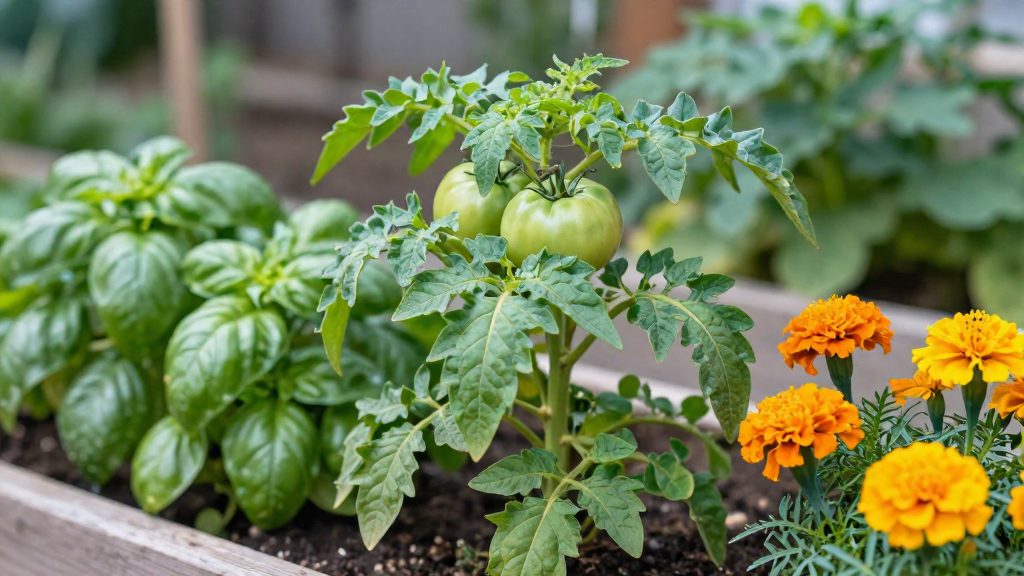
Epic Gardening’s tomato guide lists 27 companion plants for tomatoes, including 8 herbs, 8 flowers and 11 vegetables. Two herbs from that group are relevant to a tomato bed: basil and borage. Basil and borage are both named among the herb companions in this guide. Neither herb replaces good soil preparation, regular watering or crop rotation. In an organic system, they are non-chemical additions that cost little and need no treatment products.
Basil as the main herb companion
Basil is named explicitly among the companions in Epic Gardening’s guide, and it is the herb to start with for a tomato bed. Practical points:
- Plant basil in the same bed as the tomatoes, not in a separate container at the other end of the garden, so both crops share the growing area.
- Pinch the growing tips regularly and harvest leaves from the top of the plant to keep it bushy.
- Use the basil harvest in the kitchen. Regular harvesting keeps the herb in use, which is the simplest way to manage it within the bed.
The guide does not describe which pests basil repels, so this section does not claim any specific effect. Its value in the bed is as a companion plant that shares space with the tomatoes and can be grown without any chemical input.
Borage: flowering herb and pollinator attraction
Borage is on the guide’s list of companions, and it is the flowering herb among the options. Its flowers are the feature gardeners usually observe. The sources consulted do not specify how borage affects pollinator numbers in a tomato bed, so no figure or effect is given here. A practical way to check is to watch the flowers during bloom and record which insects visit them, then compare the number of visits from one season to the next.
Other aromatic herbs and the pests they may deter
The guide counts eight herbs in total, but the sources consulted do not name the six herbs beyond basil and borage, nor the pests any of them might deter. This article therefore makes no pest-deterrence claim for specific aromatic herbs. A gardener who wants to test them can plant one herb at a time next to tomatoes, then check the leaves over several weeks for pests, comparing with a tomato plant that has no herb nearby.
Summary
- Basil: the main herb companion named in the guide, grown within the tomato bed.
- Borage: the flowering herb on the list, worth observing for insect visits during bloom.
- Other aromatic herbs: a possible addition, to be tested in your own garden, with no pest effect assumed in advance.
Flowers that protect tomatoes naturally
Non-food flowers planted around tomatoes can serve two purposes in an organic bed: they draw in insects that are useful to the crop, and they can pull certain pests away from the tomato plants. According to Epic Gardening, nasturtiums and marigolds are both among the flowers recommended as tomato companions. The methods below are practical arrangements, but the official sources consulted do not quantify how well each one works in a given garden.
Nasturtiums as trap plants for aphids
Nasturtiums are listed by Epic Gardening as a tomato companion. Gardeners often use nasturtiums as trap plants, on the idea that aphids colonize the nasturtium rather than the tomatoes. The guide consulted does not confirm this effect, so treat it as something to test.
- Sow nasturtiums at the edge of the bed or in a separate row, not against the tomato stems.
Flowers that attract pollinators
The consulted sources do not name the specific pollinator-attracting flowers or measure their effect on fruit set. The general method is to include a few flowering companion plants near the tomatoes, so that insects are present while the tomatoes are in bloom. Avoid any spray application during flowering, since it can harm the insects you are trying to attract.
Marigold varieties and where to place them
The consulted sources do not specify which marigold varieties to use. As a general gardening choice, compact, bushy types are easier to fit between tomatoes without shading the stems. Two placements are common:
- Border placement: a row of marigolds along the sunniest edge of the bed.
- Interplanting: a few plants between tomato plants, leaving space around each stem for air circulation.
Which vegetables grow well beside tomatoes?
According to Epic Gardening’s tomato guide, tomatoes have 27 listed companions: 11 vegetables, 8 herbs and 8 flowers. The vegetables named explicitly are carrots, onions and beans, and this section covers those partners along with the leafy greens that share tomato beds. Each entry describes the practical role the plant can play in an organic plot, with the limits of what the sources consulted establish.
Carrots and onions as root and allium partners
Carrots and onions are the root and allium companions named in the guide. Both are grouped here simply because the guide names them as vegetable companions. The official sources consulted do not describe how carrot or onion roots interact with tomato roots, so no underground benefit is claimed in this article.
- Weed by hand or with mulch, avoiding synthetic herbicides.
Bush beans and soil nitrogen
Bush beans are listed as a tomato companion. The official sources consulted do not specify how much nitrogen bush beans add to the soil, so no quantity is given here. To check the effect on your own plot, sow beans in one bed and leave a comparable bed without them, then record tomato growth over one season. This method gives you local evidence rather than a general claim.
Leafy greens in tomato beds
Chard is the leafy green that Epic Gardening names among tomato companions. Leafy greens fit into the open areas of a tomato bed. Use compost or mulch as organic amendments, and avoid synthetic fertilizers and pesticides throughout the bed.
What should you never plant near tomatoes?
Epic Gardening’s tomato guide lists five plants to avoid near tomatoes: brassicas, potatoes, corn, fennel and strawberries. For two of them, the guide gives a specific reason. Potatoes share pests and diseases with tomatoes, and strawberries share fungal diseases. For the others, the source does not explain the problem.
| Plant | Listed as | Reason stated by Epic Gardening |
|---|---|---|
| Potatoes | Plant to avoid | Shared pests and diseases |
| Strawberries | Plant to avoid | Shared fungal diseases |
| Brassicas | Plant to avoid | Not detailed in the consulted source |
| Corn | Plant to avoid | Not detailed in the consulted source |
| Fennel | Plant to avoid | Not detailed in the consulted source |
Potatoes: shared pests and diseases
Potatoes are the clearest case. Because they share pests and diseases with tomatoes, a potato row beside your tomatoes gives those problems a second crop to move between. The consulted source does not name the specific pests or diseases involved.
- Keep potato and tomato plots in separate areas of the garden.
Strawberries: shared fungal diseases
Strawberries share fungal diseases with tomatoes. Fungal problems are often encouraged by damp leaves, so the garden practices that reduce them matter most here:
- Allow good air movement around each plant.
Brassicas, corn and fennel
Brassicas include cabbage, broccoli and kale. Corn and fennel are also listed as plants to avoid near tomatoes. The official sources consulted do not specify the reasons for these three exclusions, so this guide does not attribute a specific pest or disease to them.
The consulted sources do not specify any biological treatment for pests on tomatoes.
How far apart should companions be planted?
Measure companion spacing from the base of each tomato stem, not from the edge of the foliage. According to Epic Gardening, the recommended distances are basil 8–12 in, onions 6–8 in, bush beans 12–18 in, and chard at least 8–12 in. Larger plants need more clearance: bush zucchini should be at least 24–36 in away, and borage and wildflowers should be at least 10 ft away.
Why spacing matters
Tomatoes and their companions draw on the same soil moisture and the same light. When a companion is planted too close, its roots spread into the tomato’s root zone and its leaves start to shade the lower tomato canopy. The result is competition for water and light, which can weaken the tomato before the companion shows any problem. Spacing is the simplest way to control this competition, because the closer a plant grows to the stem, the more of the shared resources it takes.
The guide’s largest distances apply to bush zucchini, borage, and wildflowers, while the smallest applies to onions.
Recommended distances from the tomato base
| Companion | Distance from tomato base (Epic Gardening) |
|---|---|
| Onions | 6–8 in |
| Basil | 8–12 in |
| Chard | at least 8–12 in |
| Bush beans | 12–18 in |
| Bush zucchini | at least 24–36 in |
| Borage and wildflowers | at least 10 ft |
Applying the distances in the garden
- Mark the tomato stems first. Place the tomatoes, then measure outward before sowing or transplanting the companions.
- Keep the widest companions well away from the tomatoes. Bush zucchini needs at least 24–36 in from the tomato base, and borage and wildflowers at least 10 ft, so plant them in a separate area of the garden rather than inside the tomato bed.
- Choose a sunny site so the tomatoes receive full light before any companion is added nearby.
- Adapt the distances to your region and climate. The figures above are general guidance, and local conditions such as soil depth, rainfall, and summer heat can justify adjusting them.
Pair companions with rotation and good care
Companion planting works best alongside basic soil routines. Crop rotation, mulching and careful watering address the soil-borne problems that companions cannot solve on their own. Epic Gardening’s tomato guide lists basil, marigolds, nasturtiums, borage, carrots, onions and beans among its recommended companions, but these plants only support a tomato bed that is already managed well.
Rotate tomatoes to a different bed each season
Crop rotation means never planting tomatoes in the same bed two seasons in a row. Soil-borne pathogens tend to build up where a host crop has been grown repeatedly, so moving the tomatoes to a new bed each year reduces that pressure. When you plan the garden, record where the tomatoes grew and choose a bed that has not held tomatoes recently. Companions can then be placed around the new tomato position, which keeps the planting plan simple to follow.
Mulch and water to limit soil-borne disease
Splashing soil onto the leaves spreads many fungal diseases, so a layer of mulching material helps keep soil off the lower foliage and holds moisture steady between waterings. Organic options include straw, dried grass clippings without seed heads, and shredded leaves. Keep the mulch a short distance from the stems so that the base of the plant does not stay constantly damp.
Consistent watering matters as much as the amount. Large swings between dry and soaked soil stress the plant and make it more vulnerable to disease. Checking the soil with a finger before each watering is a simple way to adjust the routine to weather and bed conditions.
Treat companion planting as a complement, not a substitute
Companion plants can attract beneficial insects, shade the soil, and make a bed more diverse, but they do not replace good rotation, mulching or watering. A tomato bed with healthy soil, a sound rotation plan and disciplined watering will perform better than a densely planted bed that ignores these basics. Think of companion planting as one layer in a system of organic practices, and adjust your choices each season based on what your own bed shows you.