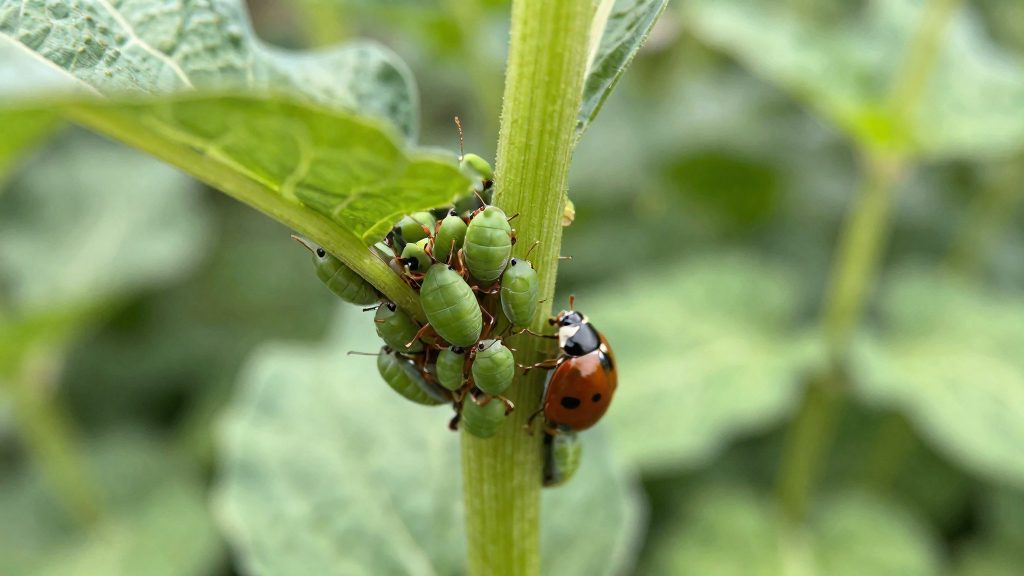
Most aphid colonies on vegetables do not need treatment. According to UC IPM, University of California Agriculture and Natural Resources (2025), the decision depends on how many aphids are present, how large the plant is, and whether natural enemies are already working on the colony. Larger plants usually tolerate light to moderate infestations, and substantial numbers of natural enemies can make treatment unnecessary.
Do aphids really need treatment?
Monitoring comes first. Check plants at least twice a week during periods of rapid growth, and look at leaf undersides and young shoots, where colonies tend to settle. Inspect several plants across the bed rather than only the most visible ones, so you get a realistic picture of the whole row.
Telling harmless numbers from a damaging infestation
The same number of aphids does not carry the same risk on every plant. Use these guidelines from UC IPM (2025):
| Situation | Suggested decision |
|---|---|
| Light to moderate aphids on a larger, established plant | Usually tolerated; keep monitoring |
| Substantial numbers of natural enemies on the same plant | Treatment may be unnecessary |
| Colonies growing from one inspection to the next, or a young plant with the same count | Look more closely and consider control (general judgment, not a UC IPM threshold) |
Young plants have less capacity to absorb damage, so the same count on a seedling deserves closer attention than on a mature plant. Track whether the colony is growing or shrinking from one inspection to the next, since a stable low population is very different from a rapidly expanding one.
Timing decisions around growth stage and harvest
The official sources consulted do not specify a harvest-interval rule for aphid control, so base timing on your own observations. Intervene while counts are still low rather than waiting for the colony to spread across the plant.
Blast aphids off with water
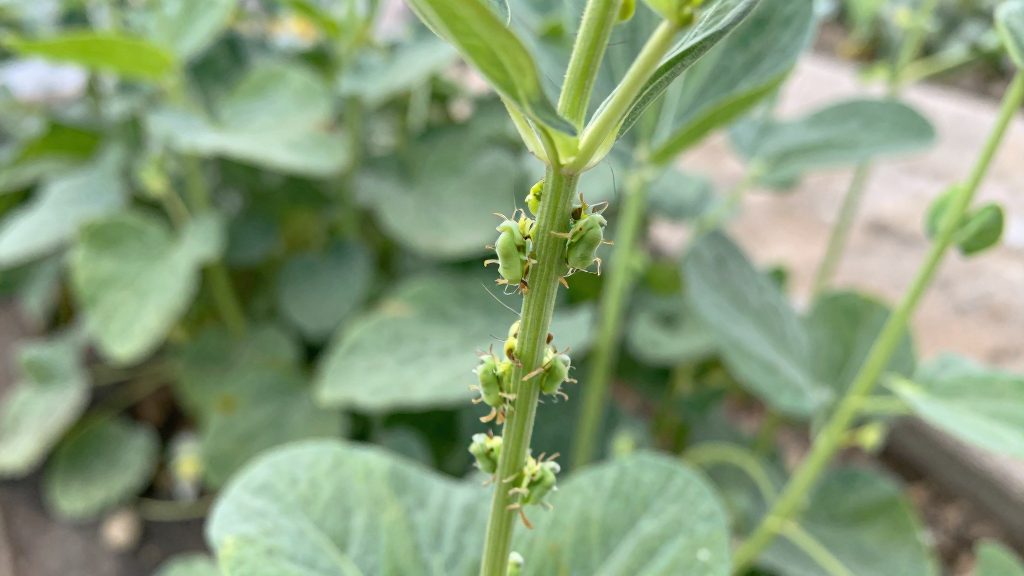
A strong stream of water is one of the simplest ways to remove aphids from vegetables without applying any product. According to UC IPM (University of California Agriculture and Natural Resources, 2025), spraying aphids with a strong stream knocks them off sturdy plants, and most dislodged aphids cannot return. Because the method is purely physical, it fits directly into an organic growing routine.
Matching the pressure to the plant
- Sturdy plants can take a firm jet from a hose nozzle, which is the setting that knocks aphids off the leaves and stems.
- Young or fragile growth should receive a gentler spray. After the first pass, check that the stems and leaves are not bruised or torn before repeating.
- Aim the stream at the colony itself, including the leaf undersides where aphids cluster, rather than only wetting the upper surfaces.
Why dislodged aphids rarely come back
Aphids that fall off a plant under a forceful spray generally cannot climb back onto it, so a pass can remove many of the aphids on the plant. New arrivals can still settle on the plant, so the method works best as part of regular checks.
Spraying early in the day
Early-morning spraying is the timing that protects foliage. Spraying early in the day lets the leaves dry quickly, which lowers the risk of fungal disease. Avoid spraying late in the day, when wet foliage stays damp overnight.
How does insecticidal soap work?
Insecticidal soap controls aphids by smothering them rather than poisoning them. When the spray contacts an aphid, it coats the insect and prevents it from surviving, so the aphid dies on contact. According to UC IPM (University of California Agriculture and Natural Resources, 2025), insecticidal soaps, neem oil and horticultural oil all work this way, which is why the same application rules apply to all three.
Because the action depends on direct contact, coverage decides the result. An aphid the spray does not touch is not affected, so the application has to be thorough. Aphids often gather on the undersides of leaves, where they feed and stay sheltered. Spray the undersides as carefully as the upper surfaces, and work along stems and into the inner growth of the plant.
The effect is limited to the aphids present at the moment of spraying. Aphids that arrive or appear after the application are not reached by it, so reapplication may be needed. UC IPM (University of California Agriculture and Natural Resources, 2025) advises treating again when aphids are found.
A simple routine for applying soap on a vegetable bed:
| Step | Action |
|---|---|
| 1. Test | Spray a small area of foliage several days beforehand, since some plants are sensitive. |
| 2. Spray | Cover leaf undersides and stems thoroughly, not just the tops of leaves. |
| 3. Recheck | Look again after treatment and reapply where live aphids remain. |
Following this routine keeps the treatment focused on the aphids that are actually present, and it avoids wasting product on leaves that are already clear.
Neem and horticultural oil: when to use them
Neem oil and horticultural oil are natural alternatives to synthetic insecticides for aphids on vegetables. According to UC IPM, University of California Agriculture and Natural Resources (2025), oil solutions are typically 1 to 2%. Whether a spray is safe depends on the state of the plant, the air temperature, and how the foliage reacts, so check these conditions before mixing anything.
Conditions that rule out spraying
| Condition | Guidance |
|---|---|
| Oil solution strength | Typically 1 to 2% |
| Plant water status | Avoid water-stressed plants |
| Air temperature | Avoid spraying when temperatures exceed 90°F |
| Foliage sensitivity | Patch test a small area several days beforehand |
Checking plant sensitivity first
Some plants are sensitive to oils, and the source does not list which ones. Before treating a whole bed, run a patch test:
- Choose a few leaves on several plants, including young ones.
- Spray only a small area of foliage at the strength you plan to use.
- Wait several days and inspect the treated leaves for damage before treating the rest of the planting.
Only proceed to full application if the test area shows no damage.
Preparing the bed
- Water the bed before treatment so plants are not water-stressed, but avoid waterlogging the soil.
- Pick a day when the forecast stays below 90°F, and avoid the hottest hours of the afternoon.
- Mix the solution within the typical 1 to 2% range and follow the label instructions for the specific product.
These checks keep the treatment matched to the plant and the weather, which is the first step before choosing a spray method.
Prune infested leaves early
Pruning is one of the most direct natural controls for aphids on vegetables. According to UC IPM, University of California Agriculture and Natural Resources (2025), pruning out heavily infested leaves and shoots helps, and it works best when done early, before colonies spread through the plant. Removing a few badly affected shoots is far more effective than trying to clear a whole plant once the population has built up.
Curled leaves are the main problem. When aphids feed, leaves often curl, and the folded tissue becomes a shelter. Inside a curl, aphids are partly protected from sprays of water, soap or oil, so a spray may miss much of the colony. Curled leaves shelter aphids from both sprays and natural enemies, so pruning them out is a way to remove colonies that other methods cannot reach.
Act at the first sign of infestation. The earlier you intervene, the smaller the colony you remove. Pinch or cut off the affected leaf or shoot as soon as you see clusters, distorted growth or sticky residue.
Prune infested shoots, not whole plants. Targeted cuts keep the plant productive. Remove only the leaves and shoots that are heavily infested, and leave the healthy growth. Put the removed material in a bag and take it away from the bed rather than leaving it on the ground.
Why do ants matter for aphid control?
Ants protect aphids from their natural enemies, which is why ant protection is a central factor in aphid control. According to UC IPM, University of California Agriculture and Natural Resources (2025), ant management is a key part of any aphid control strategy. Even when a garden has plenty of predators, a colony that ants guard can persist, so aphid numbers may not fall as expected.
Managing ant activity works best as one step within a broader plan, not as a stand-alone fix. Reducing the aphid colonies that ants tend removes the reason for ants to stay on the plant. One option described by UC IPM (2025) is a strong stream of water, which knocks aphids off sturdy plants, and most dislodged aphids cannot return. Targeting colonies this way reduces the food source that ants are protecting.
Recognizing ant traffic is the practical first sign of a colony. Look for ants moving up and down stems, along leaf stalks and across leaf undersides, where aphids usually cluster. Ants that repeatedly visit one plant or branch often indicate that aphids are present there, even before you see obvious damage.
The sources consulted do not detail specific ant-control methods, so focus on the steps above: monitor frequently, locate colonies by following ant movement, and dislodge or thin out aphids as soon as they appear.
Attract beneficial insects
Aphid colonies are often kept in check by a group of natural enemies that already live in the garden. According to UC IPM, University of California Agriculture and Natural Resources (2025), these include lady beetles, lacewing larvae, syrphid fly larvae, soldier beetles and parasitic wasps. The most effective approach is to keep these insects alive and working on the plants rather than to buy them in.
| Natural enemy | Key point from UC IPM (2025) |
|---|---|
| Lady beetles | Purchased adults disperse within a few days, so they give only temporary control |
| Lacewing larvae | Named as a natural enemy of aphids |
| Syrphid fly larvae | Named as a natural enemy of aphids |
| Soldier beetles | Named as a natural enemy of aphids |
| Parasitic wasps | Parasitized aphids form crusty golden-brown mummies |
Recognizing signs of beneficial activity
Parasitized aphid mummies are the clearest sign of wasp activity. A wasp lays eggs inside an aphid, and the aphid then hardens into a crusty, golden-brown shell. Leave these mummies on the plant, because the wasps emerge from them. The official sources consulted do not give a detailed description of the larvae of lady beetles, lacewings or syrphid flies, so confirm identification with a regional insect guide before relying on a specific look.
Avoiding broad-spectrum insecticides
Broad-spectrum insecticides kill predators along with the aphids. UC IPM (2025) states that avoiding them protects natural enemies, which is the main reason to skip them in an organic garden. When aphids must be controlled, choose a targeted method. Insecticidal soaps, neem oil and horticultural oil work by smothering aphids, but they kill only the aphids present at the time of spraying, so reapplication may be needed.
Creating conditions that favor predators
- Limit soluble nitrogen. UC IPM (2025) notes that high soluble nitrogen favors aphids, so apply less nitrogen in small amounts.
Cultural habits that discourage aphids
Aphids are drawn to plants that are growing fast and soft, so the way you feed, cover and rotate your beds affects how often they appear. UC IPM (2025) reports that high soluble nitrogen favors aphids, which makes fertilizing the main lever in this section.
Limit nitrogen fertilizer
- Apply nitrogen in small amounts rather than in one heavy dose.
- Watch for lush, soft, dark-green growth, the tissue aphids favor.
- Adjust feeding to what the plant needs during its growth stage, and avoid stacking several fertilizer applications close together.
Use reflective mulch and covers
UC IPM (2025) notes that silver reflective mulch can repel aphids and reduce virus spread in summer squash and melons. Seedlings can also be protected with covers, which keeps aphids off young plants while they are most vulnerable.
Rotate crops and clear plant debris
The official sources consulted do not specify how much crop rotation reduces aphid pressure. The official sources consulted do not give a role for crop rotation or debris removal against aphids, so treat them as general garden hygiene rather than aphid controls.
Choose resistant varieties
The official sources consulted do not name specific aphid-resistant varieties. When buying seed or seedlings, check catalogue descriptions for resistance indications, and ask local growers which cultivars have performed well in your region, since results depend on local climate.
Monitor plants regularly
Early detection helps you judge whether intervention is needed at all.
| Habit | Practical action | Source |
|---|---|---|
| Nitrogen management | Feed in small amounts, avoid soft excess growth | UC IPM (2025) |
| Reflective mulch | Lay silver mulch on summer squash and melon beds | UC IPM (2025) |
| Seedling covers | Protect young plants | UC IPM (2025) |
Frequently asked questions
Do I need to act as soon as I see aphids on my vegetables?
Not always. According to UC IPM (2025), a few aphids on a larger, established plant are usually tolerated, and a monitoring routine of two checks per week during fast growth shows whether the colony is expanding. Seedlings and young plants need closer attention even at the same count.
Which organic sprays work on aphids, and when should I avoid them?
Insecticidal soap, neem oil and horticultural oil smother aphids on contact, so cover leaf undersides thoroughly and expect to reapply, since they only kill the insects present at spraying. Avoid these products on water-stressed plants or when temperatures exceed 90°F, and test a small patch of foliage several days beforehand because some plants are sensitive (UC IPM, 2025).
Why do aphids come back, and how can I encourage their predators?
Ants protect aphid colonies from predators, so managing ants is part of control. Lady beetles, lacewing larvae, syrphid fly larvae and parasitic wasps do much of the work when broad-spectrum insecticides are avoided, and parasitized aphids turn into crusty golden-brown mummies. Purchased lady beetles disperse within a few days, so they offer only temporary relief (UC IPM, 2025).