Know your enemy: what hornworms look like
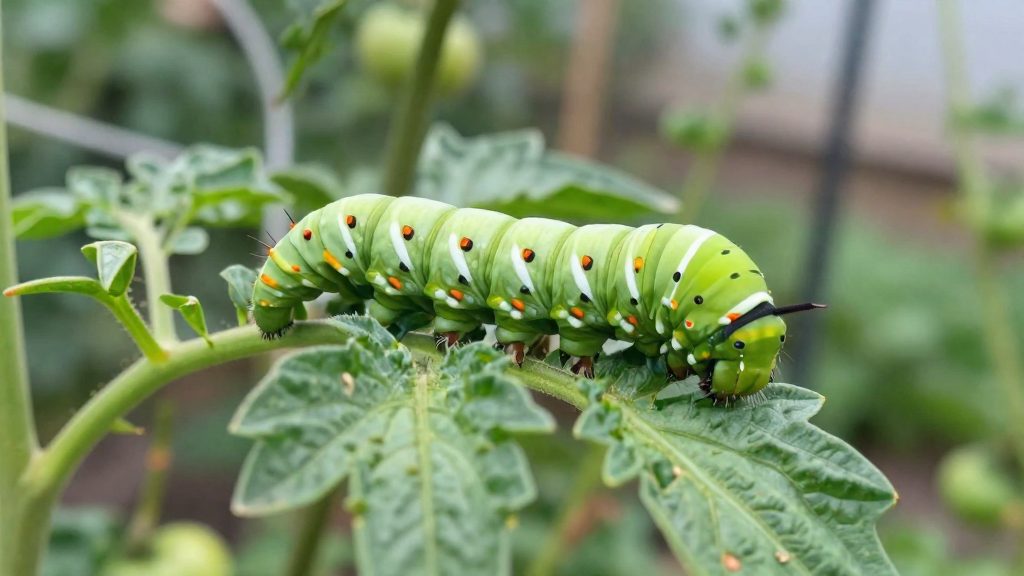
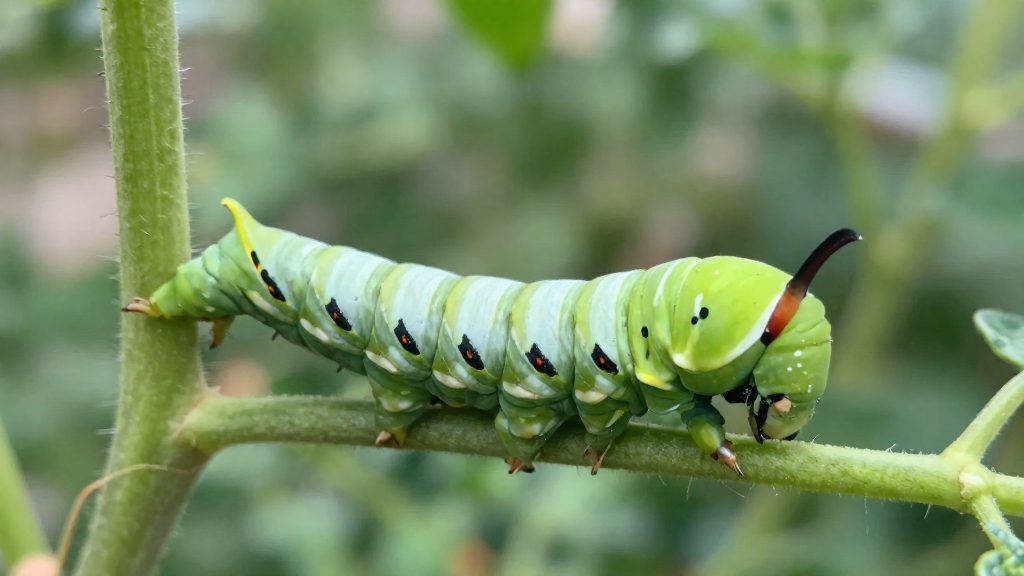
Two caterpillar species feed on tomatoes: the tobacco hornworm and the tomato hornworm. Both are large, green caterpillars that blend into the foliage they feed on, so identification depends on a close look rather than a quick glance.
Key identification traits
| Trait | Description |
|---|---|
| Maximum length | About 3 inches |
| Colour | Camouflaged green |
| Host plant | Tomato |
According to NC Cooperative Extension, Pamlico County Center (NC State) (2025), both species can reach about 3 inches long and are camouflaged green.
Telling the two species apart
The official sources consulted do not specify body markings that separate the tobacco hornworm from the tomato hornworm. A caterpillar that is green, large and found on tomato foliage is a likely hornworm, but size and colour alone do not confirm it. Check the damage and the plant, and if in doubt ask your local cooperative extension office before acting. Do not remove any caterpillar carrying white cocoons. Note the length, colour, and the plant it is on, then decide what to do.
Confirming it is a hornworm
Measure the caterpillar against the 3-inch maximum, but remember that young hornworms are much smaller, so size is only a starting point. Combine it with colour, the host plant and the damage you see. Focus on green caterpillars found on tomato plants, and compare their colour and length with the table above before taking any action.
Signs of hornworm damage on tomatoes
Hornworm damage on tomatoes is usually noticed before the caterpillar itself. According to NC Cooperative Extension, Pamlico County Center (NC State) (2025), two species feed on tomatoes, the tobacco hornworm and the tomato hornworm. They can kill young plants, reduce fruit production and damage ripening fruit, so their feeding marks appear on the foliage, the branch tips and the fruit.
Stripped leaves and defoliated branch tips
Look for leaves that have been eaten down to the veins or are left with ragged, irregular edges. Branch tips that look bare or shortened when neighbouring shoots are intact are another sign. Because the caterpillars are camouflaged green, the damage is often easier to spot than the pest. Young plants need the closest attention, since these caterpillars can kill them.
Chewed or damaged ripening fruit
Inspect tomatoes as they begin to ripen. Bite marks and chewed areas on the fruit indicate feeding, and the same extension source notes that hornworms can damage fruit at this stage. Check fruit regularly while it ripens.
Droppings and other traces
Droppings (frass) are not documented in the consulted sources as a reliable sign by themselves, so combine them with leaf and fruit damage when you inspect. Foliage that looks damaged while no caterpillar is visible on the same plant still justifies a closer check.
How do you find hornworms on tomato plants?
Hornworms are hard to spot because their green bodies blend into the foliage. A routine inspection of each plant, repeated through the season, is the most reliable way to find them. According to NC Cooperative Extension, Pamlico County Center (NC State) (2025), the tomato hornworm and the tobacco hornworm can reach about 3 inches long and are camouflaged green. Their size makes them findable, but only if you examine the plant closely rather than scanning the bed from a distance.
Inspect the undersides and upper stems of each plant
Check every plant individually, one at a time:
- Lift and turn leaves to examine their undersides, where a caterpillar can stay hidden.
- Look along the upper stems and the growing tips, not only the lower foliage.
- Examine the fruit clusters as well, since these caterpillars can also damage ripening fruit.
Work systematically from the base of the plant to the top so that no section is skipped. Keeping a consistent order from one plant to the next makes it easier to notice what has changed since your last check.
Repeat checks across two or three generations
The same source notes that there may be two or three generations per summer, so plants need repeated checks. One inspection early in the season is not enough. Schedule regular rounds of inspection for the whole growing season and treat each round as a fresh search, because a new generation can appear on plants that looked clear on an earlier visit.
Follow the droppings upward to find the caterpillar
Hornworms are often located by following evidence rather than by sight alone. Look for dark droppings, called frass, on leaves and on the soil or mulch beneath a plant. They are a clue to search more closely, not proof of a hornworm. Droppings fall downward, so the source is above them. Follow the trail up the plant, checking each leaf and stem along the way, until you reach the spot where the caterpillar is feeding.
Handpicking: the simplest natural control
Handpicking is the most direct organic control for hornworms on tomatoes. You find each caterpillar on the plant and remove it by hand. According to NC Cooperative Extension (2025), handpicking is recommended for small gardens, where plants can be checked regularly and caterpillars removed one at a time. It requires no product, only a container for disposal, and it leaves the plant and soil untouched.
The two species that feed on tomatoes, the tobacco hornworm and the tomato hornworm, can reach about 3 inches long and are camouflaged green. Inspect each stem and leaf cluster slowly, paying particular attention to the upper parts of the plant.
Once you have picked a caterpillar, dispose of it using one of the methods below.
| Disposal option | How to apply it |
|---|---|
| Soapy water | Drop each collected caterpillar into a container of soapy water. |
| Backyard chickens | Feed collected caterpillars to backyard chickens. |
Hand removal suits gardens with few plants. Because it depends on checking each plant individually, it becomes more time-consuming as the number of plants grows. The official sources consulted do not specify a plant count above which handpicking stops being practical, so judge this according to the size of your own plot.

Should you remove a hornworm covered in white cocoons?
No. According to NC Cooperative Extension, Pamlico County Center (NC State) (2025), a caterpillar with white, cigar-like cocoons on its back should be left in the garden. Those cocoons show that braconid wasps have parasitized the hornworm, and the wasps will help control the pest population.
What the white cocoons indicate
Braconid wasps parasitize hornworms. The braconid wasp cocoons sit on the caterpillar’s back, and the adult wasps are tiny and do not sting. The adult wasps are tiny and do not sting. Their role is population control, so a parasitized caterpillar is part of the natural regulation of the pest in your bed.
Why the caterpillar still matters
Hornworms can kill young plants and reduce fruit production.
Practical guidelines:
- Leave caterpillars with white cocoons on the plant rather than removing them.
- Watch young transplants more closely, since hornworms can kill them.
Natural predators as allies
The same extension source lists other natural predators of hornworms. Keeping these allies in the garden supports an organic approach that relies on living organisms instead of chemical products.
| Ally | Role in hornworm control |
|---|---|
| Braconid wasps | Parasitize hornworms; tiny and do not sting |
| Assassin bugs | Natural predators of hornworms |
| Spiders | Natural predators of hornworms |
| Yellow jackets and paper wasps | Predatory wasps that act as natural predators |
Using Bt and spinosad on small hornworms
According to NC Cooperative Extension, Pamlico County Center (NC State) (2025), spinosad and B.t. (Bacillus thuringiensis) products work on small tomato hornworms. The guidance sets two conditions for use: apply the spray in the late evening, when bees are less active, and follow the product label. In an organic plot, those two conditions are the core of using a bacterial spray responsibly. The guidance does not say whether either product is approved for organic production, so check the label for organic approval before buying, and use the product only as the label directs.
Where Bt fits in the control plan
Bacillus thuringiensis (Bt) is the bacterial product named for this control. It targets small caterpillars, so it is most useful when you spot hornworms early. Tomato hornworms can reach about 3 inches long, so early treatment limits the damage.
The guidance does not say how well Bt works on large caterpillars. Treat young larvae first, and check the label for the stage it is registered for.
Application timing that protects pollinators
| Factor | Guidance from NC Cooperative Extension (2025) |
|---|---|
| Time of day | Late evening, when bees are less active |
| Target stage | Small caterpillars |
| Products | Spinosad or B.t. |
| Dosage and interval | Follow the product label |
Hornworms can have two or three generations per summer, so one spray rarely settles the problem. Treat again only if new small caterpillars appear, following the label’s interval. The guidance does not give a reapplication interval, so the label is the reference.
How to prevent hornworms next season
Hornworm pressure on next year’s tomatoes depends partly on what you do to the bed after harvest. According to NC Cooperative Extension, Pamlico County Center (NC State) (2025), two species feed on tomatoes, the tobacco hornworm and the tomato hornworm. They can reach about 3 inches long and are camouflaged green. The official sources consulted do not specify how much these practices reduce the following season’s population, so treat them as general garden hygiene that supports regular checks during the growing season.
Turn the soil after harvest
Once the crop is finished, remove stakes, cages and ties and loosen the bed. The consulted sources do not document this step as a hornworm control, so treat it as general garden hygiene.
Rotate nightshade crops to different beds
Plant tomatoes and other nightshade crops, such as peppers, eggplants, and potatoes, in a different bed each year. Keep a simple planting map showing which crop occupied each bed, and choose a bed that did not host nightshades in the previous season. The consulted sources do not specify a minimum rotation interval, so record your layout and adjust it to the space you have.
Remove and destroy plant debris
Pull up spent plants, including stems, leaves, and fallen fruit, and remove them from the bed. Do not leave debris lying on the soil surface, where it can shelter caterpillars that have not yet been noticed. Keep checking plants during clean-up. Handpicking is recommended for small gardens: check plants regularly and drop caterpillars into soapy water, or feed them to chickens, according to NC Cooperative Extension, Pamlico County Center (NC State) (2025).
Frequently asked questions
What is the simplest natural way to get rid of hornworms on tomatoes?
Handpicking is the most practical method for a small garden. According to NC Cooperative Extension, Pamlico County Center (NC State) (2025), you should check plants regularly and drop the caterpillars into soapy water or feed them to chickens. Because two or three generations can occur per summer, repeat these checks throughout the season.
Should I remove every large green caterpillar I find on my tomatoes?
No. A caterpillar with white, cigar-shaped cocoons on its back has been parasitized by braconid wasps, which are tiny, do not sting, and help control pest populations. Leave these caterpillars in the garden so the wasp larvae can finish developing.
Which organic sprays work on hornworms, and when should I apply them?
Spinosad and B.t. (Bacillus thuringiensis) products are effective against small caterpillars, according to NC Cooperative Extension, Pamlico County Center (NC State) (2025). Apply them in the late evening, when bees are less active, and follow the label directions exactly. The official sources consulted do not specify whether these products meet organic certification rules, so check the certification listing on the product label before use.