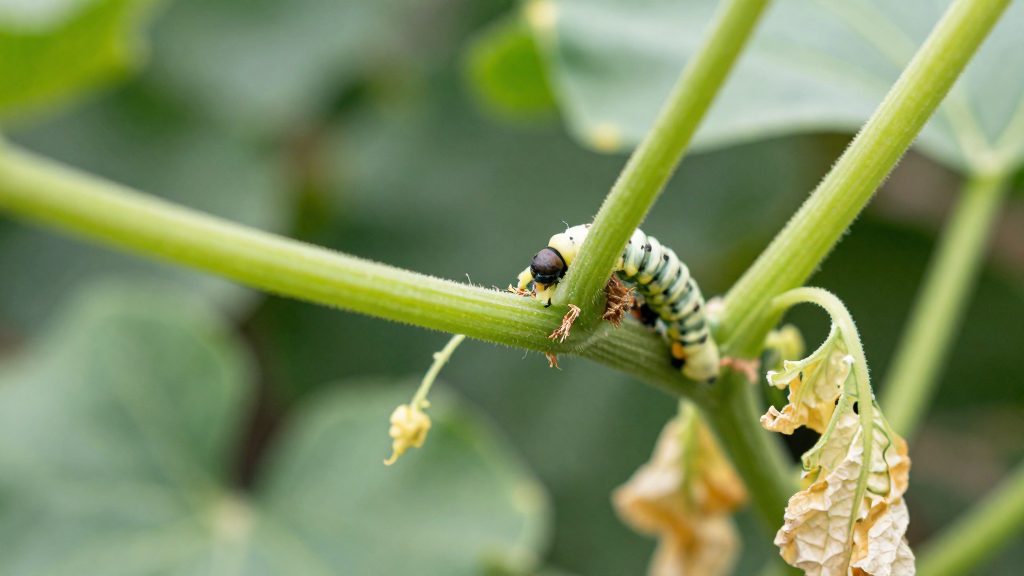
Squash vine borers are destructive because their larvae feed inside the stem rather than on the outside of the plant. Larvae that hatch bore into the vine, where they feed out of sight. Tunnelling interrupts the stem’s internal transport of water and nutrients, so the plant can decline without obvious early warning.
Why are squash vine borers so destructive?
Larvae tunnel inside the stem
- The larva lives inside the stem and feeds from within, so the damage is hidden until the vine is already weakened.
- Tunnelling cuts across the internal pathways that carry water and nutrients, which is why the plant can wilt and decline even when its leaves look healthy at first.
- Because the feeding site is inside the stem, damage is hard to reverse once a stem is tunnelled.
Adult moths lay eggs at the stem base
- Adult moths lay eggs for about two months beginning in early summer.
- Eggs are placed at the base of the stems, which is where the newly hatched larvae enter the plant.
- Timing matters: the egg-laying window is the period when a planting is most exposed.
Overwintering and generations
Regional summer climate determines how many generations develop in a season. The official sources consulted do not give exact dates for each generation.
| Summer climate | Generations per year | Overwintering stage |
|---|---|---|
| Warm summers | Two | Larvae in soil |
| Cool summers | One | Larvae in soil |
Larval feeding over several weeks
The official sources consulted do not specify the duration of each larval growth stage. Because the larva keeps feeding inside the stem as it develops, the damage builds up over several weeks rather than appearing in a single event. A stem that has been tunnelled can fail while the rest of the plant still looks sound, which is why regular inspection of the stem base during the egg-laying period is the most practical way to catch the problem early.
How to recognize squash vine borer damage
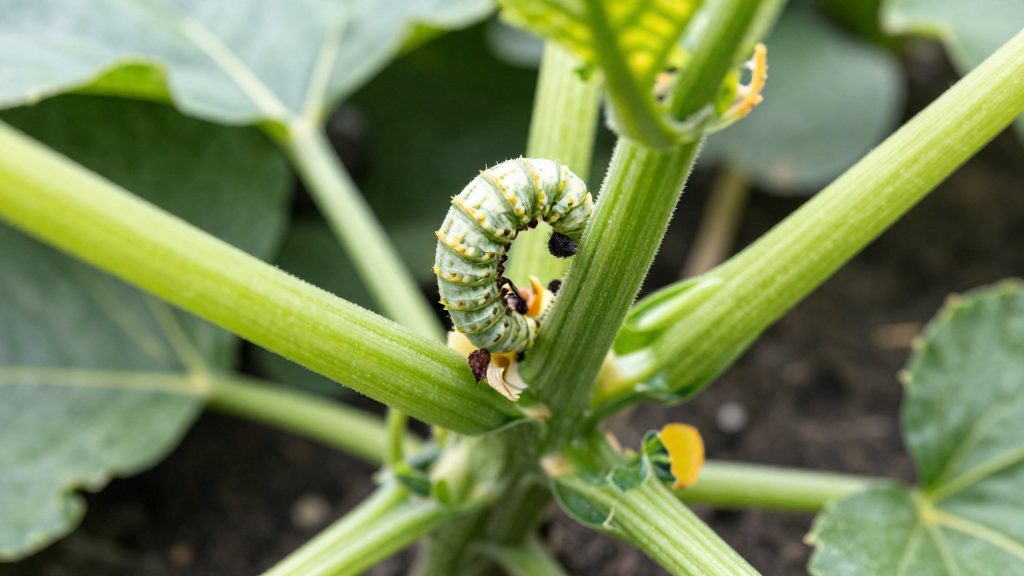
The earliest sign of a squash vine borer attack is usually at the base of the stem, not on the leaves. The larva bores into the vine and pushes out waste, so the plant shows the problem at the entry point before the rest of the vine declines. Inspecting the lower stems every few days gives you the best chance to act while only one vine is affected.
Sticky frass at the entry point
Frass is the mixture of droppings and chewed plant fiber that a borer pushes out of its tunnel. According to NCAT / ATTRA (2006), it forms a sticky mass resembling wet sawdust, and this mass marks the borer’s entry point. Check these locations:
- At the base of the main stem, where it meets the soil
- On the stem just above the soil line and at the lower leaf nodes
- Around the crown, under leaves that lie against the ground
- On the soil surface beneath the vine, where frass can fall and collect
Gently move soil or leaves aside to look. A small opening with damp, pale material packed around it is the signal to mark the spot. Check it again over the following days. Fresh, moist frass is more likely to indicate recent activity than dried material.
Sudden wilting of a single vine
A vine that wilts while its neighbors stay upright, even though the soil is adequately moist, is a warning sign. Compare the affected plant with the plants around it. If only one vine droops and does not recover, examine its base before adding water. Damage inside the stem can stop a healthy water supply, so more watering will not fix the underlying problem.
Telling borer damage apart from fungal stem rot
Both problems can make a vine wilt, and both can appear at the stem base, so wilting alone is not a reliable diagnosis. Use these observations:
- Entry opening: A discrete entry hole with sawdust-like frass points to a borer. Soft, discolored tissue without an opening may suggest rot, but these cues are general guidance and not a reliable diagnosis.
- Spread: Rot tends to spread along the stem as darkened, soft areas. A borer tunnel tends to produce a localized problem around one entry point.
- Outer stem condition: Compare the color and texture of the outer stem on the affected section with the healthy stem above and below it, without cutting into the vine.
The sources consulted do not give a reliable visual rule that separates the two in every case. When in doubt, treat a single entry opening with frass as borer activity, since frass is the sign the NCAT / ATTRA (2006) source ties directly to the entry point.
Do row covers really work?
Row covers performed best among the methods tested in a 2019 on-farm trial in Iowa. They gave better squash vine borer control than Bt injection, stem collars, or spinosad sprays. The trial used randomized, replicated plots at two farms, so its comparison is more reliable than a single-garden observation. Results depend less on the fabric itself than on two rules: when the cover goes on and comes off, and how well it is sealed.
Timing is the first rule. According to NCAT / ATTRA (2006), gauze row covers such as Reemay go on at planting and stay on until flowering. They come off just before the female blossoms open, so pollination can happen.
| Stage | Action | Purpose |
|---|---|---|
| Planting | Install the gauze row cover | Keeps borer moths off the vines |
| Throughout the cover period | Secure all edges tightly | Excludes insects |
| Just before female flowers open | Remove the cover | Allows pollination |
Sealing is the second rule. A cover that leaves gaps at the edges lets insects in, so the edges must be pinned or buried firmly. Sealing too tightly, however, creates a different problem. In the Iowa trial, the row cover probably stunted and delayed blooms at one farm, possibly because it was too tight. Aim for a snug fit that keeps insects out without restricting the plants.
The trial compared row covers against three other control methods. Bt injection, stem collars, and spinosad sprays all performed worse than row cover in the trial results. Growers who want a cover-based approach should plan for removal at flowering, because keeping it on longer blocks pollinators from reaching the flowers.
Which squash varieties resist borers?
Among squash, the Cucurbita moschata types are the safer choice against squash vine borer. According to NCAT / ATTRA (2006), these types are less susceptible overall. The University of Illinois rating cited in the same source scores varieties from 1 (most resistant) to 5 (least resistant). A low score lowers your exposure to the pest, but it does not eliminate the risk.
University of Illinois rating
| Variety | Rating (1 = most resistant, 5 = least resistant) |
|---|---|
| Butternut | 1 |
| Green striped cushaw | 1 |
| Blue Hubbard | 5 |
Butternut and green striped cushaw both scored 1, the most resistant result on the scale. Blue Hubbard scored 5, the least resistant. These scores give a clear order for planning a bed: butternut and green striped cushaw are the stronger choices, and Blue Hubbard is the most exposed of the three.
Using the ratings when you choose seed
- Choose the variety before sowing, because it sets your baseline exposure for the whole season.
- Prefer the rating-1 varieties in plots where vine borers have caused damage before.
- Keep a simple planting log that records which varieties were attacked each year, so you can compare results over several seasons.
- Mix varieties in separate beds rather than planting only one type, so a single cultivar does not make up your whole harvest.
Can you save a plant that is already infested?
A wilting vine with a sticky mass of frass at its base can sometimes be saved by hand. The NCAT / ATTRA (2006) guide notes that in small plantings you can slit the vine to remove the larva. The method is mechanical, requires no synthetic product, and fits an organic plot.
Rescue steps
| Step | Action | Purpose |
|---|---|---|
| 1 | Locate the frass mass at the base of the vine. | Identifies where the larva is feeding. |
| 2 | Slit the vine at the frass mass, which marks the entry site. The sources do not specify where or how to cut. | Exposes the tunnel so the larva can be removed. |
| 3 | Find and remove the larva from the tunnel. | Stops the damage at its source. |
| 4 | Bury the slit section under moist soil. | Lets the stem root and keep supplying the plant. |
Burying the slit stem
Harvest to Table advises mounding moist soil over the vine nodes so they root. Rooted sections can keep the plant alive if one part is attacked. Harvest to Table’s advice concerns vine nodes, not slit wounds. The sources consulted do not test burying a slit stem, so treat it as an unproven extra step. Keep the soil moist but not waterlogged, and make sure the plant has a sunny position.
Limits of this method
- It is practical only in small plantings. The sources consulted describe hand intervention on individual vines as labor-intensive, so it is not a method for commercial fields.
- The sources consulted do not give a timeframe for how long a slit stem takes to recover, nor a success rate for the rescue.
- Removing the larva does not protect the rest of the crop. Check neighbouring vines for the same frass signs.
Timing and planting tricks
Spreading planting dates across the season is one of the simplest ways to limit losses to squash vine borer. Instead of sowing early in spring to get a head start, delay planting and set out new mounds in stages, so that one wave of egg-laying cannot take the entire crop. According to Harvest to Table, delaying planting and staggering new mounds every few weeks reduces the risk of losing the whole crop, and that source does not recommend early planting.
The reason timing matters is that a large, established planting is exposed to egg-laying all at once. Staggered plantings mean that at any given time some vines are young and others are more mature, so damage is spread out instead of concentrated in one block.
Staggered mounds
- Prepare a new mound or planting spot every few weeks rather than setting out all plants on a single date.
- Keep each group physically separate, so a problem in one mound does not move straight into the next.
- Water the base of each mound without soaking it, keeping the soil moist but not waterlogged.
Mounding over vine nodes
Harvest to Table notes that mounding moist soil over vine nodes so they root lets sections survive if one is attacked. Rooted nodes can keep the plant alive after the main stem is damaged, so mounding is a useful fallback inside each planting.
Late-season backup planting
A late planting held in reserve gives you a replacement if early plantings are lost. The official sources consulted do not specify a fixed date for this. Set the timing from your local frost dates and the length of your summer, and keep the late planting as a spare rather than your main crop.
Bt, spinosad and other organic options
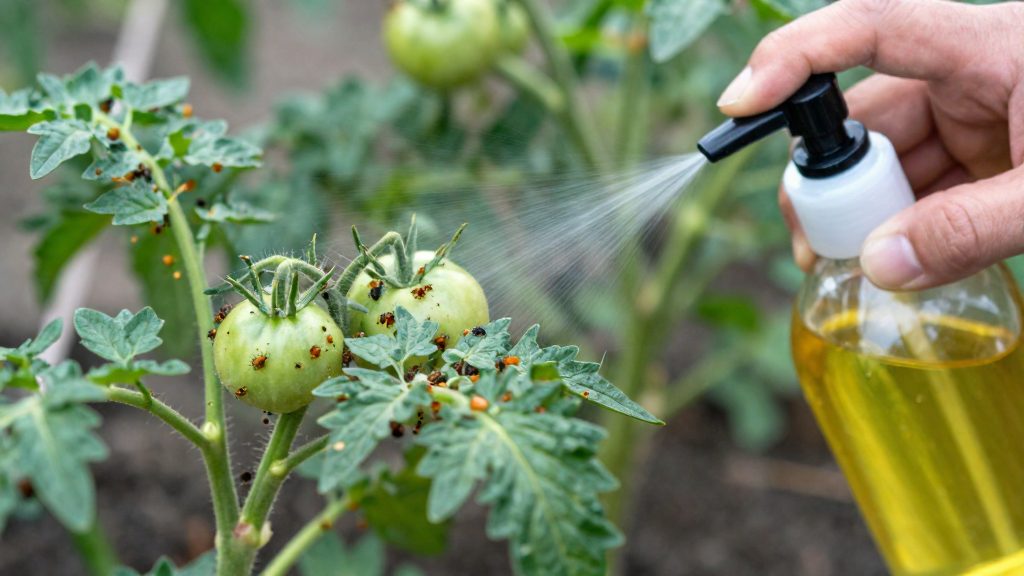
Organic insecticides can reduce squash vine borer damage, but they work within narrow limits. The larva spends most of its life inside the stem, where a spray or a surface treatment cannot reach it, so timing and application method decide whether these products help at all. The two options most often compared are Bt (Bacillus thuringiensis) injected into the vine and spinosad sprayed on the plant.
Sprays must be applied before larvae bore inside the stem. Once the larva is in the vine, a spray has little chance of reaching it. Hand-injecting Bt into each vine is the alternative, but it is labor-intensive and unsuitable for large plantings (NCAT / ATTRA, 2006).
Comparing the two main options
| Option | How it is applied | Practical limit |
|---|---|---|
| Bt injection | Hand-injected into each vine | Labor-intensive; described by NCAT / ATTRA (2006) as unsuitable for large plantings |
| Spinosad spray | Sprayed on the plant | Requires weekly applications; judged too labor-intensive in the 2019 Iowa on-farm trial reported by Practical Farmers of Iowa (2020) |
Practical limits of Bt injection
Injecting Bt into each vine is a method in use, according to NCAT / ATTRA (2006). Its main limit is labor: each vine must be treated individually, and the method is unsuitable for large plantings. It suits a small bed or a few plants, where each vine can be treated by hand.
Practical limits of spinosad spraying
Spinosad is an organic spray option. In the 2019 Iowa on-farm trial, it required weekly applications and was judged too labor-intensive by Practical Farmers of Iowa (2020). A gardener considering spinosad should plan for a repeated treatment schedule over the season, not a single application.
Fall cleanup and rotation
Annual crop rotation and fall cleanup are cultural steps against squash vine borer, but according to NCAT / ATTRA (2006) they give unreliable control when used alone. The main reason is mobility. Adults can fly up to half a mile to find squash fields, so moving the planting to a new bed does not guarantee that egg-laying females will skip it. Rotation can reduce the number of borers that start the next season near the crop, but it does not remove the population already present in the area.
Cleanup works on the other stage of the cycle. Larvae overwinter in the soil, so plant debris left on the bed can shelter the next generation. Based on NCAT / ATTRA (2006) and Harvest to Table (undated), the practical steps are:
- Destroy vine residue promptly after harvest. Remove spent vines from the bed rather than leaving them to decay in place.
- Shred infested vines. Harvest to Table (undated) notes that shredding exposes larvae to cold and predators.
- Till in fall to expose pupae. Turning the soil after harvest exposes overwintering pupae. NCAT / ATTRA (2006) classes this, like residue destruction, as a stopgap measure.
| Practice | What it targets | Limitation noted in sources |
|---|---|---|
| Annual rotation | Adults seeking squash fields | Adults can fly up to half a mile, so control is unreliable |
| Prompt destruction of vine residue | Larvae sheltering in spent vines | Stopgap measure only |
| Shredding infested vines | Larvae exposed to cold and predators | The sources give no control rate, so use it with other measures |
| Fall tillage | Overwintering pupae in the soil | Stopgap measure only |
Because these practices reduce local numbers without eliminating an incoming population, they work best as one part of a broader plan. Rotation and cleanup lower the pressure on the next crop, but they do not stop adults flying in from neighboring plantings.
Frequently asked questions
When should I apply an organic spray against squash vine borers?
Sprays need to go on before the larvae bore into the stem. Once a larva is inside the vine, a pre-entry spray has little chance of reaching it.
Is row cover a reliable organic option for squash vine borers?
In a 2019 on-farm trial in Iowa, according to Practical Farmers of Iowa (2020), row cover gave better borer control than Bt injection, stem collars, or spinosad sprays. Remove the cover just before the female blossoms open so pollination can happen, and check the plants for stunted growth, since the cover may have delayed blooms when sealed too tightly.
Are some squash varieties less affected by squash vine borers?
Yes. Types of Cucurbita moschata are less susceptible, and in the University of Illinois rating cited by NCAT / ATTRA (2006), butternut and green striped cushaw scored 1 (most resistant), while Blue Hubbard scored 5 (least resistant).