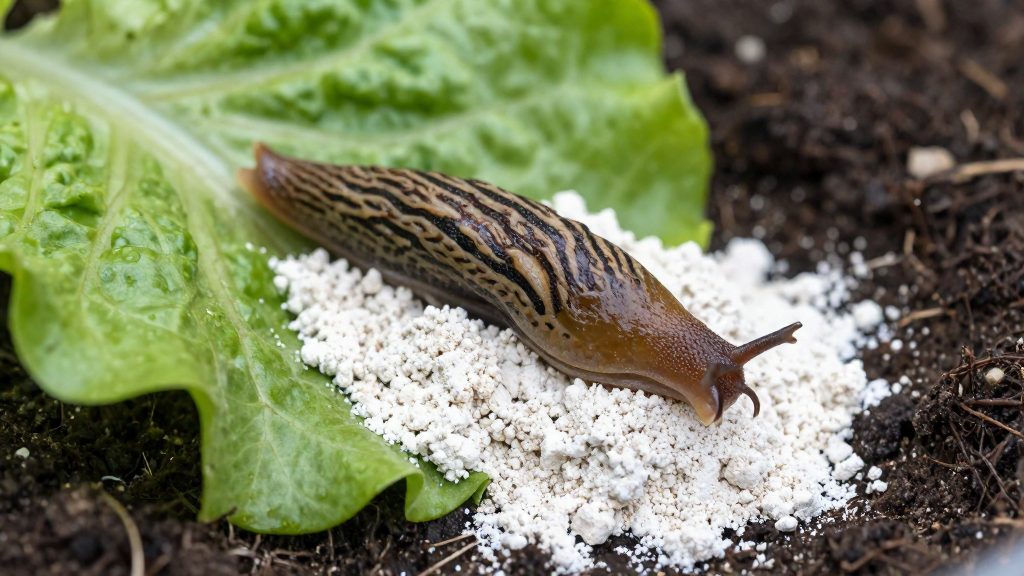
No, diatomaceous earth (DE) does not kill slugs. According to the Elisabeth C. Miller Library at the University of Washington (2026), it may slow them down, but its main effect is on hard-bodied insects. Gardeners who buy DE for slug control should expect limited results, and the common claims are worth checking against the tested evidence.
Does diatomaceous earth kill slugs?
Verdict: DE slows slugs without killing them
The Elisabeth C. Miller Library (2026) states that DE does not kill slugs, although it may slow them down. A slowed slug is not a removed slug, so DE should not be treated as a slug control method.
Its intended targets are hard-bodied insects
DE works through its abrasive dust, which is why it is aimed at insects with hard exoskeletons. Slugs are soft-bodied mollusks, so the same mechanism does not produce the same result. Expecting DE to clear a bed of slugs confuses its intended use with slug control.
Common claims versus tested evidence
| Common claim | What the tested evidence shows |
|---|---|
| DE kills slugs | DE does not kill slugs, though it may slow them (Elisabeth C. Miller Library, 2026) |
| DE is a general pest killer | DE is mainly effective against hard-bodied insects (Elisabeth C. Miller Library, 2026) |
| A dry DE ring stops slugs | Slugs turned back from a dry ring, but crossed wet DE without difficulty (Garden Myths, 2025) |
Organic alternatives for slugs
For slugs, the Elisabeth C. Miller Library (2026) suggests submerged saucers of beer, which do not harm non-target species. Sink the saucers so the rim sits level with the soil surface, and check them regularly. The same source mentions wool as an alternative but notes that wool has not been thoroughly researched, so treat it as an untested option.
How DE affects slugs
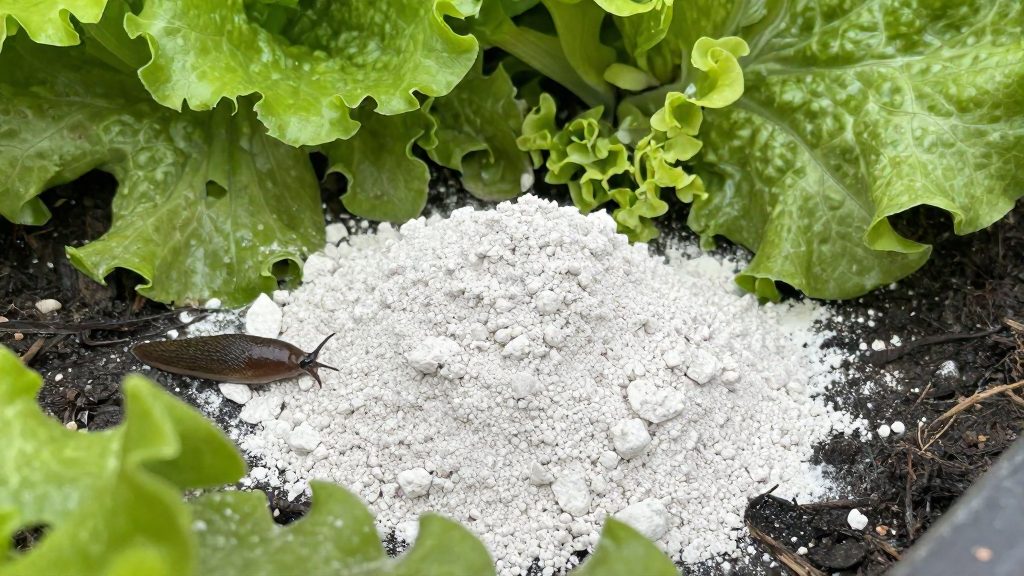
Slugs respond to diatomaceous earth (DE) mainly through avoidance, not through a lethal effect. In a trial reported by Garden Myths (Robert Pavlis, 2025), slugs and snails turned back from a dry DE ring instead of crossing it. A dry layer of DE can therefore change the direction a slug travels, but that is the extent of the deterrent effect the trial describes.
Avoidance of a dry ring
When the DE is dry, it works as a deterrent at the edge of the ring. The animals stopped and turned back rather than crossing. Gardeners who use a dry band of DE around vulnerable plants rely on this response. The sources consulted do not specify how long a dry ring keeps its effect once it has been disturbed or partly covered with soil and debris.
Crossing wet DE
Once the DE is wet, the result changes. In the same trial, slugs and snails crossed wet DE without apparent difficulty.
Survival after forced crossing
When animals were forced through DE, they remained alive and active days later, according to Garden Myths (Robert Pavlis, 2025). Contact with DE did not stop them from moving. The source summary does not give the exact number of days observed.
| Condition | Reaction observed |
|---|---|
| Dry DE ring | Slugs and snails turned back |
| Wet DE | Crossed without apparent difficulty |
| Forced crossing through DE | Alive and active days later |
Why wet weather defeats it
Diatomaceous earth (DE) is an abrasive dust, and it works best only while it stays dry. Its effect depends on the surface staying dry, and this is the main reason it fails in damp gardens. Garden Myths (Robert Pavlis, 2025) notes that slime and rain make DE wet and ineffective. Both conditions break the mechanism that makes the powder useful in the first place.
Slugs and snails produce mucus as they move, so every pass over the powder leaves a film of slime on the particles. Rain or heavy dew does the same thing across the whole treated area. Once the particles are wet, they clump and stop acting as a rough, drying dust.
The consequences for the gardener are direct:
- Wet particles lose their abrasive, drying effect. The dust no longer scratches or dries the soft body of the animal, so it stops acting as a physical barrier.
- A ring can trap slugs. Pavlis (2025) notes that DE can trap slugs inside a ring around a plant, so check inside the ring rather than assuming it is protecting the plant.
Mother Earth News (Barbara Pleasant, 2013-05-07) states that DE works best in dry conditions and loses effectiveness when wet. In practice, the most vulnerable situations are:
| Condition | Effect on DE |
|---|---|
| Rain falling on treated soil | Particles become wet and clump |
| Heavy dew overnight | Surface moisture dulls the abrasive action |
| Slug or snail slime on the powder | Mucus coats the particles and blocks their action |
| Wide, dry band | May deter slugs only while it stays dry (Garden Myths, 2025) |
How to apply DE if you try it
Diatomaceous earth (DE) works only as a dry, surface-level barrier. Treat any application as a trial and keep checking plants for damage.
Light sprinkle on dry soil surface
- Apply DE only to soil that is dry on the surface.
- Sprinkle it lightly rather than piling it on. Mother Earth News advises a light sprinkle on the soil surface rather than a heavy layer.
- Reapply only when the surface is dry again. Dampened DE no longer forms a usable barrier.
Wide dry band and ring placement
- Make the band wide and dry. Garden Myths (Robert Pavlis, 2025) notes that a DE band may deter slugs only under those conditions.
- For a single plant, form a ring of DE on the soil around its base.
- Check inside the ring regularly. Pavlis notes that a ring can also trap slugs inside it, where they remain close to the plant.
- The sources consulted do not give a measured band width, so size the band to the bed and the plant, keeping it wide enough to cover the soil around the stems.
Timing and reapplication
| Condition | Action | Source |
|---|---|---|
| Dry soil surface | Apply a light sprinkle and lay a wide dry band | Mother Earth News (2013); Garden Myths (2025) |
| Rain | Reapply once the surface dries | Mother Earth News (2013) |
| Heavy dew | Reapply once the surface dries | Mother Earth News (2013) |
The band must be renewed after each rain or after a night of heavy dew. Inspect it each morning during damp periods, and replace any section that has clumped or soaked through.
Is DE safe for bees and beneficial insects?
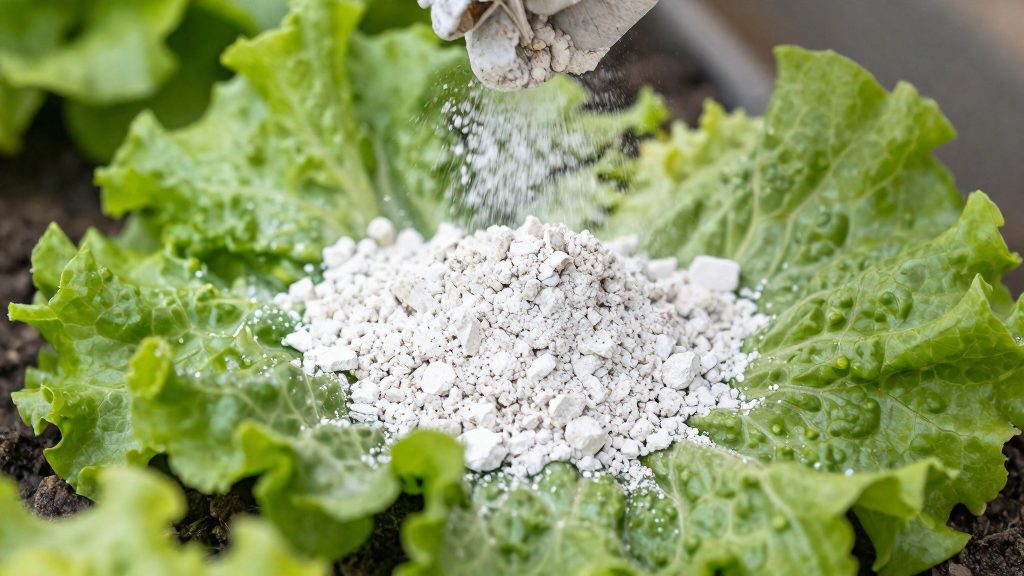
Diatomaceous earth (DE) is not selective. Its abrasive dust can harm animals other than the pests it targets. According to the Elisabeth C. Miller Library, University of Washington (2026), the dust can harm butterflies, spiders, some bees and hard-shelled beneficial insects. The risk depends on where the dust lands and how it is applied, so gardeners who want to protect pollinators should treat every application as a possible exposure for non-target insects.
Which animals are at risk
| Group | Risk noted | Source |
|---|---|---|
| Honeybees and other beneficial insects | Cannot protect themselves from DE | Mother Earth News (Barbara Pleasant), 2013-05-07 |
| Some bees | Can be harmed by the abrasive dust | Elisabeth C. Miller Library, University of Washington (2026) |
| Butterflies | Can be harmed by the abrasive dust | Elisabeth C. Miller Library, University of Washington (2026) |
| Spiders | Can be harmed by the abrasive dust | Elisabeth C. Miller Library, University of Washington (2026) |
| Hard-shelled beneficial insects | Can be harmed by the abrasive dust | Elisabeth C. Miller Library, University of Washington (2026) |
The same abrasive mechanism that damages pests can also affect hard-shelled beneficials.
Harm when dusting plants
The main risk to pollinators comes from dusting plants that bees visit, especially while they are in flower. Because bees cannot protect themselves from DE, the source recommends a specific precaution when treating such plants:
- Apply the DE to the plant.
- Cover the plants with a sheet after application.
- Uncover the plants later.
- Rinse off the DE before the plants are open to visiting insects again.
Applying DE as a light sprinkle on the soil surface, rather than onto open flowers or foliage, keeps it away from the blooms that bees visit. Mother Earth News (Barbara Pleasant, 2013-05-07) recommends this light surface application, and it is a sensible default for gardeners who want to limit exposure to beneficial insects.
Safety: food grade and dust
Diatomaceous earth is sold in several grades, and the sources consulted for this section advise choosing one specific grade for garden use. According to Mother Earth News (Barbara Pleasant, 2013), gardeners should buy a product labeled food grade. Check the packaging before purchase to confirm that it says food grade.
Handling the powder carries a second risk, which is inhalation. The Elisabeth C. Miller Library, University of Washington (2026) recommends wearing a respirator because prolonged exposure to the dust can cause serious problems. The library names silicosis as one of these problems. Silicosis is a lung condition caused by inhaling fine dust. The library recommends a respirator because prolonged exposure can cause serious problems, so wear one every time you handle the powder. The sources consulted do not specify how long an exposure must last before the risk becomes significant, so treat any repeated dusty handling as a reason to protect your airways.
Practical precautions that follow from these recommendations:
- Confirm the label says food grade before buying.
- Wear a respirator whenever the powder is poured, scooped or spread.
- Avoid stirring up dust on windy days, since airborne particles travel further.
- Keep containers closed and stored out of reach of children and pets.
- Wash hands after handling and before eating.
Organic slug alternatives suggested by the sources
Diatomaceous earth is a weak slug control. Several organic options have a clearer profile, but the evidence behind each one differs. Comparing them on two points, the strength of the evidence and the risk to non-target animals, helps you choose a control you can rely on.
Beer saucers
- Sink the saucers into the soil so that slugs can slide in and reach the liquid.
- Fill them with beer and replace the liquid when rain has diluted it.
- The sources consulted do not specify a number of saucers per bed or a refill interval.
Wool
The same library mentions wool as an alternative to diatomaceous earth. It notes, however, that wool has not been thoroughly researched. Its effectiveness against slugs and its safety for other organisms are therefore not well documented, and the sources consulted do not specify its non-target effects.
Dry diatomaceous earth bands
The Elisabeth C. Miller Library, University of Washington (2026) also warns that the abrasive dust of a DE band can harm beneficial animals such as butterflies, spiders and some bees.
Choosing a control based on evidence
| Option | Evidence noted | Non-target safety noted |
|---|---|---|
| Submerged beer saucers | Recommended by the Elisabeth C. Miller Library, University of Washington (2026) | Does not harm non-target species |
| Wool | Mentioned by the same source; not thoroughly researched | Not specified in the sources consulted |
| Dry diatomaceous earth band | Trial observation reported by Robert Pavlis (2025); may deter slugs only when wide and dry | Abrasive dust can harm beneficial animals |
Beer saucers are the option the library specifically suggests, and the only one described as not harming non-target species. The sources consulted give no trial data on how well they control slugs. Wool is an untested option. Its effectiveness and its effects on other organisms are not well documented, so it should not be relied on as a slug control. Diatomaceous earth bands should be used only where they can stay dry, and only with awareness of their impact on beneficial insects.
Frequently asked questions
Can diatomaceous earth get rid of slugs in my vegetable bed?
Not on its own. According to the Elisabeth C. Miller Library (2026), diatomaceous earth may slow slugs down, but it does not remove them. For slugs, the same source suggests beer saucers sunk to soil level as a non-harmful option.
Will a ring of diatomaceous earth keep slugs away from my lettuces?
Only under narrow conditions. In a trial reported by Garden Myths (Robert Pavlis, 2025), slugs turned back from a dry ring but crossed it without trouble once it was wet. Rain and slime make the dust ineffective, and a ring can even trap slugs inside it around a plant.
Is diatomaceous earth safe to use around bees and my own health?
Caution is needed on both counts. The Elisabeth C. Miller Library (2026) reports that the dust can harm butterflies, spiders, some bees and other hard-shelled beneficial insects. It also recommends wearing a respirator, because prolonged exposure to the dust can cause serious problems such as silicosis.