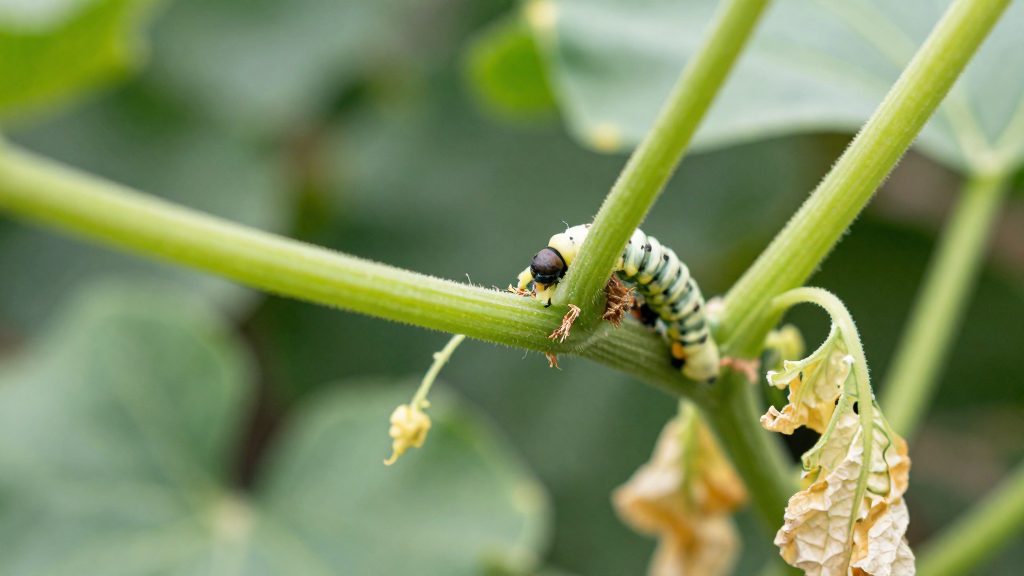
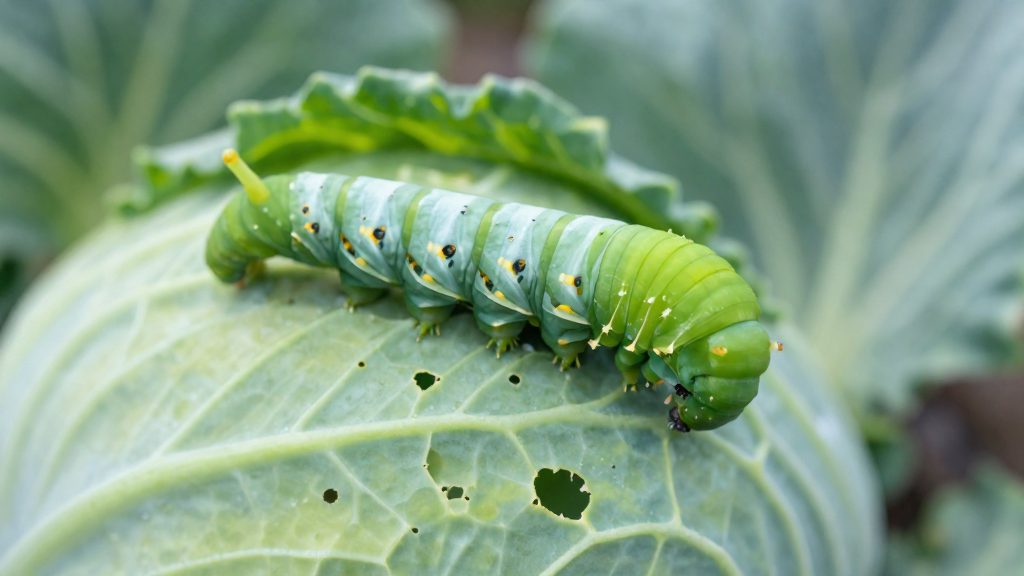
Cabbage worms are the larvae of the cabbage white butterfly, Pieris rapae. According to the Old Farmer’s Almanac (2026), adult butterflies lay their eggs on the undersides of leaves, and the larvae feed for about two to three weeks before pupating. Identifying the larvae early, within that feeding window, is the most practical way to limit damage in an organic vegetable patch.
Know your cabbage worm pests
Cabbage worms are not a separate pest. They are the caterpillar stage of the cabbage white butterfly, and the two key facts for identification are where the eggs are laid and how long the larvae feed.
| Stage | Key fact (source) |
|---|---|
| Adult butterfly (Pieris rapae) | Lays eggs on leaf undersides (Old Farmer’s Almanac, 2026) |
| Larva (cabbage worm) | Feeds for about 2–3 weeks before pupating (Old Farmer’s Almanac, 2026) |
How to identify them
- Turn leaves over and inspect the undersides, where the adults lay their eggs.
- Look for frass (droppings) on the leaves and on the soil below the plant, which indicates larval feeding.
- Inspect brassica plants regularly throughout the feeding period, since the larvae keep feeding until they pupate.
- Handpick eggs and larvae. The Old Farmer’s Almanac (2026) describes this as the most effective option for small gardens.
Why the two-to-three-week window matters
The feeding window is finite. Because larvae feed for about two to three weeks before pupating, a regular inspection routine during that period covers the stage when they are actively eating the plant. The official sources consulted do not specify how much leaf damage accumulates day by day, so the practical approach is to inspect often and act as soon as eggs, larvae or frass appear.
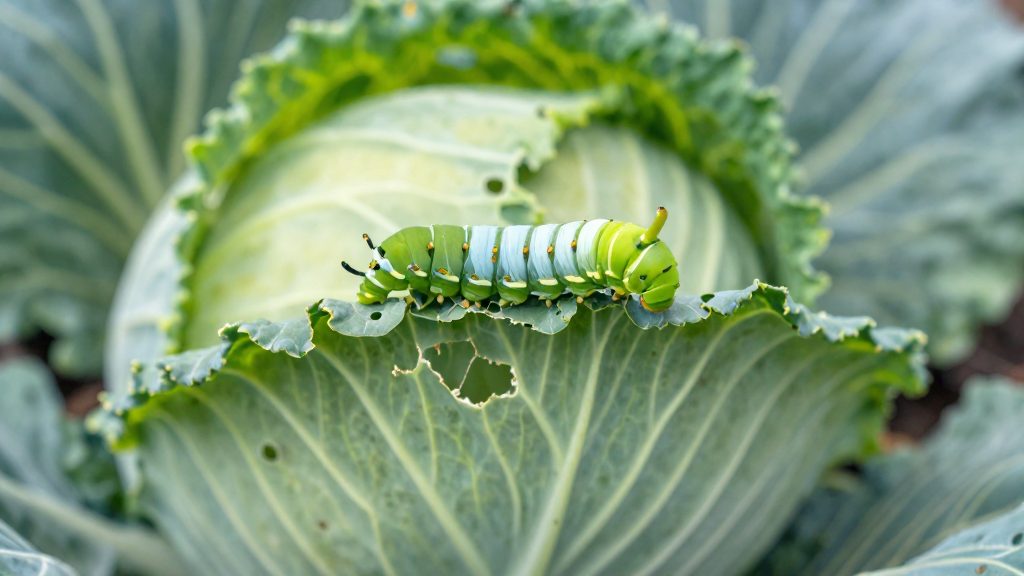
How do you spot cabbage worm damage early?
Cabbage worm damage often shows first on the outer leaves of brassicas, though larvae can also feed elsewhere on the plant, so check the whole plant. Because the first signs show up on the outside of the plant, a short inspection of each leaf can reveal an infestation while the damage is still limited and easy to manage.
Three visible signs are the most reliable indicators.
| Sign | What to look for | Where to look |
|---|---|---|
| Round or irregular holes | Chewed openings in the leaf blade, with edges that may be torn or ragged | Across the leaf blade, including the edges |
| Frass | Small, dark green pellets, the droppings of feeding larvae | Leaf undersides, where larvae feed and droppings collect |
| Early outer-leaf damage | Feeding limited to the outermost leaves, before any head has formed | The outer leaves of young and mature plants |
Round or irregular holes in the leaves
Feeding larvae chew holes in the leaf blade. These holes can be round or irregular, and they are often found in the middle of the leaf as well as at the edges. Checking several leaves on each plant gives a better picture than inspecting only one. Checking several leaves on each plant gives a better picture than inspecting only one.
Dark green frass pellets on leaf undersides
Frass is one useful sign that larvae are present. Check the leaf undersides and the soil below the plant for droppings, and keep inspecting even if you find none, because the absence of frass does not prove the plant is free of larvae.
Early damage on outer leaves before head formation
Damage often shows first on the outer leaves. Inspect these first, then work inward toward the centre of the plant, and check the growing points too. When damage is confined to the outer leaves, the plant can often be protected by removing the affected leaves and monitoring the rest of the plant closely. Once the head begins to form, a larva that reaches the centre can cause damage that is much harder to remove.
Row covers: block the butterflies
Row covers are a physical barrier. A fine insect mesh laid over the bed keeps adult cabbage white butterflies (Pieris rapae) from reaching brassica plants. According to the Old Farmer’s Almanac (2026), row covers keep adult butterflies from laying eggs on brassicas. This matters because the damage starts with the eggs. Stopping egg-laying removes the problem at its source, without any spray.
Fine insect mesh should go directly over the brassica bed, ideally as soon as transplants or seedlings are in the ground. Lay the fabric loosely so it does not press on the leaves, and let it extend past the bed edges. Insect mesh lets light and water through, and it works as a physical barrier without any spray.
Sealing all edges is the step most often skipped, and a gap is enough for a butterfly to get in. Check the following points:
- Bury the fabric edges in soil, or hold them down with stones or pegs.
- Overlap and fold any seam rather than leaving it open.
- Inspect the bed ends, where gaps are most common.
- Walk the bed after windy weather and reseal any lifted corners.
Removing covers at flowering is needed because many brassicas depend on insects to pollinate their flowers. When plants start to bloom, lift the mesh or open part of it so pollinators can reach the flowers. For crops grown for seed, this access is especially important. If caterpillar damage continues after flowering, reseal the bed promptly rather than leaving it open for the rest of the season.
The table below summarises where the cover interrupts the cabbage white cycle:
| Stage | What happens | Where the row cover acts |
|---|---|---|
| Adult butterfly | Flies to brassicas and lays eggs on leaf undersides | Blocked by an intact mesh |
| Egg | Laid on leaf undersides | Not laid under an intact cover |
| Larva | Feeds for about 2–3 weeks before pupating | Does not start if no eggs are laid |
Handpicking and garden monitoring
Removing the eggs and larvae by hand breaks the cabbage worm cycle before caterpillars spread across the plants. The method needs no product, so it suits a kitchen garden or a few raised beds of brassicas.
Why eggs and larvae are the target
| Stage | Where to look | Hand method |
|---|---|---|
| Eggs | Undersides of leaves | Rub off the eggs or remove the whole leaf |
| Larvae | Leaves and growing points, where they feed | Pick them off one by one |
Regular inspection of leaf undersides
Check the undersides of leaves at regular intervals, for example during each watering round or harvest. Look at the outer leaves first, then the inner ones, since eggs can sit anywhere on the leaf surface. Remove eggs as soon as you see them. Catching them at this stage avoids having to deal with larvae later.
Disposing of collected caterpillars
Do not drop collected caterpillars at the foot of the plants, where they can crawl back onto the crop. Put them in a sealed container or a bucket and take them well away from the bed before disposing of them. Handle the leaves gently when you pick the larvae off, so that they do not fall and go unnoticed in the soil.

Is Bt safe for organic gardens?
Bacillus thuringiensis (Bt) is a bacterium used as a biological insecticide. According to Iowa State University Extension and Outreach (2026), it specifically targets caterpillars, so it acts on the larvae that damage brassicas rather than as a broad-spectrum spray. An extension expert quoted by Ask Extension (2020) describes Dipel (Bt) as an organic, non-toxic way to get rid of caterpillars. That is one expert’s assessment, not a guarantee of safety for every insect. Because Bt targets caterpillars, it can also affect caterpillars you want to keep. The sources consulted do not detail its effects on other insects, so apply it only to affected plants and follow the label instructions for each product.
Two commercial products are named in the sources:
| Item | What the sources state |
|---|---|
| Target | Caterpillars specifically (Iowa State University Extension and Outreach, 2026) |
| Named products | Dipel and Thuricide (Iowa State University Extension and Outreach, 2026) |
| Formulations | Dipel is sold as a dust or a liquid (Ask Extension, 2020) |
| Spray interval | Bt var. kurstaki can be sprayed every 1–2 weeks (Old Farmer’s Almanac, 2026) |
The Old Farmer’s Almanac (2026) says Bt var. kurstaki can be sprayed every 1–2 weeks. Dipel is sold as a dust or a liquid, so choose the form that suits your equipment and follow the label for application and timing.
Beneficial insects that help
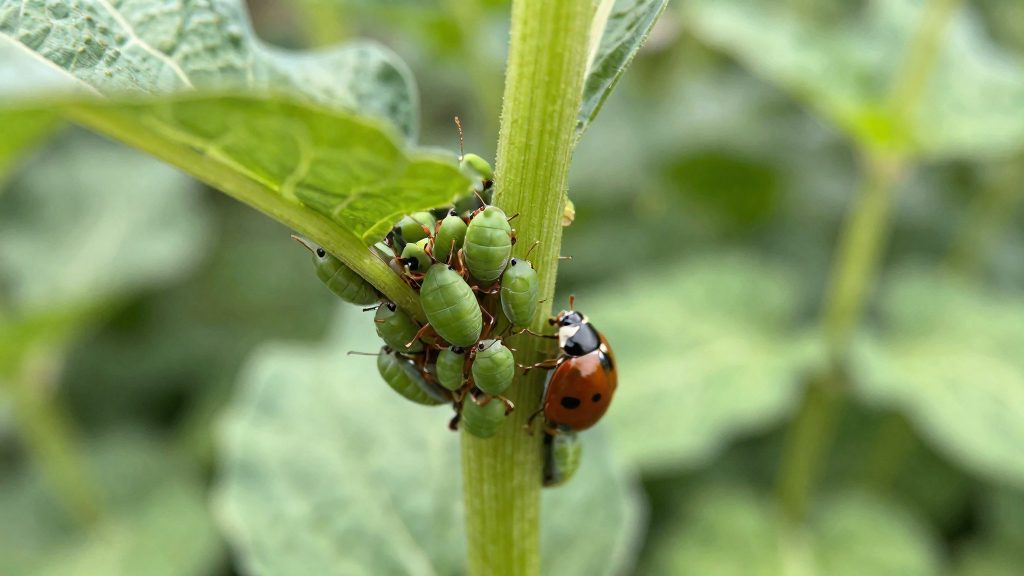
Natural enemies can reduce cabbage worm numbers without any product applied to the crop. According to the Old Farmer’s Almanac (2026), Trichogramma wasps, paper wasps and ladybugs prey on cabbage worms or their eggs. These predators work on two stages of the same pest: the eggs laid on leaf undersides and the larvae that feed on the leaves.
Trichogramma wasps act on the eggs, before any larva hatches. Because adult butterflies lay their eggs on the undersides of leaves, the wasps reduce the number of larvae that would otherwise damage the crop. Paper wasps and ladybugs are also listed as predators of cabbage worms or their eggs, but the sources do not say which stage each one targets.
| Predator | Main target | Where it acts |
|---|---|---|
| Trichogramma wasps | Cabbage worm eggs | Leaf undersides, before hatching |
| Paper wasps | Not specified in the sources (cabbage worms or their eggs) | Not specified |
| Ladybugs | Not specified in the sources (cabbage worms or their eggs) | Not specified |
Flowering plants help keep these predators present in the garden. The official sources consulted do not specify which flowering species best sustain their populations. In practice, many growers add nectar-producing flowers at the edges of vegetable beds, though the sources consulted do not say which species work best. Choose any spray carefully, because broad-spectrum products do not distinguish pests from the insects that prey on them.
Other organic options: do they work?
Several organic products are used against cabbage worms besides Bt, the biological insecticide. The official sources consulted for this section do not report measured results for neem oil, insecticidal soap, or diatomaceous earth against caterpillars, so their reliability cannot be confirmed. The option with the clearest support is handpicking.
Neem oil and insecticidal soap sprays
Both are applied as sprays on the foliage. Coverage matters most: eggs are laid on the leaf undersides, and the larvae feed there, so spray the undersides as well as the upper surfaces. The official sources consulted do not specify how neem oil or insecticidal soap perform against cabbage worm larvae, so treat them as a supplement to monitoring and handpicking rather than as a guaranteed fix. Follow the dilution and timing on the product label.
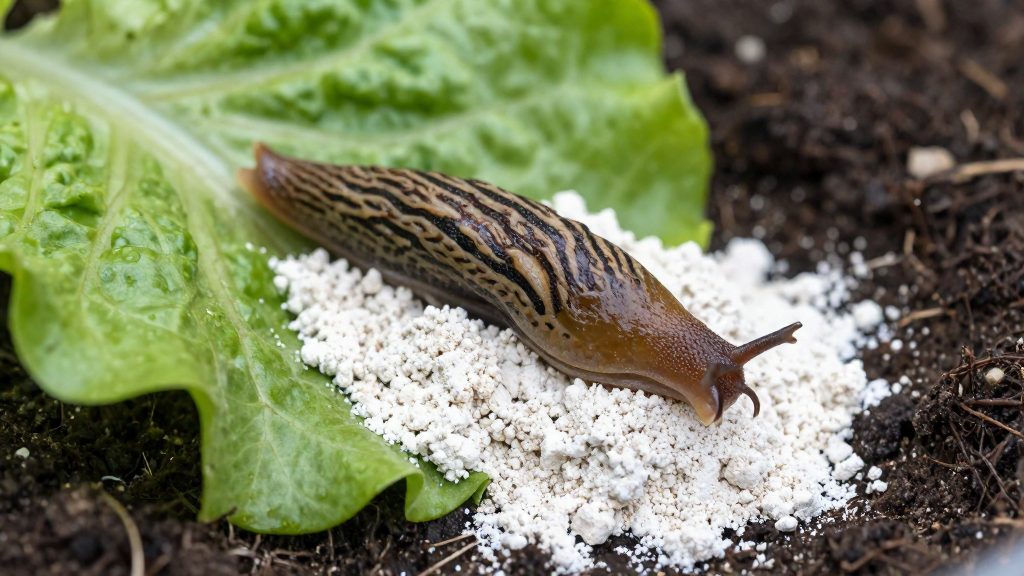
Diatomaceous earth dusting
Diatomaceous earth is applied as a dust on brassica foliage. The official sources consulted do not describe its effect on caterpillars, how long it stays active on leaves, or how often it should be reapplied. Base any reapplication on what you observe on the plants, not on a fixed schedule.
Do non-Bt organic alternatives reliably reduce caterpillar populations?
The evidence in the official sources consulted supports only a few practical measures:
| Method | What the sources support |
|---|---|
| Checking leaf undersides | Helps locate eggs and larvae |
| Neem oil, insecticidal soap, diatomaceous earth | No measured efficacy in the official sources consulted |
Handpicking is therefore the option the Old Farmer’s Almanac (2026) describes as most effective for small gardens. The other sprays and dusts may help, but they should not be relied on alone to reduce a population.
Frequently asked questions
How can I tell whether cabbage worms are on my brassicas?
Check the undersides of the leaves for eggs and larvae, and look for frass (droppings) on the leaves and on the soil below the plant. The Old Farmer’s Almanac (2026) names these as the main signs to check. Frass is only one clue, though, so keep inspecting even when you find none.
Is Bt safe for the other insects in my garden?
Ask Extension (2020) quotes an extension expert who describes Dipel, a Bacillus thuringiensis (Bt) product, as an organic, non-toxic way to control caterpillars. That is one expert’s view, not a guarantee for every insect. Because Bt targets caterpillars, it may also affect caterpillars you want to keep, and the official sources consulted do not detail its effects on other insects, so apply it only to affected plants and follow the label.
Can I avoid spraying altogether?
Handpicking eggs and larvae is the option the Old Farmer’s Almanac (2026) describes as most effective for small gardens, so it may be enough on a small plot. A row cover can also stop adult butterflies from laying eggs on brassicas, which reduces the number of larvae to remove. For larger plantings, the sources consulted do not say how well these methods work alone.