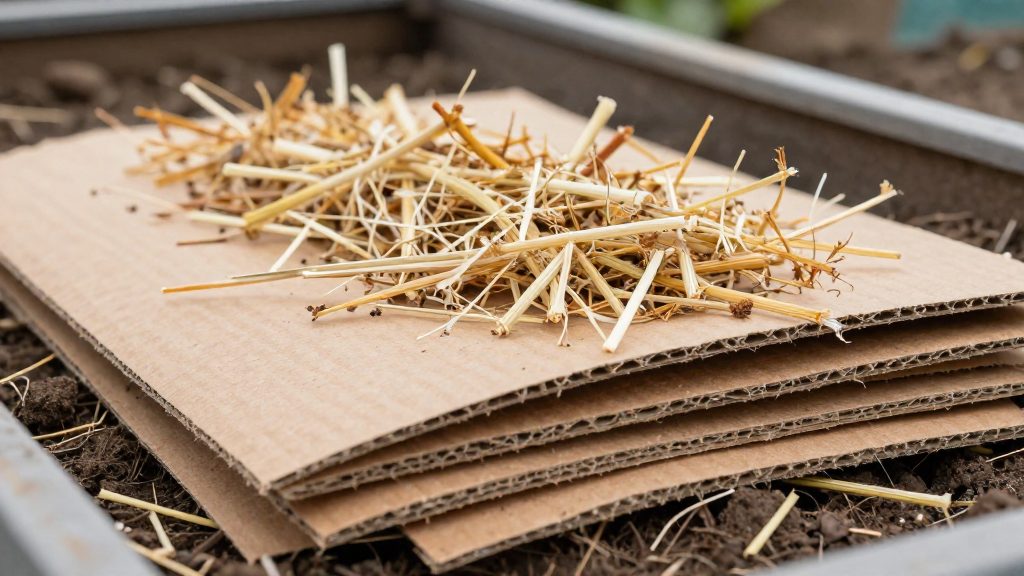
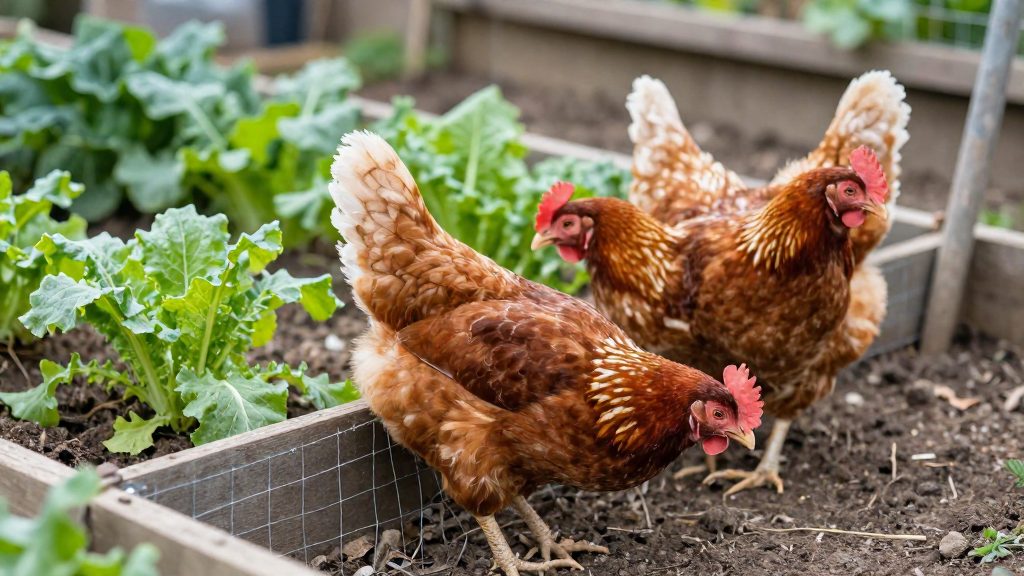
A chicken tractor is a portable coop-and-run unit that lets a small flock work a specific patch of ground without a permanent fence. In the homestead practice of Anna Hess and Mark Hamilton, three such units were used so that hens could scratch for bugs and fertilize the soil on fresh patches of lawn, according to Walden Effect (2009). In a permaculture garden, the chicken tractor works as a mobile tool that combines fertilizing, insect control and light soil disturbance.
What is a chicken tractor in a permaculture garden?
A portable coop-and-run unit is a movable shelter with an enclosed outdoor run attached. The hens live in and forage from the unit, and the unit itself is placed where the ground needs work. This reverses the usual setup: the flock comes to the bed instead of the bed being fenced off for the flock.
In permaculture use, the chicken tractor is valued for three functions:
| Role | What the hens do in the unit |
|---|---|
| Fertilizer | Deposit droppings directly onto the ground while foraging |
| Pest control | Eat insects and bugs they find by scratching the surface |
| Soil tiller | Scratch and loosen the top layer of soil while searching for food |
Hens eat some of the insects they find while scratching. The sources do not measure how much pest pressure they reduce, so treat this as a supplement to other organic pest management, not a replacement for it.
Three-unit homestead example
The homestead practice described by Anna Hess and Mark Hamilton, as recorded by Walden Effect (2009), used three chicken tractors together. Each unit was moved onto a fresh patch of lawn. Running several units on one property means the fertilizing and insect-eating work is spread across different areas rather than concentrated in one spot.
A grain-free variation
Geoff Lawton’s permaculture design, which Hobby Farms (2016) described as a “chicken tractor on steroids,” took the idea further by feeding the birds no grain. According to Hobby Farms (2016), the hens foraged on insects and kitchen scraps and received only grit. The same report states that this grain-free unit reportedly produced as many eggs as, or more than, a baseline tractor whose flock was fed grain, and that it could be built for as little as $100.
How does chicken tractor rotation work?
Rotation means moving the unit across the ground so the hens work one patch at a time. Moving the unit spreads manure and insect control across the lawn without the birds staying in one spot long enough to strip it bare.
Paddock layout and unit shifting
The method works as a sequence of paddocks, each one a defined patch of ground that a unit occupies for a period and then leaves.
- Mark out a row of paddocks along the area you want to work, so each unit has a clear next position.
- Place the unit on a patch with enough cover for the hens to forage, and keep the run closed to the rest of the garden.
- When the hens have worked the patch, lift or roll the unit to the next paddock. The ground they left behind is fertilized and loosened, and the vegetation has time to recover before the next visit.
- Keep the number of units matched to the size of the area. The homestead example used three units, each moved to a fresh patch of lawn every morning.
Grain-free foraging and grit
Foraging is the core of the system. According to Hobby Farms (2016), Geoff Lawton’s permaculture “chicken tractor on steroids” fed the birds on insects and kitchen scraps and gave them no grain, only grit. In a separate compost-pile variant, the same source reports that hens spent up to four days turning a given pile, producing fluffy compost for garden soil.
Grit is the only supplement named in these sources. It is generally used to help birds digest what they eat, so offer it alongside their foraging. The sources do not give quantities or a grit-to-feed ratio, so start with a standard poultry grit product and observe the flock.
Egg output compared with a grain-fed baseline
Hobby Farms (2016) reports that Lawton’s grain-free tractor produced as many eggs as, or more than, a baseline tractor whose flock was fed grain. The same source reports that the setup was built for as little as $100. The table below summarizes the three setups described in the sources.
| Source | Setup | Reported result |
|---|---|---|
| Walden Effect (2009) | Three chicken tractors moved to fresh lawn | Lawn patches worked in turn |
| Hobby Farms (2016) | Grain-free tractor on a compost pile, kitchen scraps and insects | Up to four days per pile, fluffy compost |
| Hobby Farms (2016) | Grain-free tractor compared with a grain-fed baseline | Egg output as high as or higher than baseline |
How often should you move the tractor?
In the homestead model described by Anna Hess and Mark Hamilton (Walden Effect, 2009), the daily move is the baseline. Each morning the coop-and-run unit goes onto a fresh patch of lawn, so the hens start the day on uncropped grass. That source describes three tractors, each moved to a fresh patch of lawn every morning.
Signs a patch needs rest
Move the unit right away, even before the next scheduled move, if you notice:
- Grass cropped to soil level, with no regrowth at the edges
- Bare, scratched-out areas or dust rising under the run
- Droppings concentrated in one spot, which can overload the ground
- Soil that feels hard and packed when pressed with a boot, or muddy footing
Do not return the unit to a patch until the grass has visibly recovered. Judge recovery by eye and by footing, since the official sources consulted do not specify a fixed recovery period.
Adjusting for weather and flock size
- Wet weather: Hens churn soft ground quickly. Move the unit onto drier ground sooner, and avoid parking it over saturated soil for extra days.
- Flock size: A larger flock strips cover faster, so it needs shorter stays. A smaller flock can stay longer on the same patch before the grass is depleted.
- Dry spells: Growth slows, so a patch recovers more slowly. Plan for longer rests between visits.
A different clock: compost rotation
Geoff Lawton’s permaculture variant, reported by Hobby Farms (2016), follows another schedule. Hens stay on a compost pile for up to four days, turning it while they forage on insects and kitchen scraps. Timing is set by the pile’s condition rather than by grass growth.
| Setting | Time on one spot | Source |
|---|---|---|
| Lawn (Hess & Hamilton) | One morning, then moved | Walden Effect (2009) |
| Compost pile (Lawton) | Up to four days | Hobby Farms (2016) |
Which beds and crops fit the rotation?
Chicken tractor rotation works on ground that is not carrying plants you plan to harvest. According to Walden Effect (2009), Anna Hess and Mark Hamilton’s homestead practice moves portable coop-and-run units onto fresh patches of lawn. Garden beds follow the same logic. The tractor suits ground that is resting, not beds holding crops you intend to eat.
Bed types suited to hen grazing
| Bed or zone | Suitability | Reason |
|---|---|---|
| Lawn zones | Good | Grass with no standing crop to disturb |
| Fallow beds with no standing crop | Good | Nothing harvestable is exposed to the hens |
| Beds with seedlings or established vegetables | Poor | Scratching disturbs the soil around the plants |
Choose beds that are bare or grassed, and keep standing crops outside the tractor’s path until they are harvested or removed.
Crop families to sow after a tractor pass
The sources consulted do not specify which crop families perform best after a tractor pass, so this section does not rank them. Practical steps for the sowing stage:
- Rake the surface to a level, loose seedbed once the tractor has moved on.
- Check the soil for scratched-up debris and remove it.
- Sow according to your region’s sowing calendar and the season, not according to the tractor’s position.
- Observe how the bed responds over the first weeks before deciding what to plant next.
Timing rules for rotation into vegetable beds
The sources consulted do not give a waiting period between a tractor pass and sowing. Base the timing on the state of the bed rather than on a fixed interval:
- The hens’ scratching should be finished and the soil loose.
- The bed should have no young plants that the hens can reach.
- Sowing dates depend on your region and climate, so check local calendars.
Can chickens turn compost and build soil?
Chickens can turn compost, and the sources describe a practice where hens work a single pile for a set period before the material goes onto the beds. In Geoff Lawton’s permaculture “chicken tractor on steroids,” the hens spend up to four days on a given compost pile, and the result is fluffy compost for garden soil, according to Hobby Farms (2016-08-23). The method is a form of animal-assisted composting: the birds do the physical turning while you supply the organic material.
How the practice works
The hens are moved onto the pile, not the other way round. Their behaviour does the work:
- Scratching breaks up and spreads the material, which is the physical action that turns the pile.
- Foraging on insects and kitchen scraps keeps them busy in the heap rather than on the lawn.
- Grit only, no grain. Lawton’s version feeds the birds insects, kitchen scraps and grit, so the pile is not enriched with spilled grain.
The Walden Effect (Anna Hess and Mark Hamilton, 2009-05-05) uses a related approach on a lawn, with portable chicken tractors. This is a grazing and fertilising method rather than a composting one, but it shows the same principle of rotating birds to avoid overworking one area.
Expected results
| Element | What the sources report |
|---|---|
| Time per pile | Up to four days (Hobby Farms, 2016-08-23) |
| Diet | Insects and kitchen scraps, grit, no grain |
| Texture | Fluffy compost suitable for garden soil |
The sources consulted describe the texture outcome but do not measure aeration or report how much the pile is reduced in volume.
Carbon and nitrogen balance
The official sources consulted do not give a carbon-to-nitrogen ratio for hen-worked compost, so no figure is stated here. In practice, keep the pile built from a mix of dry, carbon-rich material (such as dry leaves or straw) and moist, nitrogen-rich kitchen scraps, so the hens are working with a balanced heap rather than a soggy or purely green one. Check the pile by feel and adjust the mix if it smells sour or stays wet.

Is chicken manure safe for vegetables?
Chicken manure can feed vegetable beds, but fresh droppings raise two separate concerns: pathogen risk for anyone eating what grows, and a high nitrogen load that can scorch young plants. The available sources describe hens fertilizing ground directly in chicken tractor systems and foraging through compost, but they do not give pathogen risk figures, waiting intervals, or dosage limits. The guidance below is general and should be checked against your local agricultural extension service before manure goes on crops you eat raw.
Why fresh droppings carry risk
Fresh droppings can carry bacteria such as Salmonella and E. coli. Fresh droppings can carry bacteria such as Salmonella and E. coli. USDA National Organic Program rules (7 CFR 205.203) require raw manure to be applied at least 120 days before harvest for crops whose edible part touches the soil, and at least 90 days before harvest for crops whose edible part does not touch the soil. Home gardeners are not certified, but these intervals are a sensible minimum. Confirm local advice with your extension service before using raw manure on food crops. The risk comes from contact between the material and edible parts, so the main safeguard is separation in time and space: keep fresh manure away from crops you will harvest soon, and let it break down before it reaches the root zone.
Nitrogen is the second issue. Fresh manure releases nitrogen quickly, which encourages leafy growth but can burn seedlings and roots when it sits in direct contact with them.
Safe application practices
- Spread fresh droppings on paths, fallow ground, or lawn patches where hens already graze, rather than on active beds.
- Work material into the top layer of soil well before planting, so it has time to decompose.
- Use aged manure as the default for vegetable beds, and add it in thin layers rather than heavy piles.
- Keep manure off stems and foliage, and water it in lightly so it does not sit on leaves.
- Wash all produce from manured beds thoroughly before eating it.
Options by material type
| Material | Suitable use | Keep away from |
|---|---|---|
| Fresh droppings from a chicken tractor | Lawn or fallow patches where hens are moved | Leafy greens and root crops close to harvest |
| Hen manure built into a compost pile | Mixed into finished compost before use on beds | Direct contact with seedlings |
| Aged, well-rotted manure | Worked into beds before planting | Crops harvested within a short window after application |
Waiting periods and dosage
The sources for this section do not give application rates per square foot, so check them with your extension service. For waiting periods, the USDA National Organic Program sets 120 days between applying raw manure and harvest for crops whose edible part touches the soil, and 90 days for crops whose edible part does not. Use these as a minimum, and do not put fresh droppings on beds where you will harvest sooner.
Build a simple tractor on a budget
According to Hobby Farms (2016), Geoff Lawton’s team reportedly built a chicken tractor for as little as $100. The official sources consulted do not specify a full bill of materials, so the cost depends on whether you reuse salvaged parts or buy new hardware. The build below uses general principles: a light, rigid frame, wheels that let one person move the unit, and a predator-proof enclosure.
Materials and selection
| Component | Low-cost option | Selection notes |
|---|---|---|
| Frame | Reclaimed timber or light steel pipe | Must stay rigid when dragged across uneven lawn |
| Wheels | Salvaged cart or bicycle wheels | Fit them at one end so the other end can be lifted and pulled |
| Wire mesh | Hardware cloth or welded wire | Choose small openings to keep out rodents and small predators |
| Roof | Corrugated sheet or waterproof tarp | Covers the coop and part of the run |
Avoid thin poultry netting on its own. It tears easily and does little against digging or climbing predators. Mesh with a tighter weave is the safer choice for the enclosure.
Build sequence
- Build the base frame. Assemble a rectangular frame with cross-bracing at each corner. Check that it stays square before adding anything else.
- Mount the wheels. Attach the wheels to the frame at one end, with an axle or bracket that carries the load without flexing.
- Build the coop box. Enclose one end of the frame with solid walls and a roof. Add a perch and a nest box inside, sized for the number of hens.
- Wrap the run. Stretch mesh over the open section of the frame and fix it with staples or clips, leaving no gaps at the seams.
- Secure the lower edge. Bury the bottom of the mesh or fold it outward along the ground, so digging predators cannot slip underneath.
- Test the unit. Pull the tractor across the lawn, check for loose joints, and confirm that the hens cannot push through or lift any panel.
Common mistakes to avoid
Most problems with a chicken tractor come from the birds’ environment and from what is put in front of them. The sources consulted describe hens foraging on insects and kitchen scraps, and in Lawton’s grain-free system they receive grit rather than grain (Hobby Farms, 2016). Feed choices and placement therefore matter as much as the setup itself.
Heat stress, water and shade failures in summer
Heat stress is the most common summer risk for birds kept in a closed unit. Preventive steps:
- Position the unit so part of the run stays shaded through the day as the sun moves.
- Keep the waterer full and check it more than once a day during hot spells.
- Make sure the coop has ventilation so air can circulate inside.
- Avoid leaving the unit on bare, sun-exposed ground with no cover.
The official sources consulted do not specify temperature thresholds. Watch the birds instead. Hens holding their wings away from their bodies, or crowding into the shadiest corner, are signs to add shade and water immediately.
Toxic kitchen scraps and unsafe feed items
Kitchen scraps are part of the foraging diet described for these birds, but not every kitchen item is suitable. Common errors include:
- Feeding toxic scraps, such as spoiled, mouldy or fermented food.
- Offering salty, heavily seasoned or cooked leftovers.
- Letting hens eat unidentified plant material from the garden or hedges.
- Adding grain by default, when the grain-free model described by Hobby Farms (2016) relies on insects, scraps and grit.
Keep grit available alongside scraps and insects. Remove uneaten food daily so it does not spoil in the run.
Trampled seedlings and damaged young plant stems
The unit moves over fresh ground, so trampled seedlings are a real risk. Avoid:
- Setting the unit over beds where seedlings have just emerged.
- Letting hens work around the bases of newly planted stems.
- Leaving the run in place long enough for scratching to bury or crush young growth.
Protect small plants with a physical barrier, such as a guard or cloche, until their stems are established. Check the area under and around the unit before each move so no seedling is left under the wire or in the path of the scratching birds.
Frequently asked questions
How many chicken tractors do I need for my garden?
The homestead practice described by Anna Hess and Mark Hamilton, as recorded by Walden Effect (2009), used three units, each moved to a fresh patch every morning. The official sources consulted do not specify a unit count for a given garden size, so start with one unit and add more only if you can move them daily.
Can I use fresh chicken tractor droppings on vegetable beds?
Fresh droppings can carry raw manure pathogens such as Salmonella and E. coli. The USDA National Organic Program (7 CFR 205.203) sets minimum intervals of 120 days before harvest when the edible part touches the soil and 90 days when it does not, and these are a sensible minimum for home gardeners too. Keep fresh droppings off beds you plan to harvest sooner.
Can the hens also make compost?
Yes, but this is a separate variant from lawn rotation. In Geoff Lawton’s grain-free design, which Hobby Farms (2016) described, hens spent up to four days turning a compost pile, and the result was fluffy compost for garden soil.