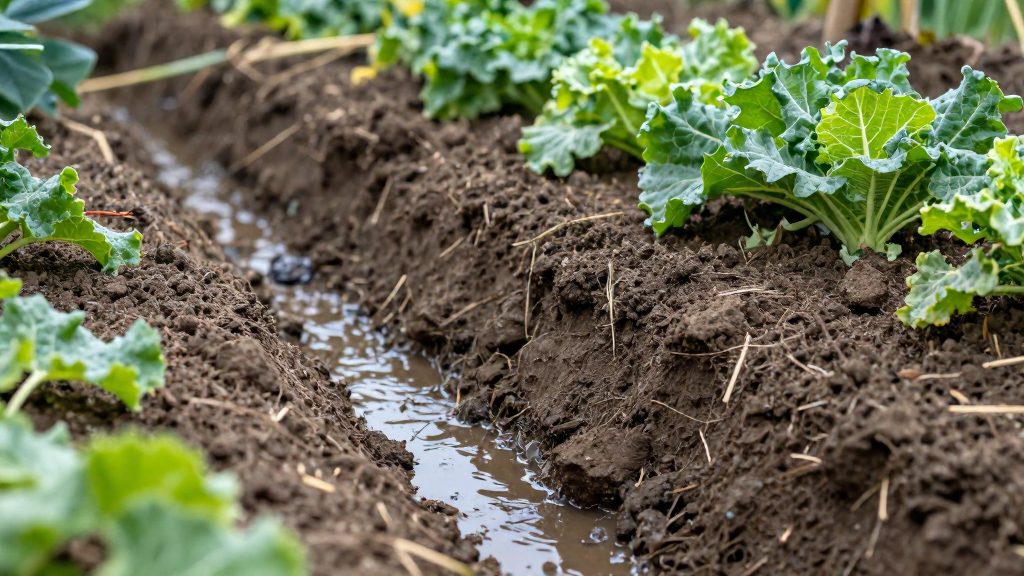
Keyline design is a whole-farm water management method developed by P.A. Yeomans in Australia. It uses the land’s natural contours to catch rainwater on higher ground and spread it over drier areas. According to California Agricultural Water Stewardship Initiative (2025), this reduces runoff and increases infiltration. For a small backyard plot, the core idea is to slow water down and distribute it across the land instead of letting it run off downhill.
What is keyline design?
Keyline design is a whole-farm water management approach. Its aim is to keep rainwater on the property longer, so it soaks into the soil rather than leaving the site as surface runoff. The method works with the shape of the ground: water is captured at high elevations and released gradually over the drier parts of the plot.
The approach is attributed to P.A. Yeomans, who developed it in Australia. According to Keyline.com.au, which presents the work of P.A. Yeomans, the planning follows a “Keyline Scale of Permanence”. This scale ranks elements from most to least permanent: climate, land shape, water, roads, trees, buildings, fencing and soil. Water control structures such as contour channels and farm dams come early in this order, so they guide where roads, tree bands, buildings and fences are placed later.
The method rests on three parts, summarised below according to California Agricultural Water Stewardship Initiative (2025):
| Component | Role in keyline design |
|---|---|
| Keylines | Contour-based cut lines that organise how water is spread across the slope |
| Yeomans plow | A subsoiler that loosens the soil without inverting it |
| Small ponds | Placed at key points to store water for gravity-fed irrigation later |
The main benefit is improved infiltration: water that is spread across the land has more time to enter the soil.
Does keyline design work on a small backyard farm?
Keyline design is often described in terms of large rural properties, but Redemption Permaculture says it also suits small hobby farms. The sources do not specifically address backyard-sized plots, so apply the principles with caution. According to Redemption Permaculture, the method applies to small hobby farms as well as large operations, so plot size alone does not rule it out. The approach was developed by P.A. Yeomans in Australia. It works by using the land’s natural contours to capture rainwater high on a slope and spread it over drier ground. On a backyard plot, the same logic applies at a smaller scale: the question is how water moves across the land and where it can be guided.
Plots without large ridges or valleys
Land without large ridges or valleys can still benefit, according to Redemption Permaculture. On a flat or gently sloping garden, the useful features are usually subtle: a slight change in grade, a low spot where water pools, or a point where a slope begins to level out.
The keypoint is the reference point for this work.
Planning priorities with the Keyline Scale of Permanence
According to Keyline.com.au (Ken B. Yeomans, from the work of P.A. Yeomans), keyline planning follows a Keyline Scale of Permanence, ordered from most to least permanent:
| Priority | Element | Planning role |
|---|---|---|
| 1 | Climate | Fixed conditions that set the framework |
| 2 | Land shape | Contours and slopes that determine water paths |
| 3 | Water | Channels and structures that control where water goes |
| 4 | Roads | Access routes placed after water control |
| 5 | Trees | Tree bands positioned relative to water control |
| 6 | Buildings | Structures placed after water and access are set |
| 7 | Fencing | Boundaries placed according to the layout above |
| 8 | Soil | Least permanent element, adapted to the structure already in place |
The source notes that water control structures, such as contour channels and farm dams, shape where roads, tree bands, buildings and fences are placed. On a backyard plot, this means fixing the water layout before deciding on paths, fruit trees or fencing, and adapting beds and soil work to that structure. Soil management comes last in the scale, so it adapts to the structure already in place.
Keypoints and keylines: how to find them
Keyline work starts with reading the shape of the land. According to Redemption Permaculture, the first step is to locate the keypoint, the place where a slope changes from convex to concave, roughly where a hill begins to level out. From that point you draw the keyline, a true level contour running in both directions across the slope.
Finding the keypoint
Walk the site after rain if you can, and note where water runs and where it pools. Then look for the change in slope:
- Upper slope (convex): the ground curves outward, and surface water moves downhill.
- Lower slope (concave): the ground curves inward and flattens, and water collects.
- Keypoint: the transition between these two curves.
Storage design is covered separately, so at this stage you only need to identify the point.
A modest garden slope is worth reading this way.
Drawing the keyline
- Mark the keypoint with a stake.
- Set a level and find points on the slope that sit at the same height as the keypoint.
- Place a stake at each of those points, moving in both directions across the slope.
- Join the stakes. The resulting line is the keyline, and every point on it is at the same elevation.
Marking contours accurately
A line that looks level by eye often is not. A water level, a laser level or an optical builder’s level transfers one reference height across the slope. Re-check the instrument after each move, and confirm that stakes in both directions read the same height.
How do you cultivate and shape beds along keylines?
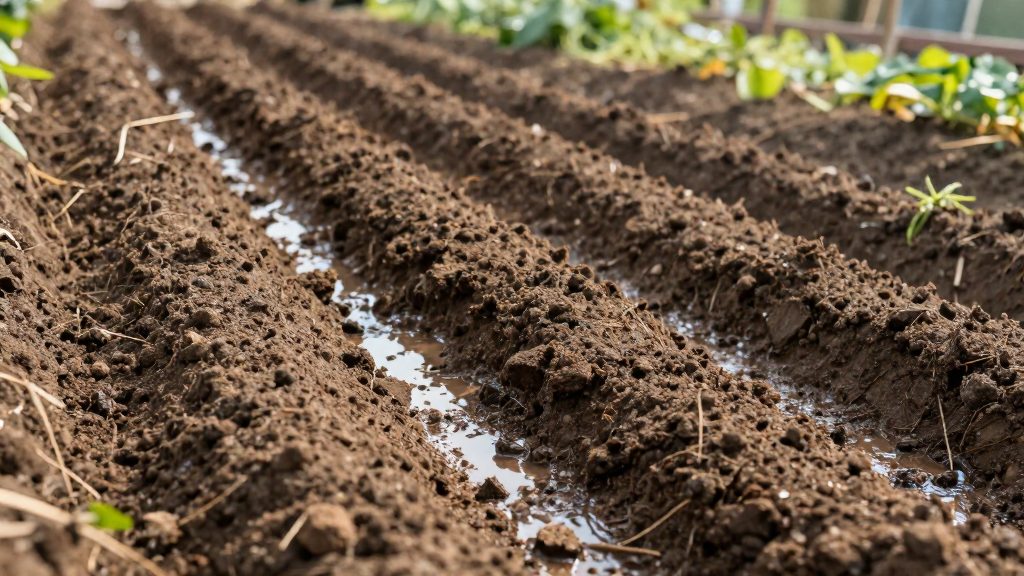
Keyline layout works with the land’s contours so that water spreads over the ground instead of collecting and leaving the field. For a small garden, the bed layout is where this principle becomes visible, because the rows you plant and the paths you walk determine whether water soaks in or runs downhill.
Aligning bed rows and planting lines with keylines
- Set bed rows parallel to the level contour lines, not straight up and down the slope. Keyline contours are true level lines, so a row that follows one holds water along its length rather than sending it downhill (Redemption Permaculture).
- Keep planting lines within the same bed and follow the contour. Each furrow then acts as a shallow level basin.
- Check every row with a level before planting. A row that drifts even slightly downhill will concentrate water at its lowest end.
Spacing beds across the slope
- Step successive beds across the slope, one contour band after another, rather than stacking them in a single downhill run.
- Leave undisturbed or mulched strips between bands. These strips slow surface flow and give water more time to enter the soil.
- Scale the spacing to your tools and walking width, not to a fixed figure. The official sources consulted do not specify a standard spacing for small plots.
Keeping paths and access lanes off runoff routes
- Place paths and access lanes on gentle ground or along the contour. The Keyline Scale of Permanence places water control before roads and soil last, so settle the water layout first, then position access routes, and fit beds around them (Keyline.com.au (Ken B. Yeomans, from the work of P.A. Yeomans)).
- Avoid paths that run downhill, since a worn track will channel water and soil.
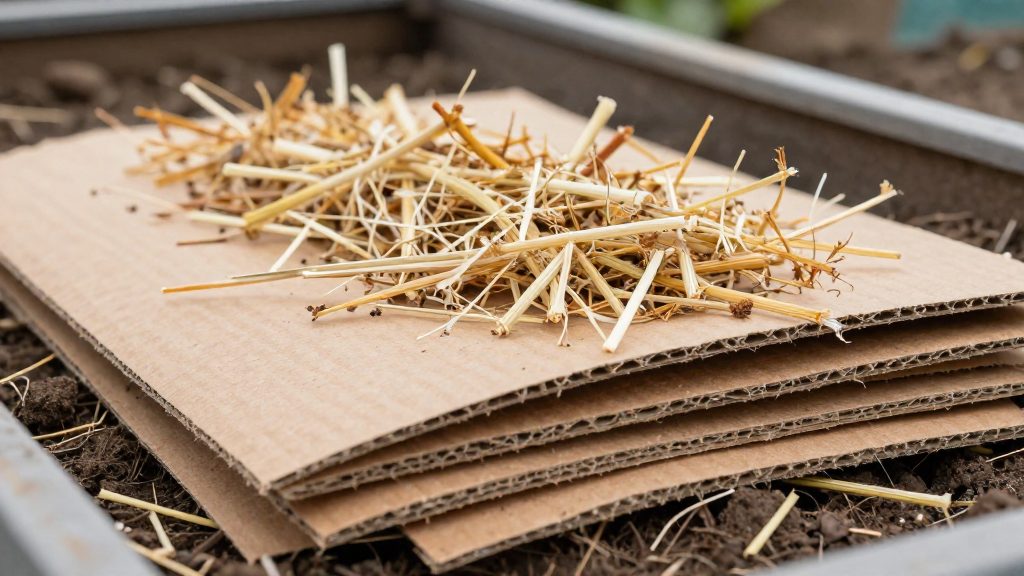
- Surface paths with natural materials such as wood chips or straw, which hold soil in place and avoid synthetic weed-control products.
Ponds at the keypoint and contour channels: how keyline design handles water storage
Keyline design manages water across the whole plot, and two of its structures handle most of the storage on a small farm: small ponds placed at key points, and contour swales that catch runoff along the land’s natural lines.
Ponds at key points
According to Redemption Permaculture, the keypoint is a common location for a dam, so a pond placed there stores water where the land already concentrates it.
- Site the pond at the keypoint so the stored water can reach beds lower down.
- Use the pond as a reservoir. Water held there is released later for gravity-fed irrigation, rather than used the moment it arrives.
Swales as contour channels
A swale is a shallow channel that follows a contour line, a path that stays at one level across the slope. Keyline planning treats contour channels as water control structures.
Because the channel runs level, water entering it spreads sideways instead of running straight downslope. That gives the water more time to soak into the soil, which is the infiltration effect described above. Swales work best when the rest of the layout is planned around them, so mark them before placing beds or paths.
Benefits and limits of keyline design
The intended outcomes of keyline design are reduced runoff and increased infiltration.
Documented advantages
- Runoff control: Water is intercepted high on the slope rather than left to flow downhill, which is the stated mechanism behind the reduced runoff.
- Better infiltration: Water spread across drier ground has more time to enter the soil, according to the same source.
- Whole-site planning: The approach treats water as the starting point for placing other features, so the layout is designed for the whole property rather than one bed at a time.
Unproven aspects and gaps
- Irrigation savings are not yet measured. No research has quantified how much keyline design reduces applied irrigation water, according to California Agricultural Water Stewardship Initiative (2025). Any claim of a specific percentage saving is not supported by the published sources.
- The method is new in California. The same source describes keyline design as not widely explored in that state, so local evidence on soils, rainfall patterns and crops is limited.
| Aspect | Status in published sources |
|---|---|
| Runoff reduction | Stated intended outcome |
| Increased infiltration | Stated intended outcome |
| Irrigation water reduction | Not yet quantified in research |
| Use in California | New and not widely explored |
How to evaluate it on your own plot
Treat keyline design as a hypothesis to test rather than a guaranteed result. Keep a simple seasonal record of rainfall, irrigation volumes, and where water pools or runs off after storms. Compare the same measurements across several seasons before and after any earthworks. Whatever layout you choose, avoid keeping beds waterlogged.
Do you need a Yeomans plow?
The Yeomans plow is not required on every small farm, but it is a practical option when you have a tractor and need to loosen compacted subsoil. According to Redemption Permaculture, the Yeomans plow is a subsoiler that loosens soil without inverting it, needs less horsepower than other subsoilers, and can be pulled by a smaller tractor.
What the Yeomans plow does
- Loosens subsoil without inverting it. Each soil layer stays in its original position, so the topsoil is not buried under lower layers.
- Breaks up compaction below the surface. A subsoiler works below the depth of a standard plow or cultivator.
- Forms one part of a three-part toolkit. The California Agricultural Water Stewardship Initiative (2025) describes keyline design as combining keylines, the Yeomans plow, and small ponds. The plow is only one component, and it is not a stand-alone solution.
Horsepower and tractor size
The main reason to consider this implement on a modest farm is its power requirement. Redemption Permaculture states that it needs less horsepower than other subsoilers, so a smaller tractor can pull it. Before buying or hiring one, compare the implement’s requirements with your tractor’s rated pulling capacity in the tractor manual. Do not pull an implement that exceeds your tractor’s rated capacity; follow the manufacturer’s guidance.
When it is worth considering
| Situation | Assessment |
|---|---|
| Small farm with a modest tractor and compacted subsoil | Well suited, because the implement needs less horsepower than other subsoilers |
| No tractor, or garden beds worked by hand | Not applicable; hand tools are a better fit |
Limits of the evidence
The case for the Yeomans plow should rest on soil structure and tractor compatibility, not on proven water savings.
Practical steps before deciding
- Check for compaction. Dig a test hole and look for roots stopping at a dense layer or water pooling after rain.
- Match the implement to your tractor. Confirm the pulling requirement against the manual before purchase or rental.
- Consider organic alternatives first. For shallow compaction, compost, mulch, and cover crops improve soil structure without machinery. These methods require no chemical inputs.
- Ask local advisors. Regional agricultural extension services can assess your soil and recommend suitable equipment for your climate.
Frequently asked questions
Does keyline design work on a small backyard plot?
According to Redemption Permaculture, the method suits small hobby farms and land without large ridges or valleys. The official sources consulted do not specify how it applies to plots at backyard scale, so test the principles on a small area before committing to earthworks.
How much water does keyline design actually save?
According to California Agricultural Water Stewardship Initiative (2025), no research has yet quantified how much keyline design reduces applied irrigation water. The method is also described as new and not widely explored in California, so any savings on a given plot remain unmeasured.
What is a keypoint, and why does it matter?
A keypoint is where a slope changes from convex to concave, roughly where a hill begins to level out. Water collects there, which makes it a common spot for a dam. According to Redemption Permaculture, keylines are true level contour lines drawn in both directions from the keypoint.