Why prune raspberry canes?
The biennial cane life cycle
Summer-bearing red raspberries fruit on second-year canes, called floricanes. First-year canes grow vegetatively and become the floricanes of the following season. Everbearing types fruit on first-year canes, called primocanes, in fall, and those canes can fruit again the next summer if left to overwinter. Once a floricane has fruited, it is spent and should be removed.
Leaving spent canes in place fills the planting with dead wood and takes up space that new canes need.
Airflow and light
Crowded canes shade one another and hold humidity around the foliage. The official sources consulted do not quantify how much pruning improves airflow or light penetration for a given planting. In practice, a limited number of canes per row lets air move between them and light reach the lower and inner growth.
Fruit quality
Fruit on well-lit, well-ventilated canes is generally easier to keep dry and easier to see and pick. The official sources consulted do not specify a measurable effect on berry size or sweetness, so treat this as a general horticultural principle rather than a measured result.
Keeping productive canes for consistent harvests
Each system needs a different approach to keep yields steady:
| Raspberry type | Pruning approach (Iowa State University Extension and Outreach, 2026) |
|---|---|
| Summer-bearing red | Keep the most vigorous canes. If there is little dieback, remove the top quarter of each cane so canes don’t bend under the crop. |
Removing weak canes each year, instead of letting the planting grow unchecked, directs the plant’s energy toward the canes that will bear the next crop. Cutting back tips that bend under the crop helps the remaining canes stay upright.
Summer-bearing or fall-bearing: which do you have?
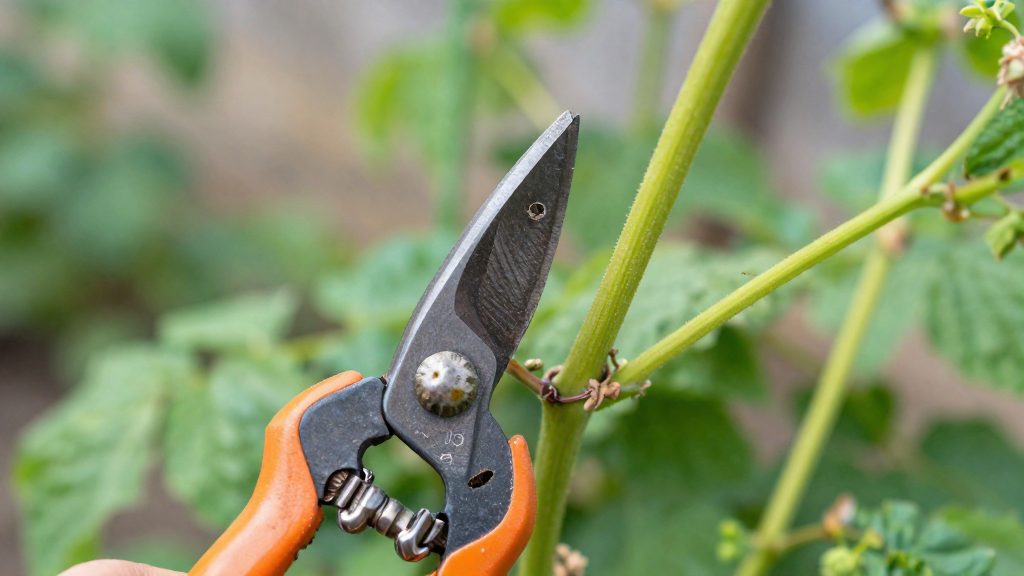
Cane age determines when a raspberry plant fruits. Identifying your plant’s bearing habit tells you whether you can expect one harvest or two each year. Checking the cane age and the fruiting timing is the most reliable way to tell the two apart.
Floricanes versus primocanes
| Cane type | Age when fruiting | Bearing habit |
|---|---|---|
| Floricane | Second year | Summer-bearing varieties |
| Primocane | First year | Everbearing varieties |
A floricane is a cane in its second growing season, the one that carries the summer crop. A primocane is a cane in its first season, which produces fruit on the new growth of everbearing varieties. Cane age can be read from the plant itself: canes that grew this year are first-year canes, and those that grew the previous year and are now fruiting are second-year canes (Iowa State University Extension and Outreach, 2026).
Checking whether canes fruit once or twice yearly
- One summer crop: the plant fruits only on second-year canes, which is typical of summer-bearing types.
- Summer and fall crops: everbearing types fruit on first-year canes (primocanes) in fall. When those canes are left to overwinter, they fruit again the next summer as second-year canes (floricanes). This is the two-crop pattern.
Reading nursery labels and catalogue descriptions
Look for the terms “summer-bearing,” “fall-bearing,” or “everbearing” in the variety name or description. These terms indicate the expected fruiting pattern. The official sources consulted do not specify how every nursery words its labels, so if the bearing habit is not stated, ask the supplier or observe the plant through one full season. Knowing the habit before purchase helps you plan the harvest period on your organic plot.
When should you prune raspberries?
Timing depends on the raspberry type. For summer-bearing red raspberries, Iowa State University Extension and Outreach (2026) gives the window as March or early April. The spring cut is made on a plant whose fruiting canes are already known from the previous season.
Summer-bearing red raspberries: March or early April
- Prune in March or early April.
- The official sources consulted do not specify a different spring window for this type.
Fall-bearing raspberries grown for one crop
When fall-bearing raspberries are grown for a single crop, all canes are cut to ground level in spring, according to Iowa State University Extension and Outreach (2026). This gives no summer crop.
Black and purple raspberries
According to Iowa State University Extension and Outreach (2026), black and purple types are pruned in spring, when you keep only the 4 or 5 largest canes per clump. Lateral branches are then cut to 12 inches on black raspberries and 18 inches on purple raspberries. The full clump-by-clump procedure is set out in the Black and purple raspberries section below.
| Raspberry type | Pruning timing |
|---|---|
| Summer-bearing red | March or early April (Iowa State University Extension and Outreach, 2026) |
| Fall-bearing, one crop | Spring: cut all canes to ground level (Iowa State University Extension and Outreach, 2026) |
| Fall-bearing, two crops | After the first frost in fall: remove the canes that fruited that summer (Iowa State University Extension and Outreach, 2026) |
| Black and purple | Spring (Iowa State University Extension and Outreach, 2026) |
Adjusting timing to your climate
Iowa State University Extension and Outreach (2026) gives March or early April and does not give dates for other regions. The official sources consulted do not specify equivalent dates for other regions. In a colder or milder climate, anchor the cut to local conditions: start the spring pruning once the winter damage is visible and before new growth starts, and check the local frost history for your area.
Timing relative to bud break and dormancy
The official sources consulted do not specify exact bud break dates. Before cutting, assess the canes for winter injury.
How do you prune summer-bearing raspberries?
Pruning summer-bearing red raspberries is a short sequence of cuts, made at ground level or back to sound wood, that sorts the canes by health and vigor. The work is to identify the canes that fruited, remove those that are dead, weak, diseased or damaged, and keep the most vigorous healthy canes.
Step 1: Identify the floricanes
Floricanes are the second-year canes that carried fruit. Their bark is typically peeling and gray, and when a cane is dead, the tissue inside is dry and brown (according to Epic Gardening). Separate these canes from the first-year canes before making any cut, so you do not mistake living wood for dead wood.
Step 2: Remove weak, diseased and damaged canes
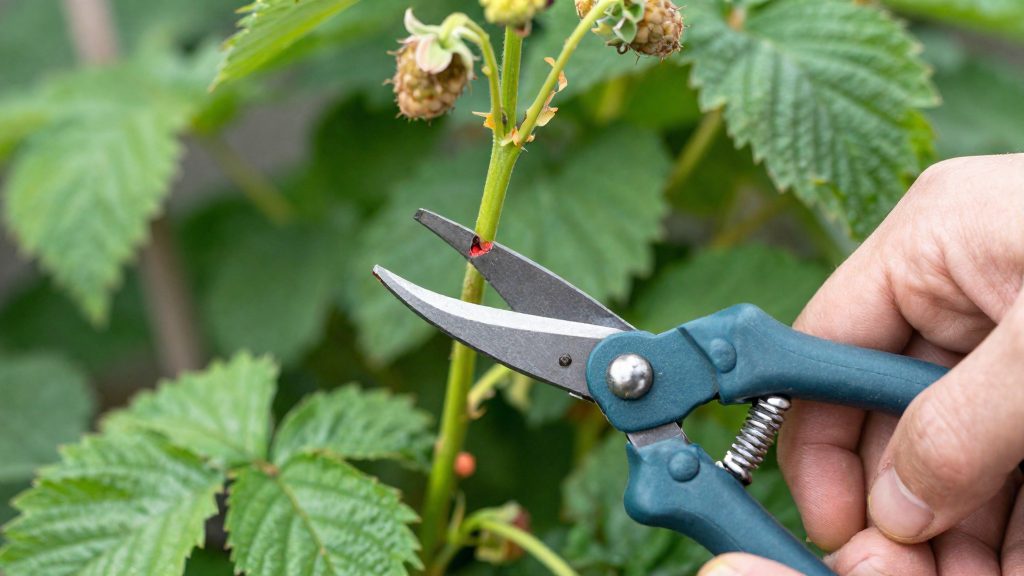
Cut out every weak, diseased or damaged cane at ground level, not just at the top. Removing the whole cane at the base is what eliminates the problem wood (according to Iowa State University Extension and Outreach, 2026).
Step 3: Select the most vigorous canes
Keep the most vigorous canes. In the Iowa State University guidance (2026), a suitable cane is about 1/4 inch in diameter, measured 30 inches above the ground, with retained canes spaced about 6 inches apart. Check each candidate for stem health while you measure: a cane with peeling gray bark and dry, brown tissue inside is dead and should be removed.
| Cane condition | How to recognise it | Action |
|---|---|---|
| Vigorous and healthy | About 1/4 inch in diameter, measured 30 inches above the ground | Keep |
| Dead | Peeling gray bark, dry brown tissue inside | Remove at ground level |
| Weak, diseased or damaged | Shows weakness, disease or damage | Remove at ground level |
| Winter-killed | Dieback at the cane tip | Cut back to live tissue |
Step 4: Cut winter-damaged canes back to sound wood
Cut each winter-killed cane tip back to live tissue, stopping where the wood is healthy. The official sources consulted do not specify a fixed cutting length, so the cut depends on how far the dieback extends.
How do you prune fall-bearing raspberries?
Fall-bearing raspberries can be managed in two ways, and the choice changes when you harvest and how much you get. In the one-crop system, every cane is cut to ground level in spring, so the plant gives no summer crop and fruits only in fall. In the two-crop system, the first-year canes bear a fall crop and are left to overwinter to fruit again the next summer. After the first frost in fall, the canes that fruited that summer are removed at ground level. According to Iowa State University Extension and Outreach (2026), the one-crop fall crop ripens 1 to 2 weeks earlier than the two-crop system’s, and total yield is typically higher.
| Feature | One-crop system | Two-crop system |
|---|---|---|
| Spring action | Cut all canes to ground level | Leave first-year canes in place |
| Fruited canes | Removed in spring with all other canes | Removed at ground level after the first frost in fall |
| Summer crop | None | Present |
| Fall crop timing | Ripens 1 to 2 weeks earlier than the two-crop system | Ripens later than the one-crop system |
| Total yield | Typically higher | Typically lower |
One-crop method
- Wait until spring, then cut every cane at ground level with clean pruners.
- Expect no summer harvest. The plant’s energy goes into a single fall crop on the new growth.
Two-crop method
- After the first frost in fall, identify the canes that fruited that summer.
- Cut those canes at ground level.
- Leave the first-year canes standing through winter.
For a gardener who wants an earlier fall harvest and the highest total yield, the one-crop system is the option the Iowa State guidance describes. For a gardener who wants a summer harvest as well as a fall one, the two-crop system keeps the first-year canes for the fall crop.
Black and purple raspberries
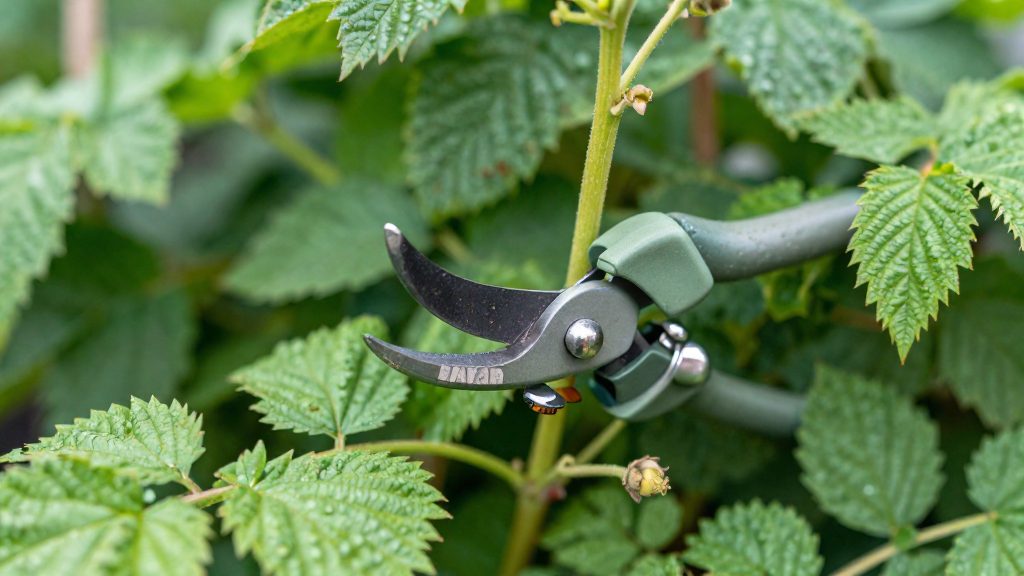
Black and purple raspberries are pruned by clump, not by the row-based method used for summer-bearing red raspberries. Instead of managing the whole row as one unit, you assess each clump separately and keep only its strongest canes. According to Iowa State University Extension and Outreach (2026), you keep the 4 or 5 largest canes per clump in spring and remove the rest.
Work through each clump in this order:
- Identify the berry type first. Black and purple types need different lateral lengths, so confirm which one you are pruning before you cut.
- Rank the canes by size. Compare the canes within each clump and mark the thickest, most vigorous ones.
- Keep the 4 or 5 largest canes. Remove the remaining canes so that each clump holds only its strongest stems.
- Shorten the lateral branches on the canes you kept, using the length for your berry type.
| Berry type | Canes kept per clump | Lateral branches cut to |
|---|---|---|
| Black raspberry | 4 or 5 largest | 12 inches |
| Purple raspberry | 4 or 5 largest | 18 inches |
Clump-based selection keeps the pruning focused on the plant’s own structure. Each clump is judged on its canes, so a weak clump is thinned without changing how the strong clumps are handled. Lateral branches are the side shoots growing from the kept canes, and cutting them to the stated length is the second step of the job.
Thinning and training the row
Once the replacement canes are chosen, the row is kept within a fixed structure. Iowa State University Extension and Outreach (2026) gives three measurable targets for summer-bearing red raspberries: a cane diameter of about 1/4 inch measured 30 inches above the ground, spacing of about 6 inches between retained canes, and a hedgerow 1 to 2 feet wide. These targets keep the canes evenly distributed, which allows air to move through the planting and makes the crop easier to pick and inspect.
Cane diameter target
Measure each cane at a height of 30 inches above the soil, not at the base. Measuring at the same height on every cane lets you compare them fairly. Canes that are clearly thinner than the target at that point are weaker and should not be kept as fruiting canes.
Spacing between retained canes
Leave about 6 inches between each retained cane along the row. Canes packed closer than this crowd one another, which slows drying after rain and reduces airflow. Thin the canes at ground level to create the gaps, then check the spacing along the full length of the row before tying the canes to the support wires.
Hedgerow width
Confine the planting to a strip 1 to 2 feet wide. Keeping the row narrow makes every cane within reach for picking, tying and inspection. Remove any shoot growing outside this strip, so the row does not spread into paths or neighboring beds.
| Parameter | Target | Where it is measured or applied |
|---|---|---|
| Cane diameter | About 1/4 inch | 30 inches above ground |
| Spacing between retained canes | About 6 inches | Along the row |
| Hedgerow width | 1 to 2 feet | Across the row |
| Shoots outside the hedgerow | Remove | Outside the 1 to 2 foot strip |
Cleanup and disease prevention
Removing and destroying pruned raspberry canes is the main non-chemical measure described for limiting anthracnose and spur blight in raspberry beds. According to Iowa State University Extension and Outreach (2026), destroying the pruned material helps control both diseases. The official sources consulted do not specify a disposal method beyond destroying the material, so the practical goal is to take every removed cane out of the planting rather than leave it lying in the row.
What to remove and destroy
The material to clear from the bed depends on the type of raspberry and the stage of the season:
| Material | Action |
|---|---|
| Weak, diseased or damaged canes | Destroy |
| Summer-bearing canes that fruited that summer (floricanes) | Destroy |
| Shoots growing outside the planting hedgerow | Destroy |
Knowing which canes fruited is what allows you to separate spent material from canes to keep.
Keeping spur blight in check
Spur blight is managed mainly by sanitation. Removing dead and spent canes eliminates the plant material that carries the problem from one season to the next. Keeping the row to a defined width also limits the spread of stray shoots:
- Keep the planting in a hedgerow 1 to 2 feet wide.
- Destroy any shoots that grow outside that width.
- Clear debris from around the base of the plants so that no removed material is left on the soil.
Organic alternatives to chemical fungicide sprays
Cultural control is the organic approach supported by the sources consulted. Removing diseased canes, destroying pruned material, and keeping the hedgerow narrow all reduce the pathogen load without chemical sprays. The official sources consulted do not name specific organic fungicide products, rates or application intervals for raspberry anthracnose or spur blight, so no product or dosage is recommended here. Check with your regional extension service before using any spray, and confirm with your local extension office that any product you choose is approved for organic production in the United States.
Frequently asked questions
How can I tell a spent cane from a productive one?
A spent floricane has peeling gray bark and dry, brown tissue inside, according to Epic Gardening. Check a sample cane before you decide what to remove.
When should I prune summer-bearing red raspberries?
Iowa State University Extension and Outreach (2026) gives March or early April as the pruning window. The official sources consulted do not give equivalent dates for other climates, so adjust the timing to your local conditions.
Can fall-bearing raspberries give a crop without a summer harvest?
Yes. In the one-crop system, you cut all canes to ground level in spring, which gives no summer crop. According to Iowa State University Extension and Outreach (2026), the fall crop ripens 1 to 2 weeks earlier than in the two-crop system, and total yield is typically higher.