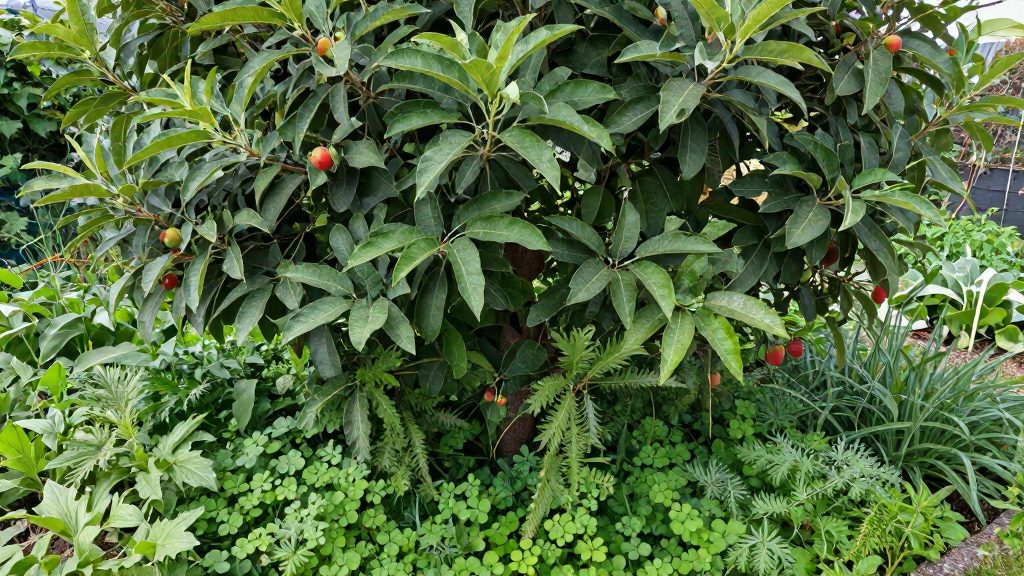
A fruit tree guild is a permaculture planting built around one focal tree, such as a cherry, and surrounded by species that support the tree and each other. The goal is to treat the tree as the centre of a small, layered community whose plants share the work of feeding, protecting and attracting beneficial life to the orchard.
What is a fruit tree guild?
The focal tree is the anchor of the guild. Every other plant is chosen and placed in relation to it. The tree sets the size of the planting area, its canopy determines which companion plants receive full sun and which are shaded, and its root zone is where any competition for water and nutrients will occur.
Mimicking natural plant communities
In a woodland or along a forest edge, plants rarely grow as isolated single-species stands. They overlap in height and root depth, cycle nutrients through fallen leaves and root activity, and host insects and birds. A fruit tree guild copies this organisation at orchard scale. Gardener’s Path describes the guild as a mix of species that support the tree and each other, reflecting the interconnected communities found in nature.
Pip Magazine (Australia) describes several intended effects of this design. Planting a mix of plants under the tree is said to reduce root competition. Guilds are also said to add nutrients, attract pollinators, stabilise temperatures and help control pests and diseases. These are presented as the aims of the approach. How consistently they occur in a given garden depends on local conditions.
Guild planting versus monoculture
A monoculture places one crop across a bed or block, usually at uniform spacing, with plants of similar height, root depth and flowering time. Its plants tend to draw on the same soil layers and attract the same pests, so a single problem can spread across the whole planting.
A guild does the opposite. It groups several species with different growth habits and root depths around one tree, so that the plants occupy different layers and niches. The planting is then managed as a single community rather than as a row of identical plants.
Practical considerations
- Position the guild where the focal tree receives sun, since shade from the canopy affects every companion plant.
- Plan the planting around the tree’s current and mature size, because the canopy determines the usable area.
- Water the root zone without waterlogging it, so that companion plants and the tree do not compete in saturated soil.
Which plants work in a guild, by role?
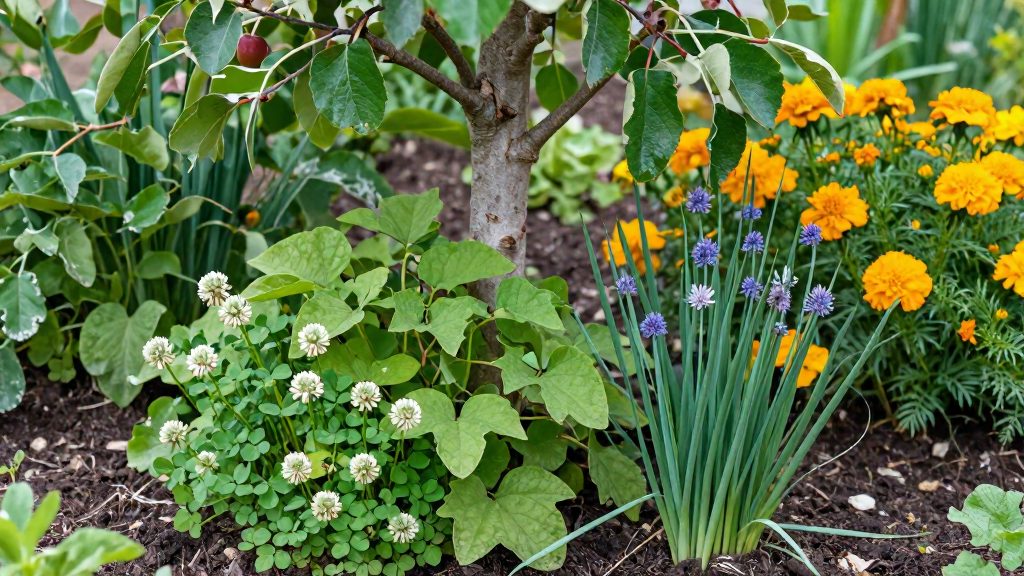
A tree guild groups companion plants by the job each one does for the focal tree and for the other plants around it. Guild plants fall into four functional roles: nitrogen fixers, nutrient accumulators, beneficial-insect attractors, and pest deterrents. The table below lists the species named for each role.
| Role | Species named | Source |
|---|---|---|
| Nitrogen fixer | White clover, fava beans, Siberian pea shrub | Gardener’s Path |
| Nutrient accumulator | Comfrey, yarrow, chicory | Gardener’s Path |
| Beneficial-insect attractor | Dill, fennel, chives | Gardener’s Path |
| Pest deterrent | Peppermint, lemon balm, nasturtium | Gardener’s Path |
| Pest deterrent | Rosemary | Nutrition Studies |
Nitrogen fixers
White clover, fava beans, and the Siberian pea shrub are the nitrogen fixers in the Gardener’s Path model. Clover has a second role in the guild: Nutrition Studies lists clover and strawberries as weed suppressors, so a clover groundcover can serve two functions at once.
Nutrient accumulators
Comfrey, yarrow, and chicory make up the accumulator group. Pip Magazine (Australia) describes deep-rooted accumulators as plants that bring nutrients up from the subsoil. Nutrition Studies names comfrey specifically as a source of fertilizer and mulch, which gives it a practical use beyond nutrient accumulation.
Beneficial-insect attractors
Dill, fennel, and chives attract beneficial insects, according to Gardener’s Path. Nutrition Studies groups a separate set of pollinator attractors, including lavender and bee balm, so a guild can cover both insect-support roles if space allows.
Pest deterrents
Nasturtium is listed as a pest deterrent by Gardener’s Path, and Nutrition Studies lists rosemary in the same role, alongside garlic and marigolds. Both are presented as deterrents in these sources, not as complete pest control.
How do you build a fruit tree guild step by step?
A fruit tree guild is built in a fixed sequence, and the setup phase takes most of the labor and cost. According to Nutrition Studies, setup is the most labor- and cost-intensive part of the process, while later maintenance should be low. The table below lists the five steps in the order that source gives.
| Step | Action | Key detail |
|---|---|---|
| 1 | Choose a tree suited to your hardiness zone | Dwarf trees or berry bushes suit small spaces |
| 2 | Size the guild to the mature canopy | Clear grass and weeds within that area |
| 3 | Test soil nutrients and pH, then add compost | Do this before planting |
| 4 | Lay out a few plants from each functional category | Arrange them on the ground before digging |
| 5 | Establish the guild | Plant the arranged layout |
Step 1: Choose the focal tree
Start with the focal tree, the centre around which the rest of the guild is organised. Gardener’s Path uses a cherry as its example. Pick a tree that suits your hardiness zone. In small gardens, dwarf trees or berry bushes are the suggested options.
Step 2: Size the guild and clear the ground
Measure the area the tree will cover at maturity, not its size at planting. Remove grass and weeds from that area before adding any other plants. Clearing first means the new plants do not compete with turf for space and light.
Step 3: Test the soil and add compost
Test the soil for nutrients and pH before adding compost, so you know what the soil already holds. The sources consulted do not give target pH or nutrient values, so judge your results against the needs of the plants you intend to grow. Then add compost to the cleared area.
Step 4: Lay out the plants before digging
Place a few plants from each functional group on the ground before digging. This lets you check spacing against the mature canopy and adjust the plan.
Step 5: Establish the guild
Planting the arranged layout completes the setup phase.
Which guild works for an apple or cherry tree?
Apple and cherry trees both work as focal trees in a tree guild, and the same design logic applies to either. The sources consulted do not give separate species lists for apple and cherry, so the choices below apply to both.
Recommended companion species
Use species from several functional groups rather than a single plant. The sources name these options:
| Group | Species named in the sources |
|---|---|
| Nitrogen fixers | White clover, fava beans, Siberian pea shrub |
| Nutrient accumulators | Comfrey, yarrow, chicory |
| Beneficial-insect attractors | Dill, fennel, chives |
| Pest deterrents | Garlic, rosemary, marigolds, nasturtium |
| Pollinator attractors | Lavender, bee balm |
| Wildlife support | Elderberry, hawthorn |
Siberian pea shrub placement and pruning
Siberian pea shrub is the nitrogen fixer that Gardener’s Path discusses in most detail. Plant it in or next to the sapling’s planting hole. Prune it to about half the tree’s size, which keeps it from overtaking the young tree.
Gardener’s Path advises removing or relocating the shrub after about five years to avoid crowding the tree. The sources do not specify how often the shrub should be pruned between those points.
Elderberry and hawthorn for wildlife habitat
Nutrition Studies lists elderberry and hawthorn under wildlife support. Adding them turns the guild into habitat as well as a planting for the tree. The sources do not give spacing or mature heights for either shrub, so check the expected size of the variety you buy before choosing a spot in the guild.
Plants to keep away from the trunk
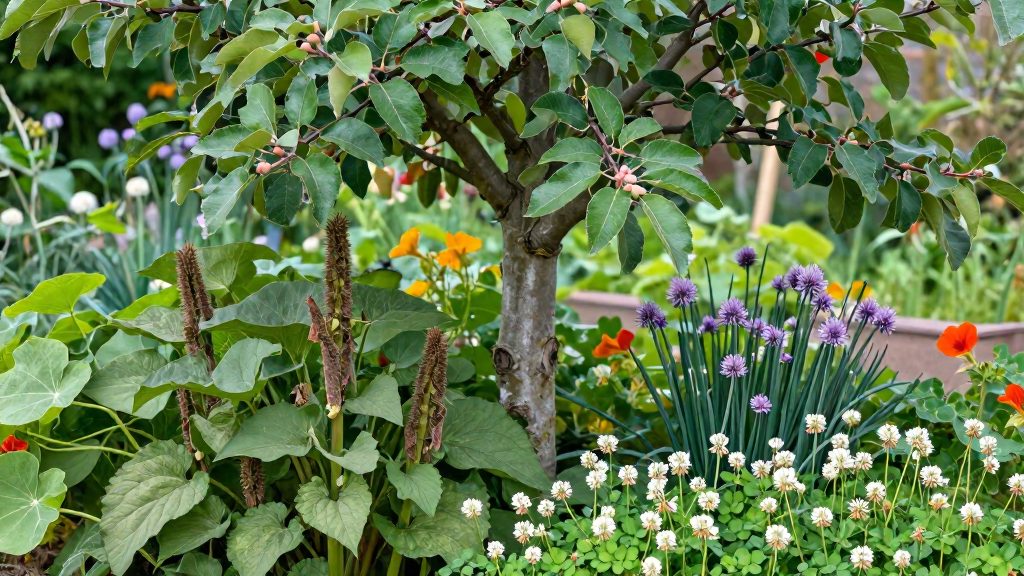
A guild works only if its plants stay in their own space. The main risk is a spreading species that grows into the focal tree’s root zone and competes with it for water and nutrients. Gardener’s Path identifies spreading mints as the clearest case: peppermint and lemon balm should be kept several feet from the trunk. Gardener’s Path says to keep them several feet from the trunk, so set them at the outer edge of the guild, not beside the tree.
Mints and lemon balm are useful guild members because Gardener’s Path lists them as pest deterrents. Their spreading habit is the problem, so the placement rule matters more than the choice of species. Plant them in a separate bed or in a container sunk into the ground, and check them each season for runners that have crossed toward the trunk.
Root competition around the focal tree
The practical rule is to avoid letting one vigorous plant take over the area beneath the canopy. Keep the root zone under the tree planted with a deliberate mix, and do not allow a single fast-spreading species to fill the gaps.
Size each companion to leave room for the tree’s roots, and leave the immediate trunk area open.
Mulch and ground cover at the trunk base
The official sources consulted do not specify a distance for mulch or ground cover from the trunk, so the following is general good practice rather than a sourced figure. Keep mulch and low ground cover pulled back from the base of the trunk to leave a bare ring. This keeps the bark dry and gives air to the base, and it makes it easier to see the trunk when checking for damage.
Do fruit tree guilds really work?
The published sources on tree guilds describe expected benefits rather than measured results. The official sources consulted do not specify controlled comparisons between guild trees and neighbouring trees managed on their own, and they give no yield figures for either system.
What published sources say about guild performance
Nutrition Studies lists typical roles: comfrey as fertiliser and mulch, and clover and strawberries as weed suppressors. These are phrased as expected effects.
The functional roles are the easiest part of the claim to check. A ground cover either shades bare soil or it does not, and a flowering plant either draws pollinators or it does not. The system-level claims, such as temperature stabilisation and whole-guild pest control, are harder to observe, and the sources reviewed offer the least support for them.
| Claimed benefit | Source | Status in consulted sources |
|---|---|---|
| Weed suppression by clover and strawberries | Nutrition Studies | Listed as a role; no coverage data given |
| Reduced root competition | Pip Magazine (Australia) | Described as “said to”; no root data given |
| Pest and disease control | Pip Magazine (Australia) | Described as “said to”; no comparison with untreated trees given |
| Pollinator attraction by lavender and bee balm | Nutrition Studies | Listed as a role; no visitor counts given |
Limits of evidence and conditions where benefits appear
Several conditions determine whether a guild performs as described:
- Duration: Gardener’s Path advises removing or relocating the Siberian pea shrub after about five years to avoid crowding the tree.
- Local conditions: outcomes depend on climate and soil.
Comparing guilds against conventional orchard monoculture
The consulted sources do not describe conventional orchard monoculture management in enough detail to support a direct comparison of labour, input costs or yields. What they do establish is structural. A guild adds several functional species around one tree and requires more planning and planting work at the start. A monoculture has no companion planting, so the guild’s claimed benefits are presented against that baseline without a controlled trial in the sources.
To test the claims on your own plot, you can keep a simple season-long record: note pollinator visits to the flowering companions, track weed cover under the tree, and observe pest and disease symptoms on the focal tree and on a similar tree without a guild. Your own observations will tell you more about your site than the published descriptions do.
Adapting guilds to your US hardiness zone
A tree guild works only when the focal tree and its companion plants can survive the winters and summers of your location, so the zone check comes before any planting. Gardener’s Path describes the focal tree as the centre of the guild.
Selecting the focal tree and companions
- Find your USDA hardiness zone on the zone map, then check that the tree you want is rated for that zone.
- Keep the guild’s functional groups (nitrogen fixers, nutrient accumulators, beneficial-insect attractors, pest deterrents) and choose species that fit your zone.
Adjusting guild species for cold, hot or dry climates
The sources consulted do not specify which guild species suit cold, hot or dry climates, so the points below are general method. Swap individual species within each functional group rather than dropping a group, so the guild keeps its nitrogen, nutrient and insect functions. Check the growth habit of each companion before planting.
Adjusting planting calendars to local frost dates
The sources consulted do not give frost dates for any region, so set your calendar from a local source for your area. Record the last spring and first autumn frost dates for your location, then plan the sequence for each year:
- Plant the focal tree first, in the period your local frost dates allow.
- Add the nitrogen fixers and nutrient accumulators next, since they start the soil work.
- Add the attractors and pest deterrents once the tree is established.
Check each companion’s growth habit and local conditions before choosing its planting date. Note the dates you planted each year, and adjust the calendar if your local frost pattern shifts.
Frequently asked questions
Which plants should I choose to surround a fruit tree?
Choose species from four functional groups rather than one favourite. Gardener’s Path sorts guild plants into nitrogen fixers (white clover, fava beans, Siberian pea shrub), nutrient accumulators (comfrey, yarrow, chicory), beneficial-insect attractors (dill, fennel, chives) and pest deterrents (peppermint, lemon balm, nasturtium). Planting a few species from each group covers the main roles.
Why keep spreading herbs away from the trunk, and when should the Siberian pea shrub go?
Gardener’s Path advises keeping spreading mints and lemon balm several feet from the trunk so they do not compete with the tree’s roots. It suggests planting the Siberian pea shrub in or beside the planting hole, pruning it to about half the tree’s size, and removing or relocating it after about 5 years to avoid crowding the tree.
What should I do before planting a guild around my tree?
According to Nutrition Studies, start by choosing a tree suited to your hardiness zone, then size the guild to the mature canopy and clear grass and weeds. Test soil nutrients and pH, add compost, and lay out a few plants from each group before digging. Setup is the most labor-intensive phase, so later maintenance should be light.