How to Recognize Aphids on Kale
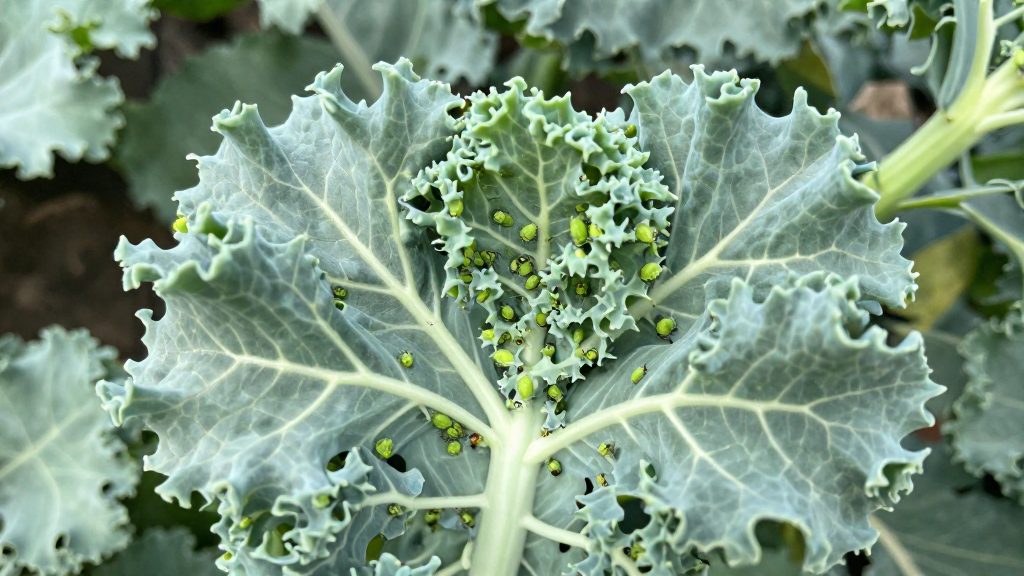
Aphids on kale are small soft-bodied insects that gather in colonies, usually on the undersides of leaves and on young shoots and growing tips. Check these areas first, because a plant can carry a colony before the damage is visible from above. Look at the whole plant, not just the most damaged leaves, and check every few days during the growing season, since colonies can build up quickly.
Signs to check
- Clusters on the undersides of leaves and on new growth, where aphids feed on sap.
- Distorted or curled young leaves, which can indicate a colony feeding on the growing tip.
- Parasitoid mummies: aphid bodies that have swollen, hardened and turned to a papery look. They are a sign that parasitoid wasps have laid eggs inside the aphids and are working on the colony.
Natural enemies to look for
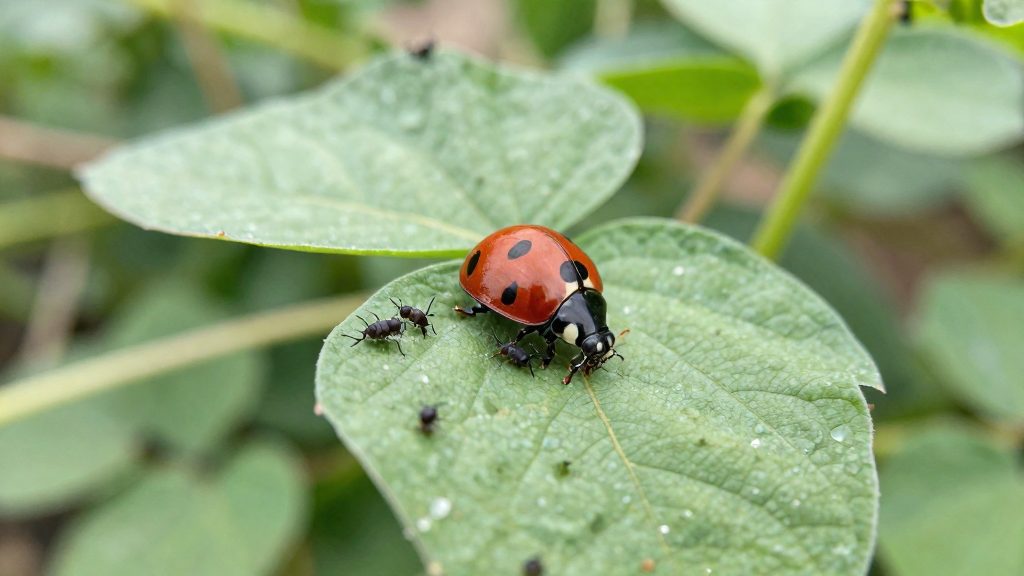
Before treating anything, look for the beneficial insects that already feed on kale aphids.
| Natural enemy | What to look for |
|---|---|
| Lady beetles (adults and larvae) | Adults and their larvae moving among aphid colonies |
| Lacewing larvae | Larvae feeding on aphids on leaves and stems |
| Syrphid fly larvae | Small, legless larvae found in aphid colonies |
| Parasitoids | Mummified aphids, as described above |
If these predators are present, the colony may be under partial natural control. Avoid broad-spectrum sprays at that point, because the PNW Insect Management Handbook (Oregon State University) advises against sprays that disrupt natural enemies once those enemies are gaining control.
Deciding whether to act
A few aphids on a few leaves usually do not require a full treatment. Gardener’s Path (2021) recommends spraying them off with a hose or picking them off by hand. If a leaf is heavily infested, remove it and discard it in the compost. If the colony keeps growing and natural enemies are not keeping up, organic-compatible options such as insecticidal soap, horticultural oil, neem and pyrethrins are described in the PNW Insect Management Handbook (Oregon State University). Recognition comes first, because choosing the right response depends on whether aphids are few or spreading, and whether predators are already present.
Why does kale attract aphids?
The official sources consulted do not specify one definitive reason why kale attracts aphids more than other brassicas. The PNW Insect Management Handbook (Oregon State University) does identify growing conditions that tend to favour larger aphid populations on this crop. The most important is heavy nitrogen fertilization. According to the handbook, aphid populations tend to be higher in liberally fertilized crops, so a kale bed that receives excess nitrogen is more likely to build up an infestation than one with moderate feeding.
Two other factors affect how aphids spread and survive from one season to the next. The same handbook notes that destroying infested crop residues right after harvest, and removing weed hosts late in the year, limits aphid dispersal and overwintering. In practice, old infested kale stalks left in the bed and nearby weeds can serve as a source of aphids for the next planting.
Natural enemies also shape aphid numbers. The handbook lists lady beetles and their larvae, lacewing larvae and syrphid fly larvae as the main natural predators of kale aphids. Parasitoids leave behind ‘mummies’, which are shrivelled aphid remains that show the parasitoids are active. Protecting these beneficial insects is therefore part of the control strategy, and it is a reason to avoid broad sprays that disrupt them when they are already bringing the population under control.
The handbook and Gardener’s Path (2021) describe the following options for managing aphids on kale:
| Method | Practical details |
|---|---|
| Strong water spray | Washes aphids off the leaves; home gardeners can often control aphids this way |
| Hose spray or hand picking | Suited to a few aphids; heavily infested leaves can be discarded in the compost |
| Insecticidal soap (organic-compatible) | May need several applications; spray in the morning or evening, outside strong sun |
| Horticultural oil (organic-compatible) | Listed among organic-compatible options; some formulations are OMRI-listed |
| Neem oil, azadirachtin (organic-compatible) | Dilute according to the product label and reapply about every 7 days; can be toxic to bees |
| Pyrethrins (organic-compatible) | Listed among organic-compatible options; some formulations are OMRI-listed |
Strong Water Spray and Hand-Picking
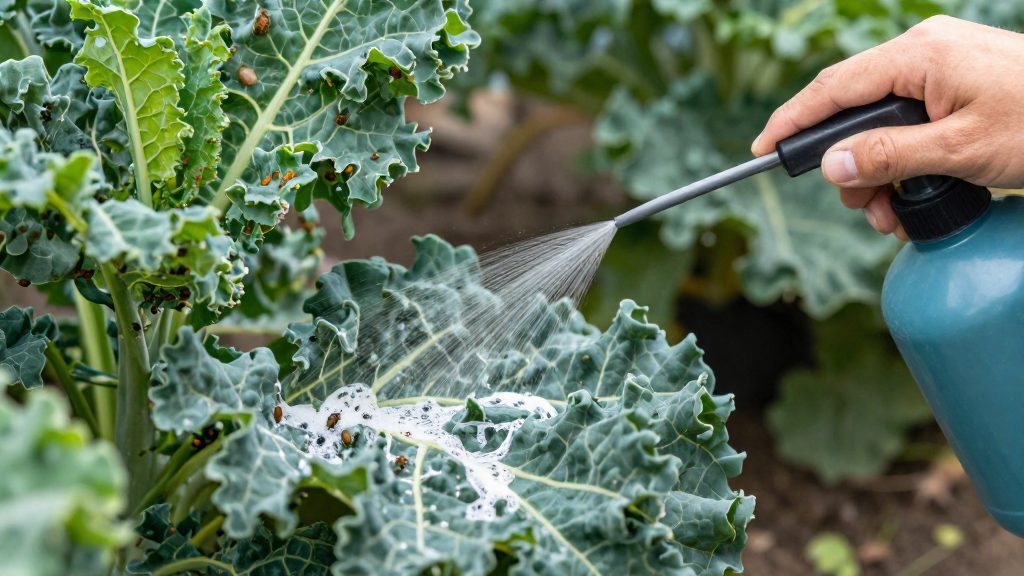
According to the PNW Insect Management Handbook (Oregon State University), home gardeners can often control aphids on kale by washing them off with a strong stream of water. This mechanical method removes colonies without adding any substance to the leaves or soil, which makes it one of the simplest organic options for a kale bed. It works best while infestations are still localized, before aphids have colonized most of the plant.
Washing aphids off with water
- Fit the hose with a firm nozzle or a jet setting, and aim the stream at the undersides of the leaves, where colonies tend to cluster.
- Work from the top of the plant downward, so that dislodged aphids do not fall onto lower leaves you have already cleaned.
- Check the plant again over the following days and repeat the spray if aphids return.
- Avoid spraying in the hottest part of the day, so the leaves are not stressed.
Hand-picking
For a small number of aphids, Gardener’s Path (2021-08-06) recommends either spraying them off with a hose or picking them off by hand. Hand-picking suits young plants and light infestations, where you can check each affected leaf and remove the insects directly. It is slower than a spray, so it is practical mainly on a few plants at a time.
Removing heavily infested leaves
Gardener’s Path (2021-08-06) notes that heavily infested leaves can be discarded in the compost. The PNW Insect Management Handbook (Oregon State University) adds that destroying infested crop residues right after harvest limits aphid dispersal and overwintering, so clear spent kale plants promptly at the end of the season.
Protecting natural enemies
Lady beetles and their larvae, lacewing larvae, and syrphid fly larvae are the main natural predators of kale aphids. Parasitoids leave behind “mummies,” which are a sign that they are working. Keep these beneficial insects in the patch by avoiding unnecessary sprays.
How to Attract Natural Predators
The most reliable way to keep kale aphids in check is to protect the predators that already live in the garden. According to the PNW Insect Management Handbook (Oregon State University), the main natural enemies of kale aphids are lady beetles and their larvae, lacewing larvae, and syrphid fly larvae. Parasitoid wasps also attack aphids and leave behind aphid mummies, which are hardened, swollen aphid bodies that signal parasitoids are at work. Finding mummies on your plants is a good sign that biological control is already happening.
The main way to support these predators is to avoid harming them. The same handbook advises against spraying products that disrupt natural enemies once those enemies start gaining control of the aphids. Before treating, check for lady beetle adults, lacewing and syrphid larvae, and mummies. If they are present, let them do the work.
Several cultural practices also help:
- Avoid heavy nitrogen fertilization. Aphid populations tend to be higher in liberally fertilized crops, so moderate feeding keeps pest pressure lower.
- Remove infested residues right after harvest. Destroying crop debris limits aphid dispersal and overwintering.
- Control weed hosts late in the year. Weeds can shelter aphids, so clearing them reduces the population that carries over.
- Wash aphids off with water. According to Gardener’s Path (2021), a few aphids can be sprayed off with a hose or picked off by hand, which leaves predators on the plant.
The official sources consulted do not specify particular flowering plants or habitat features that attract these predators to kale beds, so treat those as untested for this crop.
Insecticidal soap and neem oil: when to use them
Insecticidal soap and neem oil are sprays for organic kale growers when the aphids don’t come off with water. The PNW Insect Management Handbook (Oregon State University) lists insecticidal soap, horticultural oil, neem (azadirachtin) and pyrethrins as organic-compatible options, and notes that some formulations are OMRI-listed. Start with the lowest-impact steps. Home gardeners can often control aphids on kale by washing them off with a strong stream of water. For a few aphids, spraying them off with a hose or picking them off by hand is usually enough. Discard heavily infested leaves in the compost.
Move to a spray when the colony keeps coming back after these steps. Check for natural enemies before spraying, because the PNW Insect Management Handbook warns against sprays that disrupt natural enemies once those enemies are gaining control. Lady beetles, their larvae, lacewing larvae and syrphid fly larvae feed on kale aphids. Parasitoids leave “mummies” on the colony, which is a sign they are working.
| Product | Application notes from the sources |
|---|---|
| Insecticidal soap | May need several applications. Spray in the morning or evening, outside strong sun, to avoid burning leaves (Gardener’s Path, 2021). |
| Neem oil | Dilute according to the product label. Reapply about every 7 days (Gardener’s Path, 2021). |
Insecticidal soap works only on the aphids it touches, so cover the undersides of the leaves, where colonies often sit. Neem oil can be toxic to bees, so avoid spraying flowering plants or any area where bees are foraging. Read the product label before use and follow its dilution instructions. The official sources consulted do not give standard dilution ratios, so do not mix by estimate.
Preventing aphids: fertilization and cleanup
Aphid problems on kale often start with the way the crop is fed and how the previous crop is handled. According to the PNW Insect Management Handbook (Oregon State University), aphid populations tend to be higher in liberally fertilized crops, so moderate feeding keeps colonies from building up as quickly. Clearing out infested material after harvest also reduces the number of aphids that can survive the season and spread to new plants.
Fertilization
- Avoid heavy nitrogen fertilization. Lush, fast-growing kale attracts more aphids than moderately fed plants.
- Feed the soil with compost or other organic amendments and adjust the feeding to what the plants actually need, rather than adding extra nitrogen as a precaution.
- Adjust feeding to what the plants actually need.
Cleanup and garden hygiene
- Remove and destroy infested crop residues right after harvest. This limits aphid dispersal and overwintering, according to the PNW Insect Management Handbook.
- Remove weed hosts late in the year, since these can shelter aphids before the next season.
- Hand-pick aphids on a few affected leaves, or wash them off with a hose. Heavily infested leaves can be discarded in the compost, as recommended by Gardener’s Path (2021).
Protecting natural enemies
Lady beetles and their larvae, lacewing larvae and syrphid fly larvae all feed on kale aphids. Parasitoids leave behind “mummies,” which are a sign that they are working. Keeping these predators in the garden is part of prevention, because they reduce colonies without any input.
Choosing organic-compatible products: what to check on the label
The official sources consulted do not specify Canadian federal requirements for organic inputs, so this section cannot confirm which products are permitted in Canada or how they must be labelled. Before buying, check each product label for an organic-compatible listing and confirm the current rules with the certifying body or the relevant Canadian authority. The PNW Insect Management Handbook (Oregon State University), a US reference, notes that some formulations of the following options are OMRI-listed, which is a US listing and not a Canadian requirement. If you grow under organic certification, confirm with your certifier that a product is acceptable. Always follow the label:
- Insecticidal soap: may need several applications to control aphids. Gardener’s Path (2021-08-06) recommends spraying in the morning or evening, away from strong sun, to avoid burning leaves.
- Neem oil (azadirachtin): dilute it according to the product label and reapply about every 7 days, per Gardener’s Path (2021-08-06).
- Horticultural oil and pyrethrins: listed by the PNW Insect Management Handbook as organic-compatible options. Follow the label directions.
The PNW Handbook also advises avoiding sprays that disrupt natural enemies such as lady beetles, lacewing larvae and syrphid fly larvae, especially once those predators are gaining control. For a small infestation, washing aphids off with a strong stream of water or picking them off by hand requires no product at all.
Frequently asked questions
How can I get rid of aphids on kale without spraying anything?
For a light infestation, a strong stream of water from a hose can knock colonies off the leaves, according to the PNW Insect Management Handbook (Oregon State University). Gardener’s Path (2021) also suggests picking the aphids off by hand. Heavily infested leaves can go in the compost.
Should I leave aphids alone if I see ladybird larvae or mummified aphids?
Yes, check first. Lady beetle larvae, lacewing larvae and syrphid fly larvae are natural enemies that feed on kale aphids, and parasitoid mummies show that wasps are already working on the colony. The PNW Insect Management Handbook (Oregon State University) advises against sprays that disrupt these predators once they are gaining control.
Which organic treatments can I use if the aphids keep coming back?
The PNW Insect Management Handbook (Oregon State University) lists insecticidal soap, horticultural oil, neem (azadirachtin) and pyrethrins as organic-compatible options, though soap may need several applications. Neem can be toxic to bees, so spray it in the evening, and always follow the product label. OMRI is a US listing, so check with your own certifier about which products are allowed where you live.