Companion planting is not a documented control for the carrot fly. The Old Farmer’s Almanac presents alliums (onion, chive, leek, garlic, shallot) and rosemary as repellent because of their strong odour, but the official sources consulted do not give any efficacy data for them. The methods with the strongest support are crop rotation, removing wild carrots and other umbellifers, and floating row covers.
Do companion plants repel carrot flies?
Companion plants are presented as a secondary, unproven aid. Their strong scent is the mechanism cited, and no trial figures are available to measure how much damage they prevent.
| Plant | Status for carrot fly | Source |
|---|---|---|
| Onion, chive, leek, garlic, shallot (alliums) | Presented as repellent through their strong odour; no efficacy data | Old Farmer’s Almanac |
| Rosemary | Presented as repellent in the same way; no efficacy data | Old Farmer’s Almanac |
| Dill, celery, parsnip | Avoid near carrots: they share carrot pests | Old Farmer’s Almanac |
| Marigold, nasturtium | Used against other pests, not the carrot fly | Old Farmer’s Almanac |
Measures with documented support
- Crop rotation plays an important role in reducing carrot fly populations. Wild carrots and all umbellifers must be destroyed, since they serve as alternative hosts (Pacific Northwest Insect Management Handbook).
- Floating row covers “work very well” against the carrot fly and can be cost-effective for high-value crops (Pacific Northwest Insect Management Handbook).
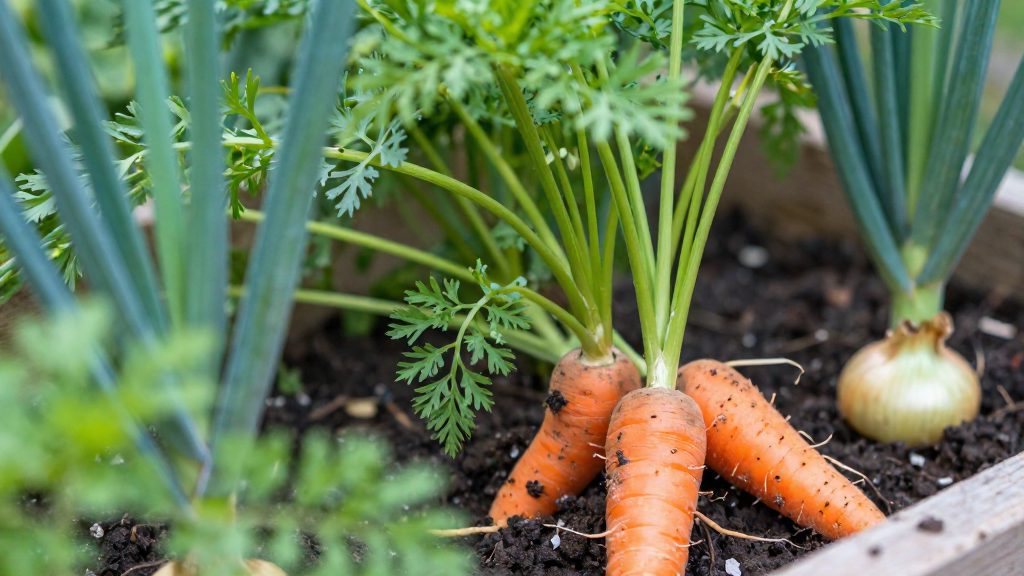
- Larvae tunnel into carrot roots, making them unmarketable and more prone to secondary bacterial and fungal infections. The fly is present throughout the field, not only at its edges (Agriculture and Agri-Food Canada). A row of companion plants along one border is therefore unlikely to protect the whole bed.
Monitoring and harvest
Yellow sticky traps attract carrot flies more than other colours, and colour matters more than trap material. However, catches correlate poorly with observed damage, so traps are best used to track activity rather than to confirm protection (Agriculture and Agri-Food Canada). If early harvest is not possible, harvesting whole blocks is preferable to selective picking (Pacific Northwest Insect Management Handbook).
To test companion planting in your own garden, sow a row of alliums beside one carrot bed and leave a second bed without them, then compare root damage at harvest. Regional emergence dates also vary, so record local timing for your own plot.

Alliums and rosemary: what we really know
Onion-family plants and rosemary are often recommended beside carrots because of their strong odour. The Old Farmer’s Almanac lists onion, chives, leek, garlic and shallot, and rosemary, as repellent to the carrot fly for this reason. It gives no efficacy data, and the other sources consulted do not measure how much protection these neighbours provide. Treat them as a supporting measure, not a standalone control.
Companion plants compared
| Plant group | Role according to the sources | Source |
|---|---|---|
| Onion, chives, leek, garlic, shallot | Presented as repellent through strong odour; no efficacy data | Old Farmer’s Almanac |
| Rosemary | Presented as repellent in the same way; no efficacy data | Old Farmer’s Almanac |
| Dill, celery, parsnip | Avoid near carrots, because they share carrot pests | Old Farmer’s Almanac |
| Marigold, nasturtium | Used against other pests, not the carrot fly | Old Farmer’s Almanac |
Methods with better-documented results
Companion planting is a minor layer in the sources compared with practices that address the fly’s life cycle:
- Crop rotation plays an important role in reducing carrot fly populations, according to the Pacific Northwest Insect Management Handbook, produced by the universities of Oregon, Washington and Idaho.
- Removing wild carrots and all umbellifers matters because they serve as alternative hosts, according to the same handbook.
- Floating row covers work very well against the carrot fly, according to the Pacific Northwest handbook, and can be cost-effective for high-value crops.
- Pest presence across the field: Agriculture and Agri-Food Canada notes that the fly is present throughout the field, not only at the edges, so border planting alone does not protect a bed.
Larvae tunnel into carrot roots, making them unsaleable and prone to secondary bacterial and fungal infection, according to Agriculture and Agri-Food Canada. Yellow sticky traps attract the fly, and colour matters more than material, but Agriculture and Agri-Food Canada reports that catches correlate poorly with observed damage, so traps are better used for monitoring than for control.
Plants to Avoid Near Carrots
Some plants grown beside carrots can keep carrot fly problems going rather than preventing them. The main risk comes from shared pests. According to The Old Farmer’s Almanac, dill, celery and parsnip share carrot pests, so they should not be planted near carrots. The Pacific Northwest Insect Management Handbook adds a second risk: wild carrots and other umbellifers act as alternative hosts for the fly, so they keep populations alive when no carrot crop is present. Removing these plants from the growing area is one of the measures the handbook recommends.
Plants to keep out of carrot beds
| Plant | Reason to keep away | Source |
|---|---|---|
| Dill | Shares carrot pests | The Old Farmer’s Almanac |
| Celery | Shares carrot pests | The Old Farmer’s Almanac |
| Parsnip | Shares carrot pests | The Old Farmer’s Almanac |
| Wild carrot | Alternative host; destroy it | Pacific Northwest Insect Management Handbook |
| Other umbellifers | Alternative hosts; destroy them | Pacific Northwest Insect Management Handbook |
Plants often suggested as repellents
Alliums (onion, chives, leek, garlic, shallot) and rosemary are presented as repellent because of their strong odour. The Old Farmer’s Almanac lists them for this purpose, but the sources consulted do not give any efficacy data, so they should be treated as a supplement, not a barrier.
Marigolds and nasturtiums are also common companions, but the Almanac links them to other pests, not to carrot fly. Do not count on them for this problem.
Organic methods with documented effect
- Floating row covers: The Pacific Northwest Insect Management Handbook states that they work very well against carrot fly and can be cost-effective for high-value crops.
- Yellow sticky traps: According to Agriculture and Agri-Food Canada, they attract carrot fly, and colour matters more than material. However, trap catches correlate poorly with observed damage, so they are better for monitoring than for judging how much harm to expect.
- Crop rotation: Rotations reduce carrot fly populations, as noted by the Pacific Northwest Insect Management Handbook.
The sources consulted do not specify a minimum spacing distance between carrots and dill, celery or parsnip, so the safest approach is to keep these plants in separate beds.
Are floating row covers more reliable than companion plants?
Among the methods covered by the sources consulted, floating row covers are the only one with a clear endorsement against carrot fly. The Pacific Northwest Insect Management Handbook, a publication of the universities of Oregon, Washington and Idaho, states that floating covers “work very well” against the pest and can be cost-effective for high-value crops. Companion plants, by contrast, are presented as repellent because of their strong odour, but the Old Farmer’s Almanac gives no efficacy data for them.
The difference matters for planning. Carrot fly larvae tunnel into the roots, and the damaged carrots become unsellable and more prone to secondary bacterial and fungal infections, according to Agriculture and Agri-Food Canada. The same source notes that the fly is present throughout the field, not only along its edges. A physical barrier that covers the whole planting therefore addresses the population across the bed, while a few aromatic plants at the border do not.
| Method | Source | What the source says |
|---|---|---|
| Floating row cover | Pacific Northwest Insect Management Handbook | ”Works very well” against carrot fly; may be cost-effective for high-value crops |
| Alliums (onion, chives, leek, garlic, shallot) | Old Farmer’s Almanac | Presented as repellent through strong odour; no efficacy data given |
| Rosemary | Old Farmer’s Almanac | Presented as repellent in the same way; no efficacy data given |
| Marigolds and nasturtiums | Old Farmer’s Almanac | Used against other pests, not carrot fly |
| Dill, celery, parsnip (planted nearby) | Old Farmer’s Almanac | Should be avoided near carrots because they share carrot pests |
Timing deserves caution. Agriculture and Agri-Food Canada reports that degree-day models developed in Quebec did not correctly predict emergence in Nova Scotia, Prince Edward Island and Ontario, so emergence dates vary by region. Installing a cover should rely on local observation rather than a single calendar date borrowed from another area.
Sticky yellow traps are often used to monitor the fly. Agriculture and Agri-Food Canada notes that yellow attracts carrot fly more than other colours, and that colour matters more than the trap material. However, trap catches correlate poorly with the damage actually observed, so a trap count alone does not show whether a crop is at risk.
Crop Rotation and Garden Cleaning
Crop rotation plays an important role in reducing carrot fly populations, according to the Pacific Northwest Insect Management Handbook, a publication of the universities of Oregon, Washington and Idaho. Rotation is recommended alongside destroying wild carrots and all umbellifers, which serve as alternative hosts. Agriculture and Agri-Food Canada notes that the fly is present throughout the field.
Removing Alternate Hosts
Alternate hosts are plants other than the crop that the pest can use to breed. The Pacific Northwest Insect Management Handbook states that wild carrots and all umbellifers should be destroyed. The Old Farmer’s Almanac adds that dill, celery and parsnip should not be grown near carrots, because they share the same pests.
| Plant | Recommended action | Source |
|---|---|---|
| Wild carrot | Destroy | Pacific Northwest Insect Management Handbook |
| Other umbellifers | Destroy | Pacific Northwest Insect Management Handbook |
| Dill | Keep away from carrot beds | Old Farmer’s Almanac |
| Celery | Keep away from carrot beds | Old Farmer’s Almanac |
| Parsnip | Keep away from carrot beds | Old Farmer’s Almanac |
Treating the Whole Plot
Agriculture and Agri-Food Canada reports that the carrot fly is present throughout the field, not only along its borders. Cleaning and monitoring should therefore cover the entire bed area. Larvae tunnel into carrot roots, which makes them unmarketable and more vulnerable to secondary bacterial and fungal infections, according to the same source.
Harvest Timing
When early harvest is not possible, the Pacific Northwest Insect Management Handbook advises harvesting whole blocks rather than picking selectively. The source gives this as the preferred approach when early harvest is not possible.
Non-Chemical Barriers
Floating row covers, or fleece, are a non-chemical barrier. The Pacific Northwest Insect Management Handbook says they “work very well” against the carrot fly and can be cost-effective for high-value crops. They complement rotation and cleaning rather than replacing them.
Adapting to Your Region
Agriculture and Agri-Food Canada notes that degree-day models developed in Quebec did not correctly predict fly emergence in Nova Scotia, Prince Edward Island and Ontario. Emergence dates therefore vary by region, and timing taken from one area should be checked locally before being applied elsewhere.
Monitoring carrot fly with yellow sticky traps
Yellow sticky traps are a practical, non-chemical way to track carrot fly activity in an organic garden. According to Agriculture and Agri-Food Canada, these traps attract carrot fly more effectively than other options, and trap colour matters more than the material the trap is made from. They work best as an early-warning tool that shows when adult flies are active near your beds, not as a direct measure of how much damage your carrots will suffer.
Yellow sticky traps attract the carrot fly more than other colours, according to Agriculture and Agri-Food Canada. They can help track fly activity, but the sources do not specify how to place or replace them. Record the catches by date so you can compare activity from one week to the next and across seasons.
Keep the following points in mind when reading your results:
- Captures do not reflect damage. The sources note that trap catches correlate poorly with the damage observed in the root crop, so a low count does not guarantee healthy carrots.
- The fly is present across the whole plot. Agriculture and Agri-Food Canada reports that the fly is found throughout the field, not only along the edges, so a single trap at the border may not represent the entire bed.
- Emergence timing varies by region. Degree-day models developed in Quebec did not correctly predict emergence in Nova Scotia, Prince Edward Island, and Ontario. Your local observations, rather than a model from another region, should guide when you start checking traps.
| Monitoring tool | What the sources report | Limitation |
|---|---|---|
| Yellow sticky traps | Attract carrot fly more than other trap types; colour matters more than material | Catches correlate poorly with observed damage |
| Degree-day models | Developed in Quebec | Did not correctly predict emergence in Nova Scotia, Prince Edward Island or Ontario |
The official sources consulted do not specify trap density, placement height, or replacement intervals, so adapt these details through trial in your own garden and keep a written log of the results.
Regional Variation in Carrot Fly Emergence Across Canada
Carrot fly activity does not follow one national calendar. According to Agriculture and Agri-Food Canada (AAFC), degree-day models developed in Quebec did not correctly predict carrot fly emergence in Nova Scotia, Prince Edward Island and Ontario. Regional populations may need different amounts of heat before they emerge, so emergence dates vary from one region to another. A sowing calendar copied from another province is therefore a starting point, not a reliable schedule.
| Region | What the consulted sources say about timing |
|---|---|
| Quebec | Degree-day model developed here (AAFC) |
| Nova Scotia | Quebec model did not predict emergence correctly (AAFC) |
| Prince Edward Island | Quebec model did not predict emergence correctly (AAFC) |
| Ontario | Quebec model did not predict emergence correctly (AAFC) |
The official sources consulted do not give sowing dates for each Canadian region, so this section does not list them. The practical approach is to track carrot fly activity where you garden.
- Record local emergence. Note the date of first carrot fly sightings each season and compare it with previous years.
- Log your own timings. Write down your sowing dates and the date damage first appears. Over several seasons, this log shows how your plot compares with regional patterns.
- Do not rely on trap counts for timing. According to AAFC, yellow sticky traps attract carrot flies more strongly than other colours, but catches correlate poorly with the damage observed. A trap count is a weak signal for deciding when to act.
- Plan harvest by block. If an early harvest is not possible, the Pacific Northwest Insect Management Handbook recommends harvesting the whole block at once rather than selectively.
- Plan rotations ahead. Crop rotation plays an important role in reducing carrot fly populations, according to the same handbook. Avoid planting carrots in the same bed each year, and remove wild carrots and other umbellifers, which serve as alternative hosts.
Frequently asked questions
Do onions or garlic planted near carrots keep carrot flies away?
Alliums such as onion, chive, leek, garlic and shallot are often presented as repellent because of their strong smell, but the official sources consulted do not provide any efficacy data for this effect. Treat them as a minor complement to other methods, not as a reliable barrier. Alliums may still add some diversity to the bed, but they should not replace other protection.
Which plants should I keep away from my carrot bed?
Avoid planting dill, celery and parsnip near carrots, because they host the same pests (Old Farmer’s Almanac). Their presence can increase pest pressure on the carrot bed instead of reducing it.
What is the most reliable organic protection against carrot fly?
Among the measures with documented support, floating row covers are described by the Pacific Northwest Insect Management Handbook as working very well against the carrot fly, and they can be cost-effective for high-value crops. Combine them with crop rotation and the removal of wild carrots and other umbellifers, which serve as alternative hosts.