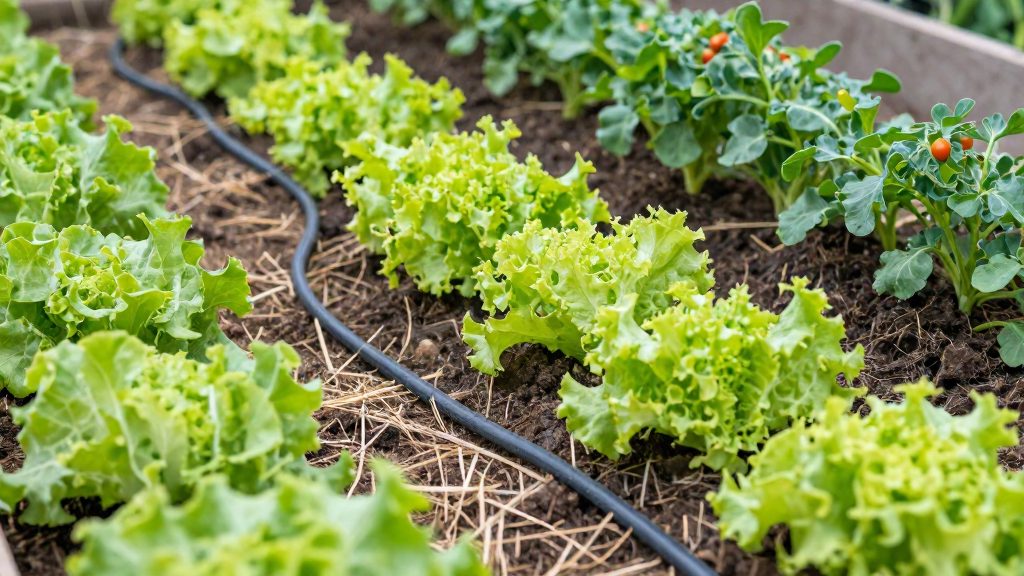
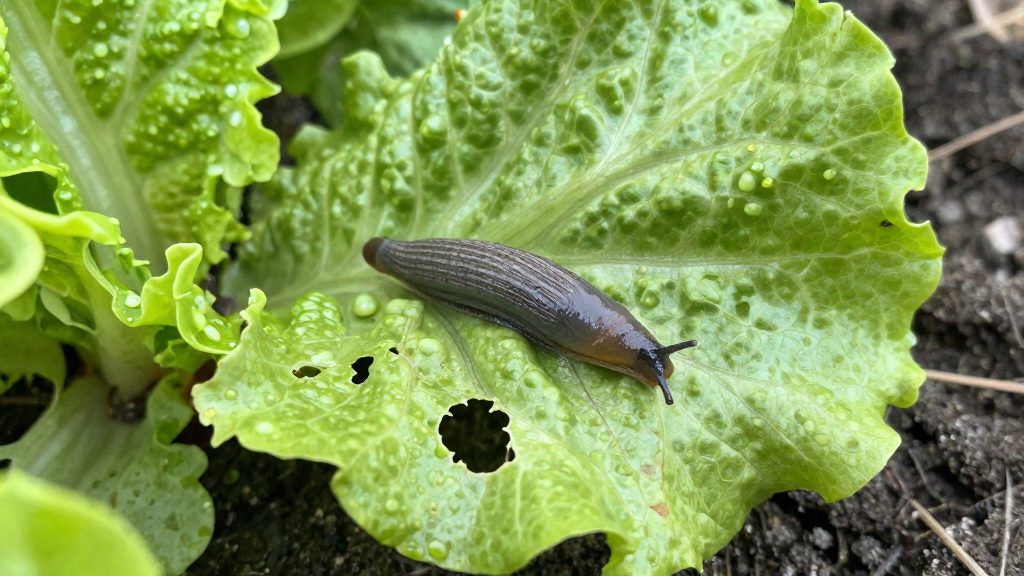
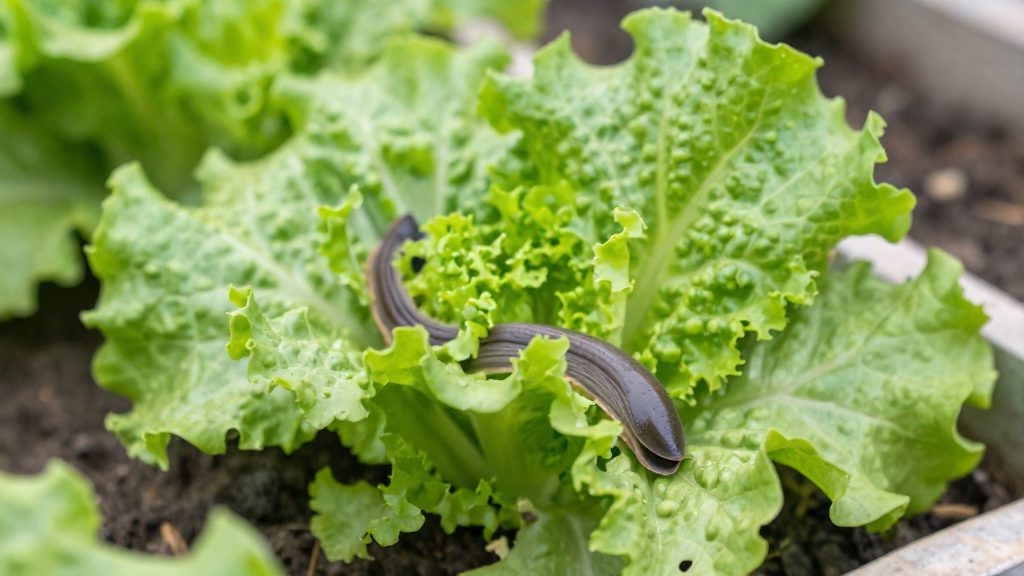
Slugs are a frequent problem in lettuce beds, where damp, sheltered conditions favour their feeding. Small gray milk slugs are a frequent problem on lettuce and other leafy greens. They feed at night and during wet, overcast weather, chewing smooth-edged holes and leaving shiny slime trails. Damage is heaviest when moisture stays high for long periods, so the feeding window depends more on the weather than on the calendar.
Why do slugs target lettuce beds?
Lettuce is among the leafy greens most often reported with slug damage. The official sources consulted do not specify why lettuce is preferred over other crops, so this section focuses on the conditions in which feeding occurs.
Night feeding and wet weather
Night feeding is the main pattern. Slugs are active after dark, and activity rises in wet, overcast weather. A bed that stays damp at ground level matches these conditions, which is why the same planting can show little damage in a dry spell and heavy damage after several rainy days.
Prolonged rain increases the risk further. According to Mother Earth News (2013), problems are worst in heavily mulched gardens during prolonged rain.
Milk slug damage on lettuce
Milk slugs are small and gray, which makes them easy to miss during the day. Their feeding leaves smooth-edged holes in the leaves. The slime trails they leave are shiny and are often the clearest evidence that slugs are present, even when the slugs themselves are hidden.
| Sign | What it indicates |
|---|---|
| Smooth-edged holes in leaves | Feeding by milk slugs |
| Shiny slime trails on leaves and soil | Slug movement through the bed |
| Damage concentrated after wet, overcast nights | Peak feeding period |
Thinning leafy greens so that the soil dries out between plants is listed by Mother Earth News (2013) as a cultural measure for lettuce, and it reduces the moist, sheltered cover that slugs use.
Handpicking and night patrols
Handpicking is the simplest organic control for slugs in a lettuce bed. The University of Saskatchewan recommends collecting slugs by hand at night with a flashlight (Gardening at USask, University of Saskatchewan, 2018). Slugs are nocturnal, so the work is done after dark, when they are out feeding on leaves rather than hiding in the soil or under debris.
Timing and tools
- Go out after dark with a flashlight. Check the undersides of outer leaves, the base of plants, and the soil at the edge of the bed.
- Use a container to hold the slugs you pick. Gloves are a practical choice for handling them.
- Work the whole bed in one pass so no plant is missed.
How often to patrol
The official sources consulted do not specify a fixed number of nights per week. The timing does follow from how slugs behave. Small gray milk slugs are a frequent problem on lettuce and other leafy greens, and they feed at night and in wet, overcast weather (Mother Earth News, Barbara Pleasant, 2013). Patrols are therefore most useful on damp evenings and after rain, when feeding activity is highest.
Signs that slugs are active include smooth-edged holes in leaves and shiny slime trails across the soil and foliage (Mother Earth News, Barbara Pleasant, 2013). When you see these, schedule an extra evening check.
| Condition | Why it matters for patrols |
|---|---|
| Night, after dark | Slugs feed at night |
| Wet or overcast weather | Feeding activity increases |
| Smooth-edged holes, slime trails | Confirms slugs are present |
Disposal of collected slugs
The official sources consulted do not specify a disposal method. As general practice, move collected slugs away from the vegetable bed and dispose of them in a way that suits your site and local rules. Keep the container out of reach of pets and children, and wash your hands after handling.
Beer, rind and board traps
Passive traps catch slugs without poisons or barriers. They work because slugs feed at night and in wet, overcast weather, and they shelter in dark, damp spaces during the day. Small gray milk slugs are a frequent problem on lettuce and other leafy greens, and they chew smooth-edged holes and leave shiny slime trails. Setting traps where slugs already hide, and checking them on a fixed schedule, gives the most catches.
Beer or yeast-water traps are one common option. The University of Saskatchewan (2018) suggests sinking bowls of cheap beer or yeasty water near ground level as drowning traps. Mother Earth News (2013) gives the setup in more detail: bury the container so its rim sits level with the soil surface, fill it with about an inch (roughly 2.5 cm) of liquid, and empty and refill it daily. A sugar-water-and-yeast mix is an alternative to beer. Place several traps along the edge of the lettuce bed, since slugs travel the same routes each night.
Inverted melon or grapefruit rinds work as shelters. Slugs gather under the cool, moist rind during the day. The University of Saskatchewan (2018) recommends flipping the rinds in the evening to remove the slugs gathered beneath them. Check them every evening, collect what you find, and set the rind back in place.
Boards work the same way. Lay a flat board on the soil next to the bed and lift it each evening to collect the slugs sheltering underneath. The University of Saskatchewan (2018) lists boards alongside rinds as a trapping method.
Pit traps are a more permanent option. Mother Earth News (2013) describes a pit about 4 inches (roughly 10 cm) wide and 6 inches (roughly 15 cm) deep. Cover it with a shingle or with foil-wrapped plywood, and leave it in place for 2 to 3 days before checking it.
| Trap | Setup | Upkeep | Source |
|---|---|---|---|
| Beer or yeast water | Buried, rim at soil level, about 1 inch of liquid | Emptied and refilled daily | Mother Earth News (2013) |
| Inverted melon or grapefruit rind | Placed on soil near the bed | Flipped each evening | University of Saskatchewan (2018) |
| Board | Laid flat on soil near the bed | Lifted and checked each evening | University of Saskatchewan (2018) |
| Pit trap | 4 in. (about 10 cm) wide, 6 in. (about 15 cm) deep, covered | Left 2 to 3 days before checking | Mother Earth News (2013) |
Do copper and diatomaceous earth really work?
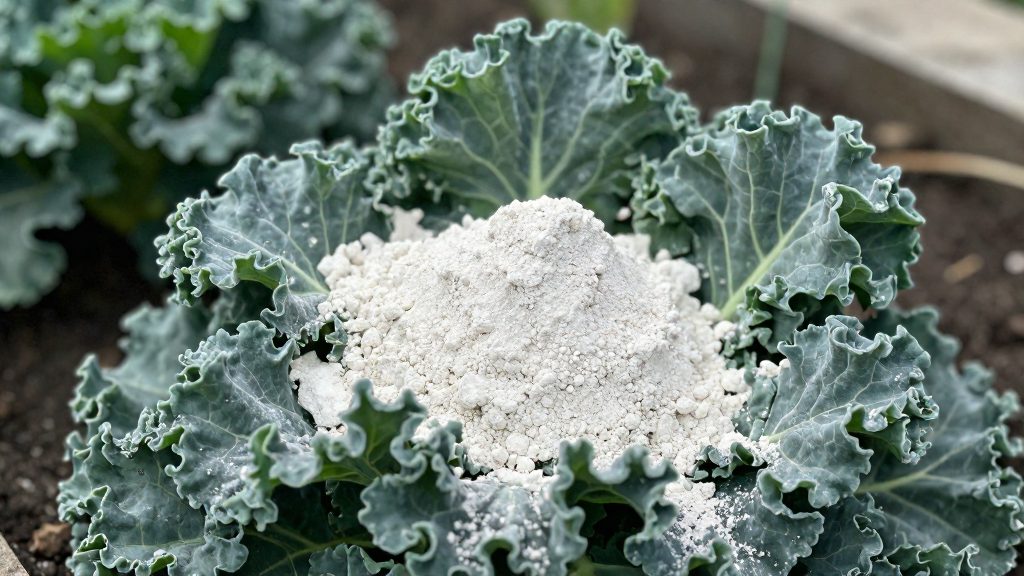
Copper and diatomaceous earth are often sold as organic slug barriers, but the University of Saskatchewan reports that neither stops slugs. Most loose materials fail for the same reason: the slug’s body mucus. The University of Saskatchewan instead recommends a physical plastic slug guard with an upside-down L-shaped lip.
Why powders and metals fail against slime
Slugs move on a film of slime. According to Gardening at USask, University of Saskatchewan (2018-02-07), slime lets slugs cross diatomaceous earth and copper unharmed. The mucus coats the surface, so the slug travels over the barrier without being damaged, and the slug keeps feeding inside the ring. A powder border can give a false sense of protection for lettuce beds.
The same source lists several common garden materials as ineffective barriers:
| Material | Result according to Gardening at USask, University of Saskatchewan (2018-02-07) |
|---|---|
| Diatomaceous earth | Does not work; slime lets slugs cross unharmed |
| Copper | Does not work; slime lets slugs cross unharmed |
| Eggshells | Does not work as a slug barrier |
| Coffee grounds | Does not work as a slug barrier |
| Grass mulch | Does not work as a slug barrier |
| Compost | Does not work as a slug barrier |
A physical barrier that works: the plastic slug guard
The University of Saskatchewan recommends a plastic slug guard around the perimeter of raised beds. The guard has a thin, upside-down L-shaped lip, which is the feature that distinguishes it from the loose materials above. The official sources consulted do not specify the guard’s height or the exact installation method, so check the product dimensions before installing it.
Lettuce-specific context
Small gray milk slugs are a frequent problem on lettuce and other leafy greens. They feed at night and in wet, overcast weather, chew smooth-edged holes, and leave shiny slime trails, according to Mother Earth News (Barbara Pleasant, 2013-05-02). Cultural measures reduce their activity: use soaker hoses, avoid watering late in the day, and thin leafy greens so the soil dries out. Problems are worst in heavily mulched gardens during prolonged rain.
Handpicking is a practical organic method. The University of Saskatchewan recommends collecting slugs at night with a flashlight.
Water and bed management
Watering and bed structure are among the few factors a gardener controls directly, and they affect how much shelter slugs find in a lettuce bed. According to Mother Earth News (Barbara Pleasant, 2013-05-02), small gray milk slugs feed at night and in wet, overcast weather, so the aim is to prevent the soil surface and the leaves from staying damp for long periods.
Morning watering so the surface dries by evening
- Water early in the day so that the soil surface can dry before evening.
- Avoid watering late in the day. Mother Earth News (2013-05-02) lists this among the cultural measures for lettuce.
- Use soaker hoses, which the same source recommends. They supply water to the root zone rather than spraying the foliage.
Thinning and spacing
Thinning leafy greens is a cultural measure that helps the soil dry out between waterings. Mother Earth News (2013-05-02) notes that slug problems are worst in heavily mulched gardens during prolonged rain, so spacing and mulch depth need to be considered together. A bed that is tightly planted and heavily covered stays wet longer after rain.
Low-water planting and mulch choice
The University of Saskatchewan (Gardening at USask, 2018-02-07) recommends practising low-water landscaping to reduce the moist shelter slugs use. The same source suggests mulching with shredded wood, which encourages birds and egg-eating predators. Mulch works as a habitat tool here, not as a barrier. The University of Saskatchewan states that grass mulch and compost do not work as slug barriers, so they should not be relied on to stop slugs from crossing a bed.
| Practice | Effect on slug pressure | Source |
|---|---|---|
| Soaker hoses | Keeps water at the root zone, away from foliage | Mother Earth News (2013-05-02) |
| Avoiding late-day watering | Limits the wet period at night | Mother Earth News (2013-05-02) |
| Thinning leafy greens | Lets soil dry out between waterings | Mother Earth News (2013-05-02) |
| Shredded wood mulch | Encourages birds and egg-eating predators | Gardening at USask (2018-02-07) |
| Low-water planting | Reduces moist shelter | Gardening at USask (2018-02-07) |
Clearing debris and weeds
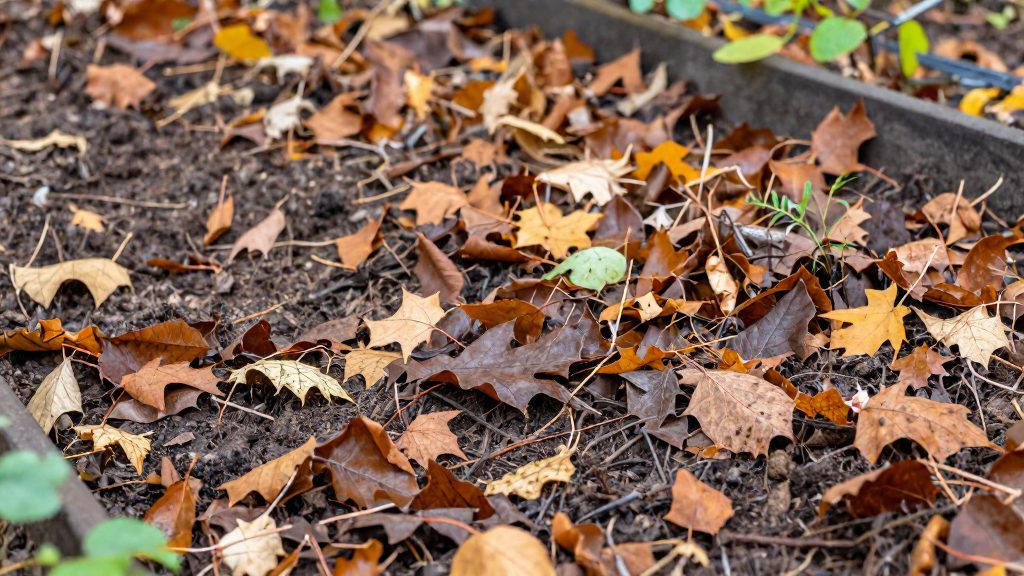
Remove fallen leaves, cut plant residue, and weeds along the bed edges. These materials hold moisture and give slugs a damp place to hide during the day. Clearing them regularly keeps the bed edges drier and reduces the number of hiding spots near young lettuce. Doing this in the afternoon, before slugs become active at dusk, makes the sites easier to inspect.
Encouraging natural predators
Natural predators can reduce slug numbers in a lettuce bed when you give them shelter and a reason to stay. According to the University of Saskatchewan (2018), shredded wood mulch attracts egg-eating predators and encourages birds, which makes it the most direct habitat change you can make in a bed. Predators work best alongside handpicking and trapping, not as a replacement for them.
Shredded wood mulch
- The University of Saskatchewan (2018) suggests mulching with shredded wood to attract egg-eating predators. Mother Earth News (Barbara Pleasant, 2013) notes that problems are worst in heavily mulched gardens during prolonged rain, so weigh the predator benefit against that risk in a lettuce bed.
- Keep the layer moderate. Mother Earth News (Barbara Pleasant, 2013) reports that slug problems are worst in heavily mulched gardens during prolonged rain, so avoid piling mulch thickly against the stems.
- Water with soaker hoses at the soil surface and avoid watering late in the day, so the mulch layer dries between rains.
Bird habitat
Birds that feed in the garden can take slugs and their eggs, and the University of Saskatchewan (2018) recommends encouraging them. Three features help:
- Perches: Place a few posts, stakes or small branches at the edges of the vegetable plot so birds have a place to watch the ground from.
- Hedges: Plant a shrub hedge along a boundary to give birds cover close to the beds. Lavender and rosebushes are common choices for this role.
- Water sources: Set a shallow dish of fresh water at ground level, refilled regularly, so birds can drink and bathe near the lettuce.
Ground beetles, frogs and garden snakes
These animals need shelter more than food supplied by the gardener. Provide it with:
| Predator | Habitat to provide |
|---|---|
| Ground beetles | Flat stones, stacked logs and undisturbed leaf litter at the bed edge |
| Frogs | A shallow pond or water dish, plus damp cover such as stones or a log pile |
| Garden snakes | Stones or boards laid on the ground, and a sunny spot nearby for basking |
Avoid broad-spectrum insecticides, which harm these animals along with the pests. Keep the shelters in place through the season so the animals return to the same areas.
When is iron phosphate bait acceptable?
Iron phosphate is an organic slug bait that Mother Earth News (Barbara Pleasant, 2013) recommends only as a last resort for lettuce and other leafy greens. Use it only after hand-picking, watering changes and physical barriers have failed to control the damage. Salt is not an alternative: it should not be used on slugs because it ends up in the soil and can harm sensitive plants.
Non-chemical steps come first
- Hand-pick at night with a flashlight, as the University of Saskatchewan recommends (2018).
- Change watering habits. Use soaker hoses and avoid watering late in the day. Thin leafy greens so the soil dries out (Mother Earth News, 2013).
- Install a plastic slug guard around the perimeter of raised beds. The University of Saskatchewan describes its thin, upside-down L-shaped lip (2018).
- Skip ineffective barriers. The University of Saskatchewan says diatomaceous earth, copper, eggshells, coffee grounds, grass mulch and compost do not stop slugs, because slime lets them cross unharmed (2018).
| Stage | Action | Source |
|---|---|---|
| 1 | Hand-pick slugs at night | University of Saskatchewan (2018) |
| 2 | Water early, use soaker hoses, thin plants | Mother Earth News (2013) |
| 3 | Install a plastic slug guard on raised beds | University of Saskatchewan (2018) |
| 4 | Iron phosphate bait, only if damage continues | Mother Earth News (2013) |
Applying iron phosphate safely
- Confirm the problem persists. Check beds after dark for fresh chewed holes and slime trails, which Mother Earth News identifies as signs of slug feeding.
- Choose a product labelled as an organic iron phosphate bait. Read the label for the application rate, timing and precautions. The official sources consulted do not specify application rates for iron phosphate, so the label is your reference.
- Scatter the bait sparingly in a thin layer near the affected plants rather than in heaps.
- Keep the bait away from pets and wildlife. Store the product in its closed container, place it where dogs, cats, children and birds cannot reach it, and avoid leaving loose pellets on the soil surface. The sources consulted give no pet or wildlife guidance for this product, so follow the label’s warnings.
- Remove leftover bait after treatment and close the container.
Frequently asked questions
What is a simple organic trap for slugs in a lettuce bed?
A beer or sugar-water-and-yeast trap buried with its rim at soil level is one option described by Mother Earth News (2013). Fill it with about an inch (2.5 cm) of liquid, then empty and refill it daily.
Does mulch make slug problems worse on lettuce?
Mother Earth News (2013) reports that problems are worst in heavily mulched gardens during prolonged rain, but it does not explain why. The University of Saskatchewan (2018) suggests shredded wood mulch to attract egg-eating predators, so weigh that benefit against the risk of heavy mulch in a damp bed.
Do copper, eggshells or diatomaceous earth stop slugs?
According to the University of Saskatchewan (2018), diatomaceous earth, copper, eggshells, coffee grounds, grass mulch and compost do not work as slug barriers. For raised beds, it recommends a plastic slug guard with an upside-down L-shaped lip around the perimeter.