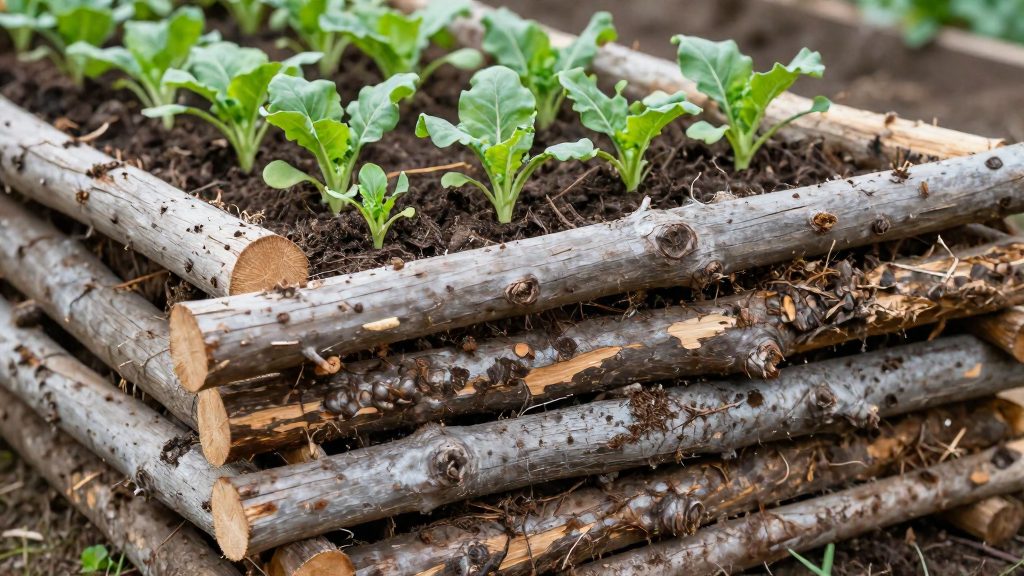
Hugelkultur is a raised garden bed built over a core of buried wood that decomposes slowly inside the mound. According to the Farmers’ Almanac, a practical minimum footprint is about 3 ft x 6 ft, and larger beds are better. The bed is assembled in a fixed order: the largest wood at the bottom, a nitrogen-rich layer, subsoil to fill gaps, compost, and topsoil on top. This makes the method useful for organic vegetable growing, especially on poor or wet ground.
What is hugelkultur cultivation?
Hugelkultur turns logs and branches into the structure of a raised bed. As the wood core breaks down over several years, it holds water and releases nutrients, while the planting layer above stays loose. The method relies on natural decomposition rather than synthetic inputs, which fits an organic vegetable garden.
Building the bed
Assemble the layers from the bottom up:
- Wood: place the largest logs at the bottom, then smaller branches on top.
- Nitrogen-rich layer: add leaves, unsprayed grass clippings, or manure to feed the decomposing wood.
- Subsoil: fill the gaps between the wood with subsoil.
- Compost: spread 3–4 in of compost.
- Topsoil: finish with 1–2 in of topsoil for planting.
Choose a sunny site, and set the bed where drainage can be managed. Water the bed without waterlogging it.
Choosing the wood
Wood type matters because some species persist for decades. The Farmers’ Almanac lists the following:
| Wood | Stated outcome |
|---|---|
| Oak, fruit trees, alder, poplar | Better choices for the core |
| Cedar or redwood | 20+ years to break down |
| Black locust | 25+ years to break down |
| Black walnut | Juglone toxicity for 5+ years |
Freshly cut green wood draws nitrogen from the soil in years 1–2. The Farmers’ Almanac advises aging logs for 6–12 months before burying them.
Expected benefits
The Farmers’ Almanac describes several effects as the wood decomposes:
- Cold climates: decomposing wood raises root-zone warmth, which can extend the growing season.
- Water retention: by about year 3, the bed holds enough water that irrigation may no longer be needed.
- Wet areas: the raised height improves drainage.
The official sources consulted do not specify exact temperature gains or water savings, so results will vary with climate, wood type, and soil.
Why choose hugelkultur raised beds for an organic vegetable garden?
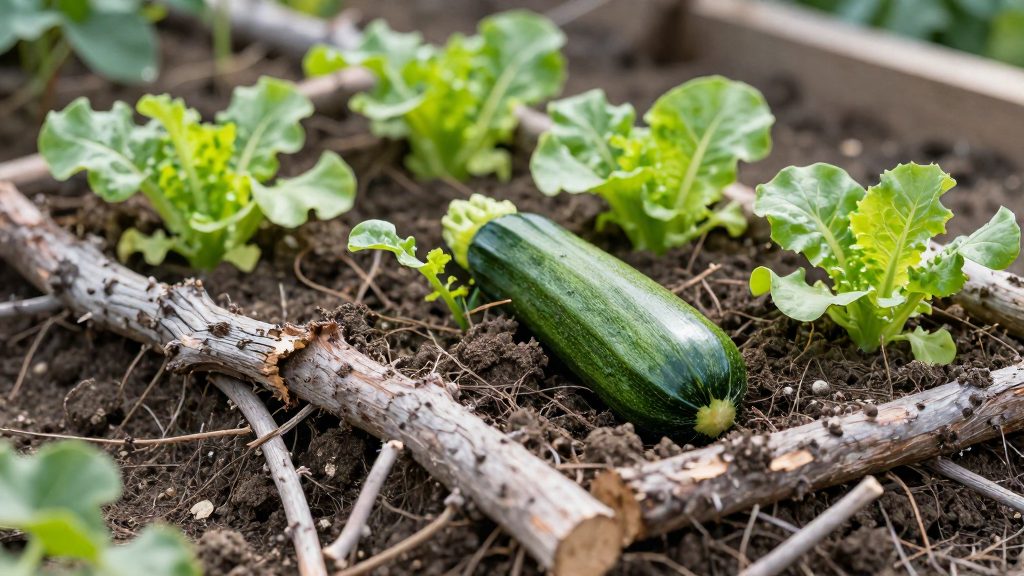
Hugelkultur beds are built over buried wood that decomposes slowly inside the bed. According to Farmers’ Almanac, the recommended minimum footprint is about 3 ft x 6 ft, and a larger bed works better. The method relies on materials such as logs, branches, leaves, unsprayed grass clippings and manure, which fits an organic approach.
The main benefits described for this type of bed are:
- Warmer root zone in cold climates: decomposing wood raises root-zone warmth, which can extend the growing season.
- Lower watering needs over time: by about year 3, the bed retains enough water that irrigation may no longer be needed.
- Better drainage in wet areas: the raised height improves drainage.
Building the bed in order
- Lay the largest pieces of wood at the bottom, then add smaller branches on top.
- Add a nitrogen-rich layer of leaves, unsprayed grass clippings or manure.
- Fill the gaps with subsoil.
- Finish with 3–4 in of compost and 1–2 in of topsoil.
Choosing the right wood
Wood species affect how long the bed takes to break down and whether it stays safe for vegetables. Farmers’ Almanac lists the following guidance:
| Wood | Guidance | Reason given |
|---|---|---|
| Black walnut | Avoid | Juglone toxicity for 5+ years |
| Cedar | Avoid | 20+ years to break down |
| Redwood | Avoid | 20+ years to break down |
| Black locust | Avoid | 25+ years to break down |
| Oak | Recommended | Listed as a better choice |
| Fruit trees | Recommended | Listed as a better choice |
| Alder | Recommended | Listed as a better choice |
| Poplar | Recommended | Listed as a better choice |
Which Woods to Use and Which to Avoid
Wood choice affects how a hugelkultur bed behaves for years after it is built. According to the Farmers’ Almanac, the largest pieces go at the bottom, with smaller branches stacked above them. The same source identifies four woods to avoid and four better alternatives.
Woods to Avoid
| Wood | Problem reported | Duration reported |
|---|---|---|
| Black walnut | Juglone toxicity | 5+ years |
| Cedar | Very slow breakdown | 20+ years |
| Redwood | Very slow breakdown | 20+ years |
| Black locust | Very slow breakdown | 25+ years |
Black walnut is the most serious concern because of juglone toxicity, which can affect plants growing in the bed. Cedar, redwood, and black locust are also woods to avoid, because they persist for decades: 20+ years for cedar and redwood, and 25+ years for black locust.
Better Choices
- Oak
- Fruit trees
- Alder
- Poplar
The Farmers’ Almanac lists these as better choices for the core of the bed. The material consulted does not give a detailed reason for each one, so choose among them based on what is locally available and on the wood’s condition.
Freshly Cut Green Wood
Green wood cut recently behaves differently from seasoned wood. The Farmers’ Almanac notes that freshly cut green wood draws nitrogen from the soil during years 1 and 2, which can slow plant growth in the early years of the bed. Adding a nitrogen-rich layer such as leaves, unsprayed grass clippings, or manure helps offset this effect.
Building your hugelkultur bed step by step
Mark out a footprint of about 0.9 m x 1.8 m (3 ft x 6 ft), the recommended minimum according to the Farmers’ Almanac. The same source notes that larger is better, so use more space if your garden allows. Build the bed in the order below, from the wood up to the topsoil.
Step 1: Choose the wood
The choice of wood affects how long the bed takes to break down and whether it releases compounds that harm plants.
| Wood | Recommendation | Reason given by the Farmers’ Almanac |
|---|---|---|
| Oak | Recommended | Listed among better choices |
| Fruit trees | Recommended | Listed among better choices |
| Alder | Recommended | Listed among better choices |
| Poplar | Recommended | Listed among better choices |
| Black walnut | Avoid | Juglone toxicity for 5+ years |
| Cedar and redwood | Avoid | 20+ years to break down |
| Black locust | Avoid | 25+ years to break down |
Step 2: Lay the logs
Place the largest wood at the bottom, then add smaller branches on top. Layering in this order gives the structure its volume and lets the finer material fill the spaces between the bigger pieces.
Step 3: Add a nitrogen-rich layer
Spread a layer of nitrogen-rich material over the wood. The Farmers’ Almanac lists leaves, unsprayed grass clippings, and manure. Unsprayed clippings are preferable here because they avoid herbicide residues.
Step 4: Fill gaps and cap the bed
Fill the gaps between the wood with subsoil. Then cover the mound with 3–4 in of compost and finish with 1–2 in of topsoil, which gives the vegetables a planting layer.
Step 5: Adjust to your climate
- Cold climates: decomposing wood raises root-zone warmth and can extend the growing season.
- Watering: by about year 3, the bed retains enough water that irrigation may no longer be needed.
- Wet ground: the raised height improves drainage.
How to manage nitrogen and settling in a hugelkultur bed
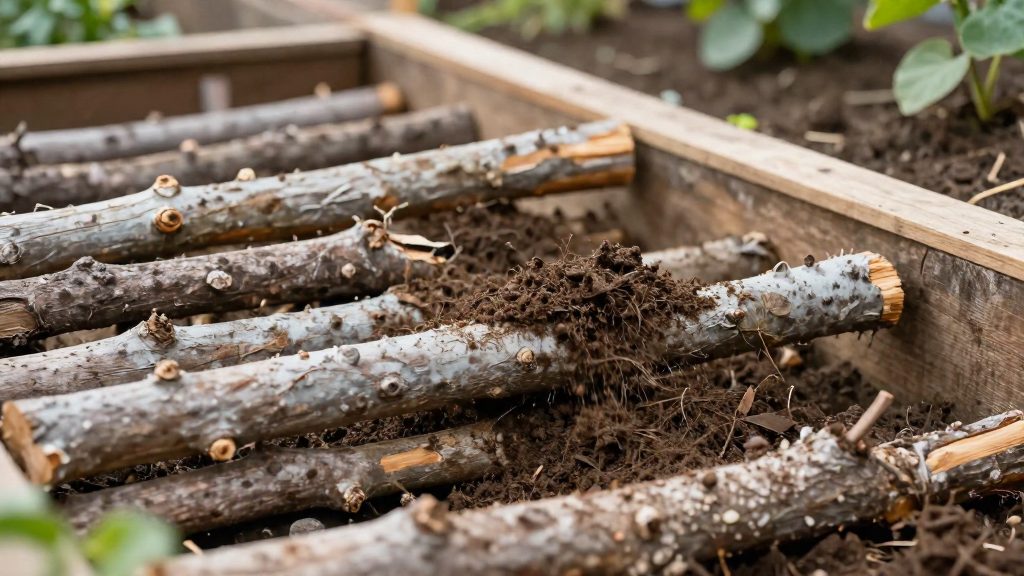
According to the Farmers’ Almanac, freshly cut green wood draws nitrogen from the soil during the first two years of a hugelkultur bed. The main preventive step is to age the logs before burying them, and the same source recommends 6–12 months. Nitrogen-rich organic material placed within the layers helps offset the early demand. Settling is a normal part of the process as the wood decomposes, and it is managed by topping up the bed with compost and topsoil. The sources consulted do not give a settling rate, so check the bed surface each season rather than following a fixed schedule.
Choose the right wood
| Wood | Recommendation | Reason given |
|---|---|---|
| Oak, fruit trees, alder, poplar | Preferred | Listed as better choices |
| Black walnut | Avoid | Juglone toxicity for 5+ years |
| Cedar and redwood | Avoid | 20+ years to break down |
| Black locust | Avoid | 25+ years to break down |
Build the nitrogen layer
Build the bed in this order:
- Largest wood at the bottom
- Smaller branches on top of the large wood
- A nitrogen-rich layer of leaves, unsprayed grass clippings, or manure
Choose unsprayed grass clippings to keep synthetic herbicide residues out of the bed. Manure and leaves supply the nitrogen-rich layer in this build.
Manage settling
Settling happens as the wood breaks down. To control it:
- Fill gaps between the wood with subsoil before adding the top layers.
- Cover with 3–4 inches (about 8–10 cm) of compost, then 1–2 inches (about 2.5–5 cm) of topsoil.
- When the surface drops, add compost to restore the bed height.
Raised height also helps drainage in wet areas, according to the Farmers’ Almanac.
Hugelkultur in cold climates: what the source covers
In cold climates, hugelkultur beds are reported to raise root-zone warmth and can extend the growing season, according to the Farmers’ Almanac. The same source says that by about year 3, a bed retains enough water that irrigation may no longer be needed. The consulted source does not give Canadian frost dates or hardiness zones, so check your local last-frost date and growing-season length before planting.
How the bed behaves in cold conditions
- Root-zone warmth: As the buried wood decomposes, it raises the temperature of the root zone, which can extend the growing season in cold climates.
- Water retention: The wood and organic layers hold moisture. By about year 3, irrigation may no longer be needed.
- Drainage in wet areas: Raising the bed above the surrounding ground improves drainage where the soil stays wet.
Timeline by year
| Period | What happens | Practical implication |
|---|---|---|
| Years 1–2 | Freshly cut green wood draws nitrogen from the soil | Age logs 6–12 months before building, and add a nitrogen-rich layer |
| Years 1–2 (cold climates) | Decomposition begins to warm the root zone | Expect the warming effect to build gradually |
| About year 3 | The bed retains enough water that irrigation may no longer be needed | Monitor soil moisture before watering on a fixed schedule |
Building for cold climates
- Collect wood early. Gather logs and let them age for 6–12 months so they do not tie up soil nitrogen during the first seasons.
- Choose the footprint. The recommended minimum is about 3 ft x 6 ft (roughly 0.9 m x 1.8 m). Larger is better.
- Layer from the bottom up. Place the largest wood first, then smaller branches, then a nitrogen-rich layer such as leaves, unsprayed grass clippings, or manure.
- Finish the top. Fill gaps with subsoil, then add 3–4 in (about 8–10 cm) of compost and 1–2 in (about 2.5–5 cm) of topsoil.
- Site it well. Choose a sunny spot, and water without waterlogging the bed.
Limits of the source
The consulted source does not address snow load, freeze-thaw cycles, or winter management of the bed. Confirm these points with local growers or a regional extension service before building a large bed.
First-year management of a hugelkultur bed
A new hugelkultur bed needs a cautious first-year plan because the buried wood is still decomposing. According to the Farmers’ Almanac, freshly cut green wood draws nitrogen from the soil in years 1–2, so nutrient supply near the roots is the main constraint during this period. The official sources consulted do not specify individual vegetable varieties or sowing dates for these beds, so the guidance below rests on general principles rather than crop-by-crop data.
Nitrogen supply is the first factor to manage. The compost and topsoil cap is the layer to rely on in the early seasons, since the wood below is still drawing nitrogen. The Farmers’ Almanac describes a top layer of 3–4 inches (about 8–10 cm) of compost and 1–2 inches (about 2.5–5 cm) of topsoil. The nitrogen-rich layer added during construction (leaves, unsprayed grass clippings, manure) supports the bed as it settles.
A practical approach for the first year:
- Plant into the upper layers only. Sow or transplant into the compost and topsoil cap rather than into deeper soil near the wood.
- Keep the bed moist. The Farmers’ Almanac notes that by about year 3 the bed retains enough water that irrigation may no longer be needed. Year-one watering is therefore still necessary. Water without waterlogging the bed.
- Choose a sunny spot. Position the bed where it receives full light.
- Record the results. Note which plants grow well and which struggle through the first season. This record gives you the data to adjust crop choices in year two, when the wood is still drawing nitrogen.
Regional climate changes the picture. In cold climates, the Farmers’ Almanac notes that decomposing wood raises root-zone warmth and can extend the growing season. In wet areas, the raised height improves drainage, which suits crops that dislike standing water. Adapt your first-year choices to your own conditions rather than following a fixed list.
Frequently asked questions
How big should a first hugelkultur bed be?
According to the Farmers’ Almanac, a practical minimum footprint is about 3 ft x 6 ft (roughly 0.9 m x 1.8 m), and larger beds generally work better. Beginners can start at this size and extend the bed once they see how the wood core settles.
Can I bury freshly cut logs right away?
The Farmers’ Almanac advises against it, because green wood draws nitrogen from the soil during its first one to two years. Letting logs age for 6 to 12 months before burying them avoids competing with your vegetables for nitrogen.
When can I stop watering a hugelkultur bed?
According to the Farmers’ Almanac, by about year 3 the bed holds enough moisture, thanks to its water retention from the decomposing wood, that irrigation may no longer be needed. Keep watering during dry spells in the early years, since the core is still building its capacity.