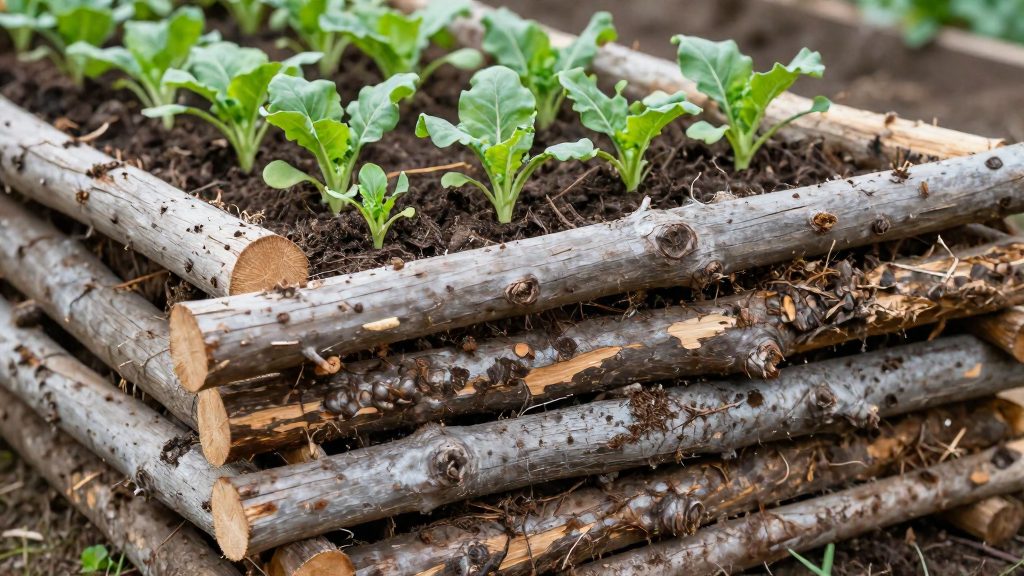

Raised beds suit strawberries mainly because they drain better than heavy ground and let you build the soil mix yourself. Agriculture and Agri-Food Canada (2000) notes that strawberries do best in deep sandy loam rich in humus, which drains well but holds moisture. It recommends ridges or raised beds for clay soils, where poorly drained clay is the least suitable option. The main trade-off is that raised beds dry out faster than in-ground beds.
Why grow strawberries in raised beds?
Raised beds address the drainage problem that makes clay soils unsuitable for strawberries. Because the bed sits above the native ground, excess water moves away from the crowns, the base of the plant where roots and leaves meet. This lowers the risk of waterlogging, a problem in poorly drained clay, which is the least suitable soil for strawberries.
The bed also gives you control over the growing medium. Savvy Gardening (2024) suggests a mix of about 50/50 topsoil and compost or aged manure, with a target pH of 5.8 to 6.2. Agriculture and Agri-Food Canada (2000) gives a wider general range of 5.5 to 6.5 as the best pH for strawberries, so the bed mix target is narrower than the general guidance.
| Parameter | Recommendation | Source |
|---|---|---|
| Soil texture | Deep sandy loam rich in humus, drains well but holds moisture | Agriculture and Agri-Food Canada (2000) |
| Bed mix | About 50/50 topsoil and compost or aged manure | Savvy Gardening (2024) |
| pH | 5.8 to 6.2 for the bed mix | Savvy Gardening (2024) |
| Spacing | 8 to 10 inches (about 20 to 25 cm) apart, in staggered rows | Savvy Gardening (2024) |
| Mulch | 1 to 2 inches (about 2.5 to 5 cm) of straw or shredded leaves after the first frost and before a deep freeze | Savvy Gardening (2024) |
Watering and moisture
Because raised beds dry out faster than in-ground beds, check moisture often, especially during dry spells. Water deeply in the morning so foliage dries before night, which reduces the time leaves stay wet.
Mulch and late-season care
Straw and shredded leaves are organic mulches that suit this method. Apply them after the first frost, before a deep freeze, and keep them away from the crowns. Do not fertilize late in the season.
Fertilization results
In a Québec trial using 3-litre containers with drip irrigation, organic and conventional fertilization and growing media had no significant effect on total yield or fruit size, according to Dalhousie University, Organic Agriculture Centre of Canada (2012). The trial used containers rather than raised beds, so it should not be read as a direct measure of raised-bed results.

Which soil mix should you choose for organic strawberries?
Strawberries grow best in deep sandy loam rich in humus, a soil that drains well but still holds moisture. Poorly drained clay is the least suitable soil, and Agriculture and Agri-Food Canada (archived copy, 2000) recommends ridges or raised beds for clay soils. For an organic raised bed, the goal is a light, fertile mix with good drainage, not a heavy garden soil brought in as is.
| Parameter | Recommended value | Source |
|---|---|---|
| Soil texture | Deep sandy loam rich in humus | Agriculture and Agri-Food Canada (archived copy, 2000) |
| General soil pH | 5.5 to 6.5 | Agriculture and Agri-Food Canada (archived copy, 2000) |
| Raised-bed mix pH | 5.8 to 6.2 | Savvy Gardening (2024) |
| Suggested blend | About 50/50 topsoil and compost or aged manure | Savvy Gardening (2024) |
Building the blend
- Combine topsoil with compost or aged manure in roughly equal parts. This is an organic way to add organic matter without synthetic inputs.
- Test the pH before planting. The target range for a raised-bed mix is 5.8 to 6.2 according to Savvy Gardening (2024).
- If the soil is acidic, Agriculture and Agri-Food Canada (archived copy, 2000) gives a general recommendation of about 1 kg of dolomitic limestone per m², worked into the soil one year before planting.
Checking the mix in practice
A Québec trial by Dalhousie University, Organic Agriculture Centre of Canada (2012) compared organic and conventional fertilization. It found that fertilization and growing media had no significant effect on total yield or fruit size. That trial used drip irrigation and 3-litre containers, so its results may not transfer directly to raised beds.
Raised beds dry out faster than in-ground beds, so check moisture often and water deeply in the morning. This lets the foliage dry before nightfall (Savvy Gardening, 2024).
What the sources say about ‘Seascape’ and ‘Charlotte’
Variety choice in Canada depends on the region and on the growing system, and the official sources consulted do not give one national list. The only direct varietal comparison in the sources is a Québec trial by Dalhousie University, Organic Agriculture Centre of Canada (2012), in which ‘Seascape’ was about 40% more productive than ‘Charlotte’. That trial used organic and conventional fertilization, drip irrigation and 3-litre containers, so the figure describes relative performance under those conditions, not a guaranteed yield in a garden bed.
Varieties named in the sources
- ‘Seascape’: about 40% more productive than ‘Charlotte’ in the Québec trial (Dalhousie University, Organic Agriculture Centre of Canada, 2012).
- ‘Charlotte’: the comparison cultivar in the same trial.
The consulted sources do not specify further characteristics for either cultivar, so check local extension or nursery recommendations for your province before buying.
Spacing by growing system
The matted-row system and the day-neutral spacing differ in both row width and in-row plant spacing:
| System | Row spacing | Plant spacing | Source |
|---|---|---|---|
| Day-neutral varieties | 80 cm | 30 cm | Agriculture and Agri-Food Canada (archived copy, 2000) |
| Matted-row system | 1.4 m | 50 cm in the row | Agriculture and Agri-Food Canada (archived copy, 2000) |
| Raised-bed staggered rows | about 20 to 25 cm between plants | staggered rows | Savvy Gardening (2024) |
According to Agriculture and Agri-Food Canada (archived copy, 2000), the matted-row system is the one best suited to Atlantic Canada.
Extending the harvest
In the same Québec trial, high tunnels extended the harvest by 4 weeks compared with the field crop. Fertilization and growing media had no significant effect on total yield or fruit size in that trial. The 4-week harvest extension with high tunnels and the productivity gap between cultivars were reported under container and drip-irrigation conditions, so they may not carry over to a raised bed.
Bed preparation for any variety
Raised beds dry out faster than in-ground beds, so check moisture often and water deeply in the morning so foliage dries before night (Savvy Gardening, 2024). For soil:
- Aim for deep sandy loam rich in humus. Poorly drained clay is the least suitable soil, and ridges or raised beds are recommended for clay (Agriculture and Agri-Food Canada, archived copy, 2000).
- The best pH is 5.5 to 6.5. On acidic soils, the general recommendation is about 1 kg of dolomitic limestone per m², worked in one year before planting.
- A raised-bed mix of about 50/50 topsoil and compost or aged manure, at pH 5.8 to 6.2, is suggested by Savvy Gardening (2024). Compost and aged manure are organic amendments.
- Mulch with 1 to 2 inches of straw or shredded leaves after the first frost and before a deep freeze. Keep mulch off the crowns and avoid fertilizing late in the season.
How to plant and space strawberry plants
Strawberries grow best in deep, sandy loam rich in humus. According to Agriculture and Agri-Food Canada (archived copy, 2000), this soil drains well but still holds moisture. Poorly drained clay is the least suitable option, and the same source recommends ridges or raised beds for clay soils. The best soil pH is 5.5 to 6.5. Raised beds let you control the planting medium directly, which is useful when the native soil is heavy or acidic.
Preparing the bed
- Build the mix: Savvy Gardening (2024) suggests about 50/50 topsoil and compost or aged manure for raised beds, with a target pH of 5.8 to 6.2.
- Correct acidity early: For acidic soils, Agriculture and Agri-Food Canada (archived copy, 2000) gives a general recommendation of about 1 kg of lime per m², applied as dolomitic limestone and worked in one year before planting.
- Mix thoroughly: Work the compost into the topsoil before planting so the roots meet an even medium rather than layers.
Spacing by system
Spacing depends on the cultivation system. The official sources consulted give these figures:
| System | Row spacing | Plant spacing | Source |
|---|---|---|---|
| Day-neutral varieties | 80 cm | 30 cm | Agriculture and Agri-Food Canada (archived copy, 2000) |
| Matted-row system | 1.4 m | 50 cm in the row | Agriculture and Agri-Food Canada (archived copy, 2000) |
| Raised bed, staggered rows | Not specified | 8 to 10 inches (about 20 to 25 cm) | Savvy Gardening (2024) |
The matted-row system is described as the best fit for Atlantic Canada. For a raised bed, staggered rows let each plant sit between two plants in the row above, so no plant shades its neighbour directly.
Planting steps
- Choose a sunny spot. Place the bed where it receives full sun for most of the day.
- Set the plants at the right height. Position each crown at soil level. A buried crown can rot, and a crown set too high can dry out.
- Water in gently. Water deeply enough to settle the soil around the roots without leaving it waterlogged.
- Keep the bed moist, not soaked. Raised beds dry out faster than in-ground beds, so check moisture often. Savvy Gardening (2024) recommends watering deeply in the morning so the foliage dries before nightfall.
Organic alternatives
Savvy Gardening (2024) advises against black plastic as mulch for raised-bed strawberries. Use 1 to 2 inches of straw or shredded leaves instead, applied after the first frost and before a deep freeze, and keep it off the crowns. For fertility, compost or aged manure in the mix is the organic base described above, so no synthetic fertilizer is needed at planting.
Watering and mulching: what to do?
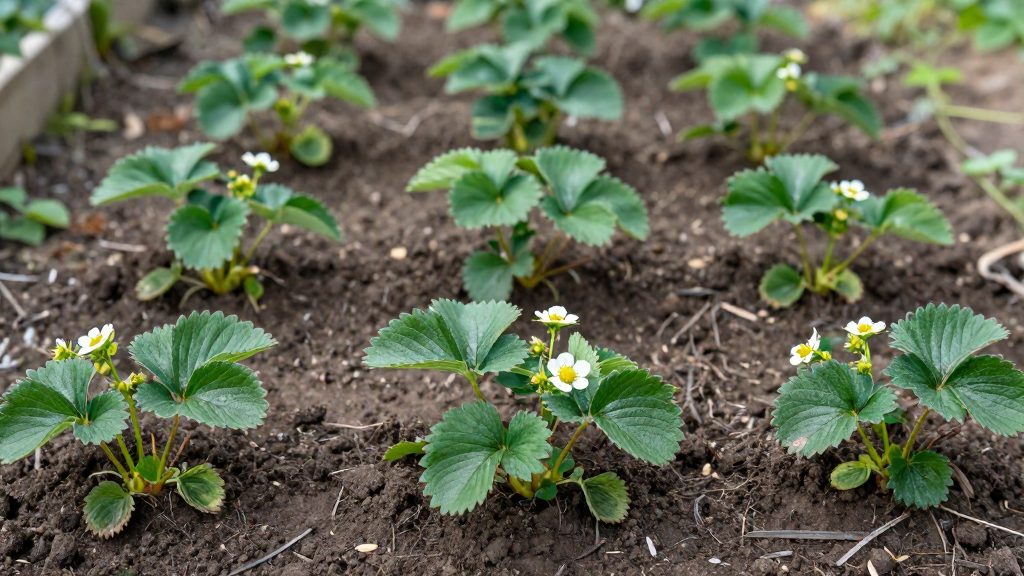
Strawberries in raised beds need closer attention to moisture than those in the ground. According to Savvy Gardening (2024), raised beds dry out faster than in-ground beds, so the soil should be checked often, especially during warm or windy spells. Push a finger into the soil near the plants: if the top layer is dry, it is time to water. A raised bed that drains quickly also loses nutrients with the water, so the watering routine matters as much as the volume.
Watering routine
- Water deeply, not briefly. A thorough soak that reaches the root zone is better than frequent light sprinkling, which keeps the surface wet and leaves the roots dry.
- Water in the morning. Savvy Gardening (2024) recommends morning watering so the foliage dries before night.
- Water at the base of the plants. Direct the water to the soil rather than over the crowns and leaves. Drip irrigation was the method used in a Québec trial of organic and conventional fertilization (Dalhousie University, Organic Agriculture Centre of Canada, 2012), but that trial used containers, so its results do not directly show how drip irrigation performs in a raised bed.
Mulching
Mulch protects the soil and keeps the fruit clean, but timing and material matter. Savvy Gardening (2024) gives the following guidance:
| Material | Depth | When to apply |
|---|---|---|
| Straw | 1–2 inches | After the first frost, before a deep freeze |
| Shredded leaves | 1–2 inches | After the first frost, before a deep freeze |
Apply the mulch around the plants, keeping it off the crowns, the central part of each plant where the leaves emerge. Organic straw and shredded leaves are the natural options recommended here.
How to Protect Strawberry Plants from a Canadian Winter
Protecting strawberry plants through a Canadian winter depends on three things: timing the mulch, keeping the crowns clear, and avoiding late-season feeding that pushes new growth before the cold. According to Savvy Gardening (2024), raised-bed strawberries should receive 1–2 inches (about 2.5–5 cm) of straw or shredded leaves after the first frost and before a deep freeze. Straw and shredded leaves are organic mulches, so this method requires no synthetic products. The official sources consulted do not specify calendar dates for the first frost or deep freeze in each region, so check local frost records to set the timing.
Winter Routine Step by Step
| Step | Action | Source |
|---|---|---|
| 1 | Wait for the first frost before mulching | Savvy Gardening (2024) |
| 2 | Spread 1–2 inches (about 2.5–5 cm) of straw or shredded leaves over the bed, before a deep freeze | Savvy Gardening (2024) |
| 3 | Keep the mulch off the crowns, the central part of each plant | Savvy Gardening (2024) |
| 4 | Do not fertilize late in the season | Savvy Gardening (2024) |
Why Raised Beds Need Extra Attention
Raised beds dry out faster than in-ground beds, according to Savvy Gardening (2024). Check soil moisture often in the weeks before winter, and water deeply in the morning so the foliage dries before night. Wet foliage held through the night increases the risk of disease.
Drainage also matters. According to Agriculture and Agri-Food Canada (archived copy, 2000), strawberries do best in deep sandy loam rich in humus, which drains well but holds moisture. Poorly drained clay is the least suitable soil, and ridges or raised beds are recommended for clay soils. A raised bed filled with a mix of about 50/50 topsoil and compost or aged manure, as suggested by Savvy Gardening (2024), helps water leave the root zone.
Mulch Choices
Straw and shredded leaves are the mulches named in the guidance. Keep the layer even and avoid piling it directly against the crowns, since this can hold moisture where the plant is most vulnerable.
Preventing pests and diseases through growing conditions
Preventing pests and diseases in organic raised-bed strawberries starts with growing conditions. The sources consulted do not specify pest-specific products, dosages, or treatment schedules, so the practices below cover what they do describe: soil drainage, watering, mulching, spacing, and fertilizing. Plants that stay dry, airy, and out of waterlogged soil give problems fewer conditions to develop, and none of these steps requires synthetic inputs.
Start with drainage
According to Agriculture and Agri-Food Canada (2000), strawberries do best in deep sandy loam rich in humus, which drains well but still holds moisture. Poorly drained clay is the least suitable soil, and the same source recommends ridges or raised beds for clay soils. A raised bed is therefore the right structure for heavy ground. Savvy Gardening (2024) suggests a mix of about 50/50 topsoil and compost or aged manure, with a pH of 5.8–6.2. Checking drainage before planting is the first preventive step.
Water deeply, in the morning
Raised beds dry out faster than in-ground beds. Savvy Gardening (2024) advises checking moisture often and watering deeply in the morning, so that the foliage dries before night. Leaves that stay wet overnight are the condition to avoid. Water the soil around the plants rather than spraying the leaves.
Mulch at the right time
Savvy Gardening (2024) recommends covering raised-bed strawberries with 1–2 inches of straw or shredded leaves after the first frost and before a deep freeze. Keep the mulch off the crowns, the central part of each plant where leaves emerge.
Space plants for airflow
Spacing affects how air moves between plants. The sources consulted give the following distances:
| System | Spacing | Source |
|---|---|---|
| Raised-bed mix (Savvy Gardening) | 8–10 inches apart, in staggered rows | Savvy Gardening (2024) |
| Day-neutral varieties (AAFC) | Rows 80 cm apart, plants 30 cm apart | Agriculture and Agri-Food Canada (2000) |
| Matted-row system (AAFC) | Rows 1.4 m apart, plants 50 cm apart in the row | Agriculture and Agri-Food Canada (2000) |
The sources do not state how spacing affects specific diseases, but keeping plants from crowding is a basic cultural measure.
Manage fertilizing
Savvy Gardening (2024) advises not to fertilize late in the season. Using compost or aged manure in the bed mix supplies nutrients without synthetic fertilizers.
Organic alternatives
Cultural practices are the main organic approach described here. Inspect plants regularly, and if a treatment becomes necessary, check that the product is approved for organic use in your region before applying it.
Frequently asked questions
What soil mix should I fill a strawberry raised bed with?
Savvy Gardening (2024) suggests a 50/50 mix of topsoil and compost or aged manure, aiming for a pH of 5.8 to 6.2. Mixing your own medium lets you control drainage and fertility without synthetic inputs.
How often should I water raised-bed strawberries?
Raised beds dry out faster than in-ground beds, so check moisture regularly, especially during dry spells. Water deeply in the morning, which lets the foliage dry before nightfall and reduces the risk of disease. This morning watering routine is the simplest organic way to keep the crowns healthy.
When and how should I mulch strawberries in a raised bed for winter?
Apply 1 to 2 inches of straw or shredded leaves after the first frost and before a deep freeze, according to Savvy Gardening (2024). Keep the winter mulch away from the crowns, and avoid black plastic, which traps heat and moisture around the plants.