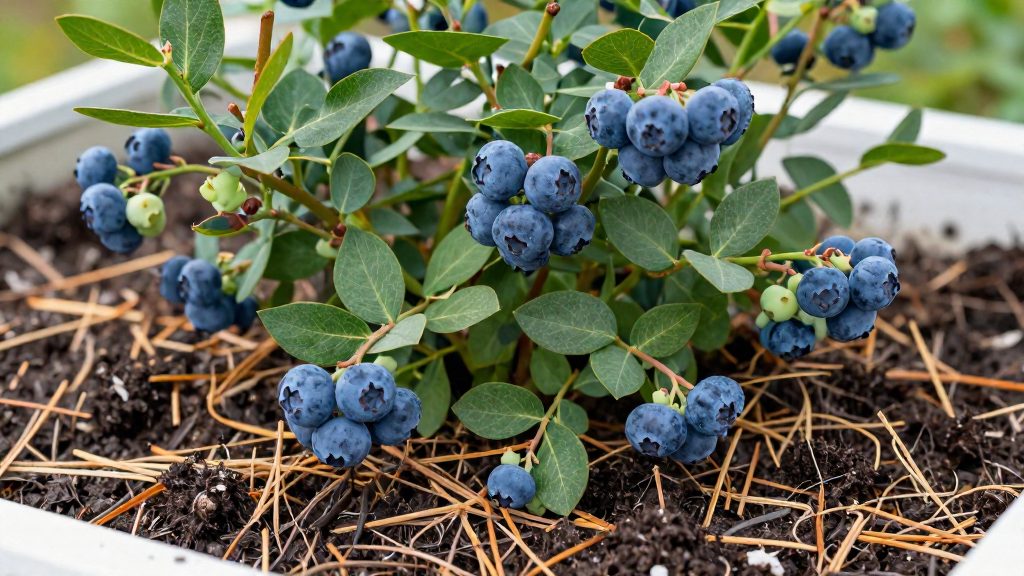
Blueberry bushes need acidic soil, with a target pH of 4.5 to 5.0 and a tolerance up to 5.5, according to the Government of Ontario (2023). Soil between pH 5.0 and 6.5 can be lowered with elemental sulfur. Above pH 6.5, sulfur alone is not enough, and the soil is considered unsuitable. Organic growers can add acidic organic matter such as sphagnum peat, compost, or aged sawdust to help keep the pH low.
What pH does an organic blueberry bush need?
The pH range determines whether you can correct the soil or need to choose another site.
| Soil pH | Status for blueberry | Action |
|---|---|---|
| 4.5 to 5.0 | Target range | Maintain with organic matter |
| 5.0 to 5.5 | Tolerated upper limit | Tolerated; sulfur (see the 5.0 to 6.5 row) can lower it toward 4.5 to 5.0 |
| 5.0 to 6.5 | Correctable | Apply sulfur before planting |
| Above 6.5 | Not suitable | Sulfur alone does not work; choose another site |
The Government of Ontario (2023) gives these figures. Test the soil before planting, because the sulfur rate depends on the starting pH.
Applying sulfur
- Apply sulfur the year before planting.
- Mix it into the top 20 cm of soil.
- Use the rate that matches your soil texture:
| Soil type | Sulfur rate (per pH point above 4.5) |
|---|---|
| Sandy loam | 75 to 100 g/m² |
| Sandier soil | 35 to 50 g/m² |
The Government of Ontario (2023) provides these rates. The sources consulted do not specify whether a given sulfur product is permitted under organic certification. Check the product label against your certifier’s list before buying.
Organic matter to lower and buffer pH
- Incorporate 10 to 15 cm of acidic sphagnum peat into the top 15 to 20 cm of soil.
- Other organic sources include manure, straw, compost, and aged sawdust (Government of Ontario, 2023).
- Organic matter improves soil structure, which supports the well-drained, loose soil that blueberry roots need. According to the University of British Columbia (UBC Wiki), roots can suffocate within a few days in waterlogged soil, and clay soils and low, frost-prone sites should be avoided.
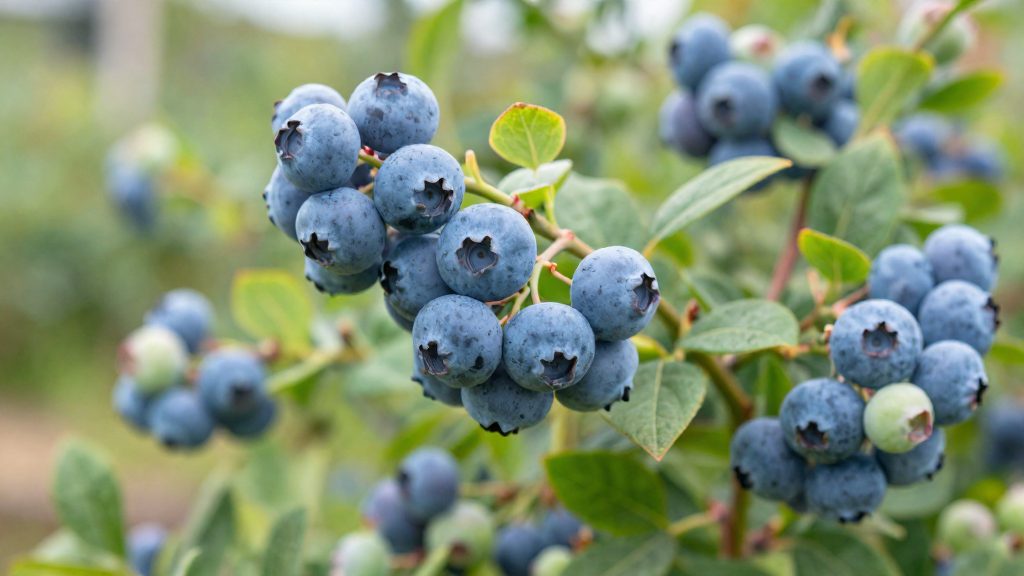
Preparing acidic, well-drained soil
Blueberry bushes need strongly acidic soil with a pH of 4.5 to 5.0, and they tolerate up to 5.5. The Government of Ontario (2023) advises testing the soil before planting. If the pH is between 5.0 and 6.5, elemental sulfur can lower it. Above 6.5, sulfur alone is not enough, and the site is not suitable for blueberries without major changes. Sulfur is a mineral amendment, and the official sources consulted do not specify its organic certification status, so check with your certifier before use.
Test and adjust the pH
| Soil pH | Action |
|---|---|
| 4.5 to 5.0 | Target range |
| Up to 5.5 | Tolerated |
| 5.0 to 6.5 | Apply sulfur to lower the pH |
| Above 6.5 | Sulfur alone is insufficient; the soil is unsuitable |
Apply sulfur the year before planting
- Apply sulfur one year before planting.
- Mix it into the top 20 cm of soil.
- For a sandy loam, apply 75 to 100 g/m² for each full pH point above 4.5.
- For a sandier soil, apply 35 to 50 g/m².
Ontario guidance (2023) gives these rates. Retest the soil after application so you know whether the pH is moving toward the target range.
Add acidic organic matter
Organic matter improves drainage and holds moisture in sandy soils while keeping the soil loose. Work 10 to 15 cm of acidic sphagnum peat into the top 15 to 20 cm of soil. Other organic sources listed in the same guidance include:
- Manure
- Straw
- Compost
- Aged sawdust
Ensure good drainage
Drainage is the main site requirement. Blueberry roots need oxygen, and the UBC Wiki notes that roots can suffocate within days in waterlogged soil. Choose a site that is loose, well-drained and rich in organic matter. Avoid heavy clay soils and low spots that are exposed to frost.
Plan spacing before planting
Ontario guidance (2023) recommends spacing plants 1.0 to 1.5 m apart within the row and 1.5 to 3.0 m between rows. Adequate spacing gives each bush room to grow and keeps air moving around the plants. Several cultivars that cross-pollinate and extend the harvest period are also recommended in the same guidance.
Planting and mulching blueberry bushes
Planting starts with the soil. According to the Government of Ontario (2023-03-31), the target soil pH for blueberry bushes is 4.5 to 5.0, with tolerance up to 5.5. Soil at pH 5.0 to 6.5 can be acidified with sulfur. Above 6.5, sulfur alone is not enough and the soil is not suitable. Test the pH before planting and choose a site that is well drained, loose, and rich in organic matter. The University of British Columbia (UBC Wiki) advises avoiding heavy clay soils and low sites exposed to frost, because roots can suffocate within days in waterlogged ground.
Lowering soil pH with sulfur
Apply sulfur the year before planting and mix it into the top 20 cm of soil. The Government of Ontario (2023-03-31) gives rates per square metre for each point of pH above 4.5:
| Soil type | Sulfur rate (per pH point above 4.5) |
|---|---|
| Sandy loam | 75 to 100 g/m² |
| Sandier soil | 35 to 50 g/m² |
For example, a sandy loam at pH 5.5 is one point above 4.5, so the rate is 75 to 100 g/m².
Adding organic matter
Work in 10 to 15 cm of acidic sphagnum peat moss, mixed into the top 15 to 20 cm of soil. Organic alternatives include manure, straw, compost, and aged sawdust, all listed by the Government of Ontario (2023-03-31) as sources of organic matter.
Spacing the plants
| Spacing | Distance |
|---|---|
| Between plants in the row | 1.0 to 1.5 m |
| Between rows | 1.5 to 3.0 m |
Watering after planting
The Government of Ontario (2023-03-31) gives an irrigation figure of about 10 to 20 L per day until early September. After that, stop watering unless the soil is very dry. Drip irrigation suits this crop well. Avoid overwatering and late autumn watering.
Mulching with natural materials
Mulch with sawdust, wood chips, or clean straw spread 5 to 10 cm thick. Start with a band 60 cm wide around each plant, then widen it as the bushes grow. Natural mulches like these are an organic alternative to synthetic ground covers.
How to water and fertilize naturally
Blueberry bushes need consistent moisture, acidic soil, and organic matter rather than conventional fertilizer. According to the Government of Ontario (2023), watering is about 10 to 20 litres per day until early September, after which it should stop unless the soil is very dry. Soil pH should sit between 4.5 and 5.0, with tolerance up to 5.5. Feeding comes mainly from incorporating organic matter before planting and maintaining a mulch layer, so the bushes build fertility gradually.
Watering
- Water steadily during the growing season. Blueberry roots are shallow and sensitive to drought, so keep the root zone evenly moist.
- Stop watering in early September. Late-autumn watering encourages growth that does not harden off before frost. Water only if the soil is very dry.
- Avoid waterlogging. Excess water is as harmful as drought. The University of British Columbia (UBC Wiki) notes that roots can suffocate within a few days in waterlogged soil.
- Use drip irrigation. The Government of Ontario (2023) identifies drip systems as well suited to blueberries because they add small amounts of water each day directly to the soil around the base of each plant.
Building fertility with organic matter
Before planting, the Government of Ontario (2023) recommends mixing 10 to 15 cm of acidic sphagnum peat moss into the top 15 to 20 cm of soil. Other organic sources include:
- Manure
- Straw
- Compost
- Aged sawdust
These materials improve drainage and structure in the root zone, which blueberries require. The official sources consulted do not specify application rates for manure or compost, so start with a moderate amount and adjust based on soil texture and plant vigour.
Acidifying the soil with sulfur
When pH is between 5.0 and 6.5, elemental sulfur can lower it toward the target range. Sulfur must be applied the year before planting and mixed into the top 20 cm of soil. Rates depend on soil texture:
| Soil type | Sulfur rate (per m²) | Per pH point above 4.5 |
|---|---|---|
| Sandy loam | 75 to 100 g | Yes |
| Sandier soil | 35 to 50 g | Rate given by Ontario without specifying a per-point basis |
Above pH 6.5, sulfur alone is not enough, and the Government of Ontario (2023) considers the soil unsuitable for blueberries without substantial amendment. Sulfur is a mineral amendment, and the sources consulted do not specify its status under organic certification. Check the product label against your certifier’s list before use.
Mulching to support moisture and organic feeding
Apply sawdust, wood chips, or clean straw in a layer 5 to 10 cm thick. Start with a band about 60 cm wide and widen it as the plants grow. Mulch conserves soil moisture and decomposes slowly, returning organic matter to the root zone over time.
Pruning at the Right Time
Pruning is the main structural task for a blueberry bush in organic growing, and timing matters as much as the cuts themselves. According to the Government of Ontario (2023), pruning should take place in late winter or early spring, and autumn pruning is not recommended. Pruning is a mechanical task that requires no synthetic inputs, so it fits naturally into an organic management routine.
Young plants need little pruning. The Government of Ontario (2023) notes that they require only light pruning for their first 3 years, which gives the root system and the first canes time to establish.
| Plant age | Pruning approach |
|---|---|
| Years 1 to 3 | Light pruning only |
| After year 3 | Keep 12 to 16 vigorous canes per bush |
| Mature bush | Remove canes older than 5 years or thicker than 5 cm in diameter |
Once the bush is established, the steps are:
- Wait for the dormant period in late winter or early spring, before new growth starts.
- Identify the oldest canes, those over 5 years old, and the thickest canes, those over 5 cm in diameter.
- Remove these canes at the base so that the bush keeps 12 to 16 vigorous canes.
- Check that the remaining canes are healthy and well spaced to let light and air reach the centre of the bush.
Removing old canes regularly renews the cane age structure of the plant, which supports steady fruit production over the years.
Protecting Berries and Plants
Protecting blueberry bushes depends mainly on physical barriers, frequent harvesting, and sound watering, pruning, and drainage. The Government of Ontario (2023-03-31) names two threats to the fruit: birds, which feed on ripening berries, and spotted wing drosophila (SWD), a pest of berries. The measures below are non-chemical and suit organic growing.
| Threat or concern | Non-chemical measure | Timing |
|---|---|---|
| Birds | Cover the plants with netting | Put on just before the berries turn blue; remove after harvest |
| Spotted wing drosophila (SWD) | Harvest every 1 to 2 days and refrigerate the berries quickly | Throughout the harvest period |
| Soil cover | Sawdust, wood chips, or clean straw, 5 to 10 cm thick | Start with a 60 cm band around each plant and widen it as the plants grow |
Netting against birds
Netting is the main physical barrier against birds. Fit it over the bush just before the berries turn blue, so that birds cannot reach the fruit while it ripens. Remove it once harvest is finished. Check that the edges are closed so birds cannot slip underneath.
Frequent harvesting against SWD
Harvesting often limits the time berries stay on the bush, which reduces their exposure to SWD. Pick every 1 to 2 days and cool the fruit as soon as possible. Refrigerating berries promptly is the step the source specifically recommends.
Mulch and soil cover
A mulch of sawdust, wood chips, or clean straw, 5 to 10 cm thick, keeps the root zone covered. Begin with a band about 60 cm wide around each plant, then widen it as the bush grows. The Government of Ontario (2023-03-31) also lists aged sawdust and compost among organic matter sources for the soil.
Watering without waterlogging
The Government of Ontario (2023-03-31) gives an approximate figure of 10 to 20 litres per day until early September. After that, watering should stop unless the soil is very dry. Avoid excess water and late-autumn watering. Drip irrigation suits this crop well. The Government of Ontario gives this volume per bush, per day.
Pruning to protect plant health
Prune in late winter or early spring. Autumn pruning is discouraged. Young plants need little pruning for their first 3 years. After that, keep 12 to 16 vigorous canes and remove those more than 5 years old or more than 5 cm in diameter (Government of Ontario, 2023-03-31).
Drainage and site choice
Blueberry roots need well-drained, loose soil rich in organic matter. According to the UBC Wiki, clay soils and low sites exposed to frost should be avoided. Roots can suffocate within a few days in waterlogged soil, so drainage matters as much as water volume.
Why plant more than one variety?
Planting more than one blueberry cultivar is a simple way to support pollination and extend the harvest in an organic planting. According to the Government of Ontario (2023), several cultivars favor cross-pollination, meaning pollen from one bush can reach the flowers of another. The same source notes that mixing cultivars also helps spread the harvest, so the berries do not all ripen at the same time.
In practice, the approach looks like this:
- Select cultivars with different ripening periods. Combine early, mid-season, and late types so the picking window spreads across the season.
- Check flowering overlap before buying. Cultivars that flower at the same time are the ones most likely to share pollen.
- Keep the recommended spacing. The Government of Ontario (2023) recommends 1.0 to 1.5 m between plants on the row and 1.5 to 3.0 m between rows, which gives each bush room for air circulation and growth.
- Label each bush when planting. Record the cultivar and planting date so you can compare harvest timing and yield in later seasons.
Mixing cultivars does not replace the other basics of blueberry care, such as acidic, well-drained soil and careful watering. Those conditions determine whether the plants can flower and set fruit in the first place, so the choice of cultivars works best alongside them.
Frequently asked questions
What soil pH does an organic blueberry bush need in Canada?
Blueberry bushes do best at a target pH of 4.5 to 5.0, and the Government of Ontario (2023) treats soil up to pH 5.5 as tolerated. If your soil reads between pH 5.0 and 6.5, you can lower it with elemental sulfur applied the year before planting, but above pH 6.5 sulfur alone will not correct it and you need another site. Test the soil before planting, because the sulfur rate depends on your starting pH.
How much sulfur should I apply, and is it allowed in organic growing?
For a sandy loam, the Government of Ontario (2023) gives 75 to 100 g/m² for each full pH point above 4.5, mixed into the top 20 cm of soil. For sandier soils, the same source gives 35 to 50 g/m² without stating whether that figure is per pH point. The sources consulted do not confirm that elemental sulfur is permitted under organic certification, so check the product label against your certifier’s list before buying.
How much water does a blueberry bush need during the growing season?
According to the Government of Ontario (2023), each bush needs about 10 to 20 L of water per day until early September, after which watering stops unless the soil becomes very dry. Drip irrigation suits blueberries well because it delivers small amounts of water directly to the soil at the base of each plant. Avoid overwatering and late-autumn watering, since the University of British Columbia (UBC Wiki) notes that roots can suffocate within days in waterlogged soil.