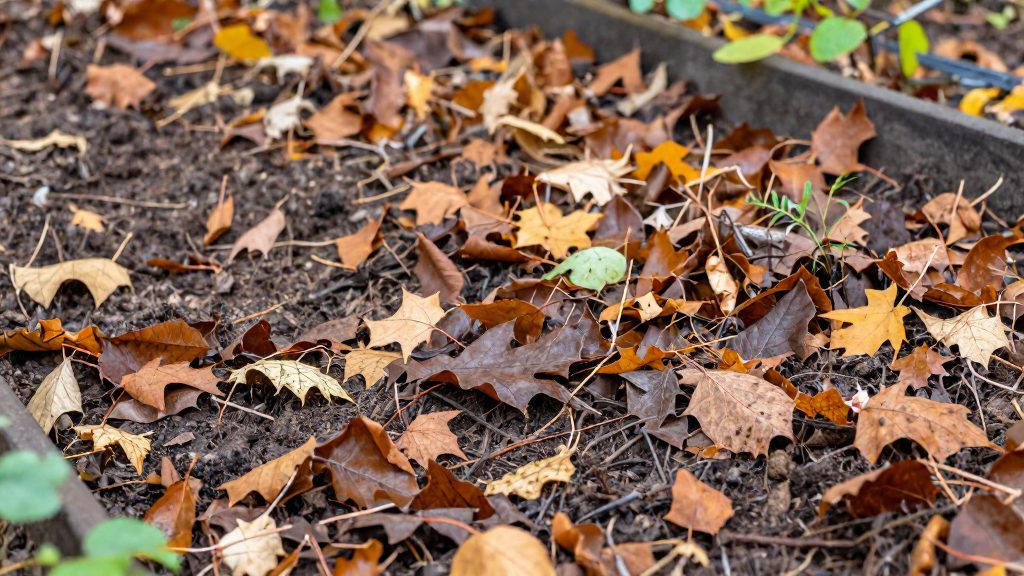
Leaves left on garden beds through winter insulate roots, hold moisture, return nutrients to the soil, improve its texture and feed the soil microbiome, according to Toronto Master Gardeners (2025). A layer of about 5 cm (2 in) imitates natural conditions, and most perennials can grow through about 7.5 cm (3 in) of shredded leaves or small whole leaves. Because the leaves break down on their own, this method needs no chemical inputs and suits organic beds.
Why Mulch with Autumn Leaves?
Autumn leaves work as a free, natural mulch. Their role in the bed depends on how they are applied and which species they come from.
What Leaf Mulch Does
- Insulates the roots of perennials during cold periods.
- Retains moisture in the soil.
- Returns nutrients as the leaves decompose.
- Improves soil texture and supports the soil microbiome.
- Protects perennials such as rhubarb, asparagus and daylilies, and slows some weeds, according to Art Knapp Surrey, a garden centre in British Columbia (2025).
Choosing the Right Leaves
Decomposition speed varies by species, which determines how long a mulch layer lasts:
| Leaf type | Decomposition time | Recommendation |
|---|---|---|
| Maple | Breaks down within one season | Suitable as mulch |
| Oak (whole leaves) | About five years | Shred part of them; perennials cannot push through a thick oak mat |
| Black walnut (Juglans) | Contains a compound that can slow growth of some plants | Keep out of beds; other leaves are acceptable |
Twigs and cones decompose more slowly than leaves, so they are better removed from beds. Black walnut is the one species the guide advises excluding from beds entirely.
How to Apply Leaf Mulch
- Rake the leaves onto the beds in autumn.
- Shred part of the leaves with a mower or shredder, which speeds decomposition.
- Keep some leaves whole, because shredding everything can kill overwintering insects.
- Spread a layer of about 5 cm (2 in), and no more than about 7.5 cm (3 in) for shredded or small leaves.
Disease Caveat
In Toronto, the main leaf fungal diseases are powdery mildew on Norway maple and tar spot. The city advises removing infected leaves for municipal collection, and Toronto Master Gardeners (2025) notes that almost all leaves are infected by autumn. Choose healthy leaves for mulch and remove visibly diseased ones.
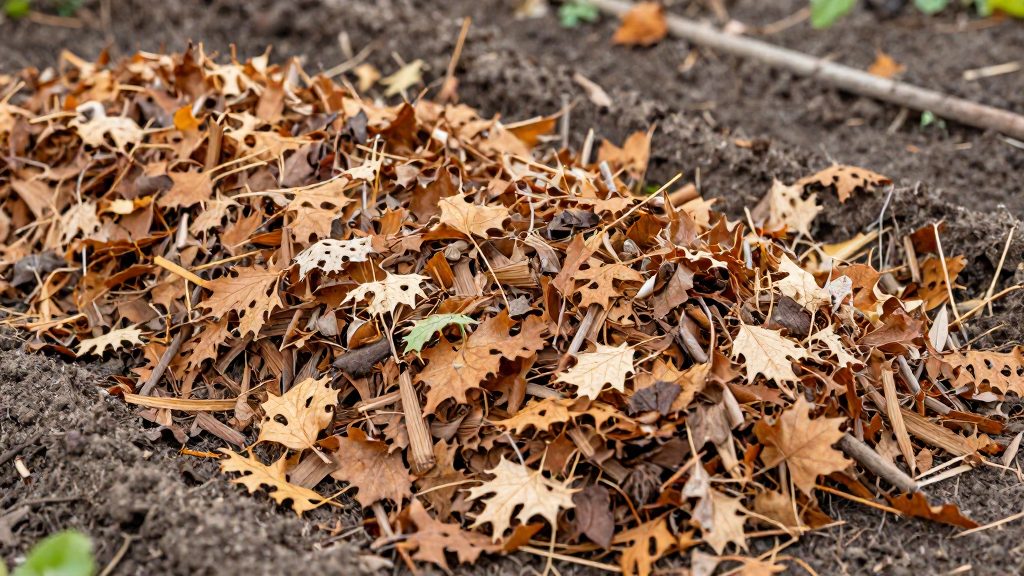
Which leaves to use and which to avoid?
Many leaves can be used as fall leaf mulch, but species and condition matter. According to Toronto Master Gardeners (2025), a layer of about 5 cm (2 in) of leaves mimics natural conditions, and most perennials can push through about 7.5 cm (3 in) of shredded leaves or small whole leaves. Walnut leaves are the main exception to watch for.
| Leaf type | Breakdown speed | How to use it |
|---|---|---|
| Maple | Breaks down within one season (Toronto Master Gardeners, 2025) | Good all-round mulch; spread it in a layer about 5 cm (2 in) deep |
| Oak (whole leaves) | Can take about five years to break down (Toronto Master Gardeners, 2025) | Shred first or mix with other leaves; perennials do not push through a thick mat of whole oak leaves |
| Black walnut (Juglans) | Not specified for decomposition | Keep out of beds: according to Art Knapp Surrey (2025), a compound in these leaves can harm some plants |
| Twigs and cones | Decompose slowly (Art Knapp Surrey, 2025) | Remove or limit them in beds |
Shredding speeds decomposition, but Toronto Master Gardeners (2025) notes it can kill overwintering insects. Leaving part of the leaf fall whole gives shelter to these insects while the rest breaks down faster.
Protecting perennials is one benefit of leaving leaves in place. According to Art Knapp Surrey (2025), leaves protect perennials such as rhubarb, asparagus and daylilies, and they slow some weeds.
Diseased leaves require care. In Toronto, the main leaf fungal diseases are powdery mildew (on Norway maple) and tar spot. The city advises removing infected leaves for municipal collection (Toronto Master Gardeners, 2025). The same guide states that almost all leaves are infected by autumn, so the official sources consulted do not specify how to handle this in a home garden.
Shredded or Whole Leaves?
Shredding and leaving leaves whole each suit a different purpose in an organic bed. Shredded leaves break down faster and form a mat that perennials can grow through. Whole leaves last longer and keep their structure over winter. According to Toronto Master Gardeners (2025), a layer of about 5 cm (2 in) of leaves imitates natural conditions, and most perennials emerge through about 7.5 cm (3 in) of shredded or small whole leaves. The Xerces Society is credited with that depth figure. The right choice depends on the leaf species and on how much overwintering life you want the bed to shelter.
Leaf type changes the result
| Leaf type | Decomposition time (Toronto Master Gardeners, 2025) | Practical effect in the bed |
|---|---|---|
| Maple | About one season | Breaks down quickly and feeds the soil soon |
| Whole oak leaf | About five years | Perennials cannot push through a thick oak mat |
Shredding versus leaving whole
- Shredding speeds decomposition.
- Shredding can kill insects that overwinter in the leaves, so the same source advises leaving some leaves whole.
- Twigs and cones decompose more slowly, according to Art Knapp Surrey (2025). Remove them or shred them separately.
Practical method
- Shred part of the leaves with a mower or by hand.
- Spread the shredded leaves in a layer of about 5 cm (2 in) over the bed.
- Leave some leaves whole in quieter corners or under shrubs.
- Keep rhubarb, asparagus and daylily crowns covered with leaves left in place. Art Knapp Surrey (2025) notes that leaves protect these perennials and slow some weeds.
- Check leaves for disease before use. Toronto Master Gardeners (2025) reports that powdery mildew on Norway maple and tar spot are the main fungal leaf diseases in Toronto. The city advises removing infected leaves for municipal collection, and the guide notes that almost all leaves are infected by autumn.
How thick should the leaf mulch be?
For fall leaf mulch in organic beds, a layer of about 2 inches (5 cm) of leaves mimics natural conditions, according to Toronto Master Gardeners (2025). Most perennials can push through about 3 inches (7.5 cm) of shredded leaves or small whole leaves, a depth Toronto Master Gardeners (2025) attributes to the Xerces Society. Leaf type changes how long the layer lasts, so thickness should match the leaves you have.
| Leaf type | How long it lasts | Practical layer guidance |
|---|---|---|
| Shredded leaves or small whole leaves | Break down faster | Up to about 3 in (7.5 cm); most perennials emerge through this depth |
| Maple leaves | Break down within one season | Suitable as a full-season layer |
| Whole oak leaves | About five years for one whole leaf | Thick mats can block perennials, so keep the layer thinner or mix in shredded leaves |
Shredding speeds decomposition, but Toronto Master Gardeners (2025) notes it can kill overwintering insects. The recommended approach is to shred part of the leaves and keep part whole, so the layer decomposes while some insect habitat remains.
To apply the mulch:
- Spread the leaves evenly over the bed, starting at about 2 inches (5 cm) for a mixed layer.
- Add more shredded leaves where you want faster breakdown, and keep whole oak leaves to a thinner layer.
- Leave leaves in place around perennials such as rhubarb, asparagus and daylily, since Art Knapp Surrey (garden centre, BC) (2025) reports that leaves left in place protect these perennials and slow some weeds.
- Check the bed in spring and rake away any excess that has matted down.
Leaves also insulate roots, hold moisture, return nutrients, improve soil texture and feed the soil microbiome, according to Toronto Master Gardeners (2025). A layer of about 5 cm (2 in) imitates natural conditions, and thick mats of whole oak leaves can block perennials.
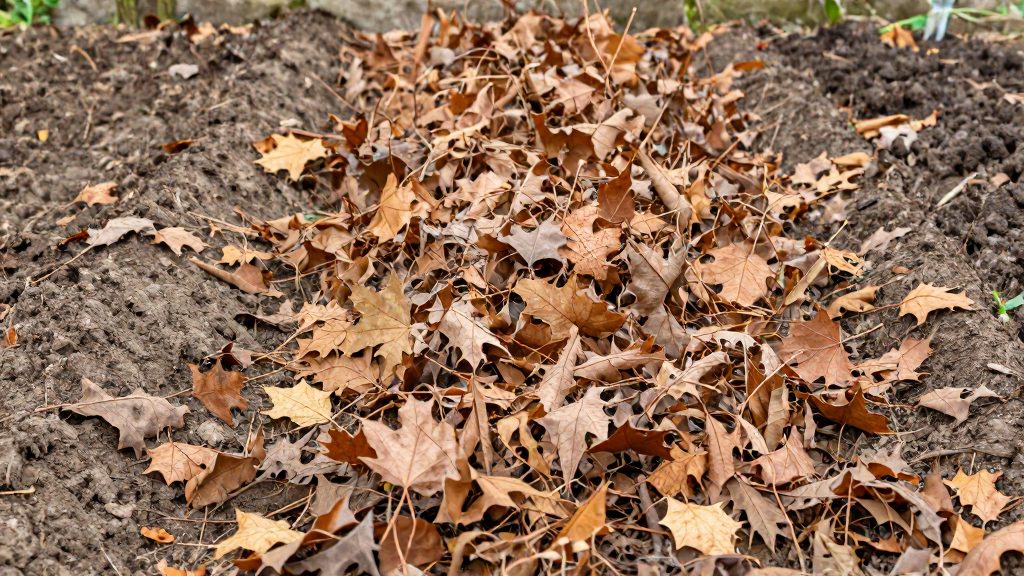
How to Lay Fall Leaf Mulch in Garden Beds
Leaves left on beds insulate roots, hold moisture, return nutrients, improve soil texture and feed the soil microbiome, according to the Toronto Master Gardeners (2025). For most beds, spread a layer of about 5 cm (2 inches) in autumn, which the same guide says imitates natural conditions. Choose the leaves carefully, because species and leaf size change how fast they break down.
Step-by-step method
- Clear the bed of tall, dead plant debris so the leaves lie flat on the soil surface.
- Set aside black walnut leaves. Black walnut (Juglans) leaves contain a compound that can harm some plants, so keep them out of vegetable and perennial beds. Art Knapp Surrey (2025) notes that other leaves are acceptable.
- Shred part of the leaves and keep part whole. Shredding speeds decomposition but can kill overwintering insects, so leaving some whole helps wildlife.
- Spread the leaves evenly to about 5 cm, working around existing perennial crowns.
- Remove twigs and cones if you want faster breakdown, since Art Knapp Surrey (2025) notes they decompose more slowly.
Leaf types at a glance
| Leaf type | Breakdown time | Use in beds |
|---|---|---|
| Maple | Decomposes within one season (Toronto Master Gardeners, 2025) | Suitable as mulch |
| Whole oak | Can take about five years (Toronto Master Gardeners, 2025) | Use shredded or in thin layers |
| Black walnut (Juglans) | Not specified in the sources consulted | Keep out of beds (Art Knapp Surrey, 2025) |
| Other leaves | Not specified in the sources consulted | Acceptable (Art Knapp Surrey, 2025) |
Perennials and depth
Most perennials push through about 7.5 cm (3 inches) of shredded or small whole leaves, a depth attributed to the Xerces Society in the Toronto Master Gardeners guide (2025). Leaves left in place also protect perennials such as rhubarb, asparagus and daylily, and help slow some weeds, according to Art Knapp Surrey (2025).
Leaf mulch breaks down into the soil over the seasons, but thick or matted layers, especially whole oak leaves, may still need thinning in spring.
What to do with diseased or walnut leaves?
Not every fallen leaf belongs in a bed. Three categories need different handling: leaves carrying fungal disease, black walnut leaves, and leaves that break down too slowly to be useful as mulch.
Diseased leaves should be removed rather than left in place. In Toronto, the main fungal leaf diseases are powdery mildew on Norway maple and tar spot. According to the Toronto Master Gardeners (2025), the city advises removing infected leaves for municipal collection. The same guide notes that nearly all leaves are infected by autumn, so the practical goal is to keep the most visibly affected foliage out of beds, not to produce a perfectly clean leaf pile.
Black walnut leaves (Juglans) should be kept out of planting beds. According to Art Knapp Surrey (2025), they contain a compound that can harm the growth of some plants. Other leaves are acceptable. Twigs and cones, from any tree, break down more slowly than leaves, so remove them from beds. Keep black walnut leaves out of planting beds.
Leaf type determines how long a layer lasts and whether perennials can grow through it:
| Leaf type | Breakdown time | Recommended action |
|---|---|---|
| Maple | About one season | Suitable as a mulch layer in beds |
| Whole oak | About five years | Shred, or use a thin layer, because perennials do not push through a thick mat |
| Black walnut | Not specified in the sources consulted | Keep out of beds |
| Infected leaves | Not specified | Remove for municipal collection where the city advises it |
Shredding speeds decomposition, but it can kill overwintering insects. The Toronto Master Gardeners (2025) recommend leaving part of the leaves whole for this reason.
For depth, the Toronto Master Gardeners (2025) describe a layer of about 5 cm (2 in) as mimicking natural forest-floor conditions. The depth is attributed to the Xerces Society, and most perennials can grow through about 7.5 cm (3 in) of shredded leaves or small whole leaves. Art Knapp Surrey (2025) notes that leaves left in place protect perennials such as rhubarb, asparagus and daylilies and slow certain weeds.
When to remove leaf mulch in spring?
Remove leaf mulch in spring once your perennials begin to emerge, not on a fixed calendar date. The official sources consulted do not specify a calendar date, so timing depends on your region and the conditions in your bed. Leaves insulate roots and retain moisture. According to the Toronto Master Gardeners (2025), they also return nutrients, improve soil texture, and feed the soil microbiome, so the goal is to clear only the material that blocks growth, not the whole bed.
Identify the leaves before you clear them
Leaf types break down at very different rates, which determines how much you need to remove. The Toronto Master Gardeners (2025) report the following:
| Leaf type | Decomposition | Spring action |
|---|---|---|
| Maple | Breaks down within one season | Low risk to leave in place |
| Whole oak leaf | Can take about five years | Rake off or thin before perennials emerge |
| Black walnut (Juglans) | Contains a compound that can harm some plants (Art Knapp Surrey, 2025) | Remove from the bed |
Perennials do not push through a thick mat of oak leaves, so this is the material most likely to delay spring growth.
Spring clearing method
- Wait for shoots. Watch for new growth on plants that the leaves protect, such as rhubarb, asparagus and daylilies, which Art Knapp Surrey (2025) identifies as species that benefit from leaves left in place.
- Pull back mulch from the crown as shoots appear. Use your hands or a rake, and avoid digging into the soil.
- Clear thick mats completely. Remove dense oak layers so that new shoots reach light.
- Keep a thin layer. The Toronto Master Gardeners (2025) state that a layer of about 5 cm (2 in) imitates natural conditions, and Art Knapp Surrey (2025) notes that leaves left in place also slow certain weeds. Leave this thin cover around established plants.
- Account for shredding. Shredded leaves break down faster, but the Toronto Master Gardeners (2025) advise keeping some whole leaves, because shredding can kill overwintering insects.
- Remove diseased material. Toronto’s municipal guidance recommends removing infected leaves for city collection. The same guide notes that almost all leaves are infected by autumn, so do not assume the mulch is disease-free.
Frequently asked questions
Can I leave fall leaves on my organic vegetable beds over winter?
Yes. According to Toronto Master Gardeners (2025), leaves left in place provide winter insulation for roots, help the soil hold moisture, and break down into nutrients that feed the soil microbiome. No synthetic products are needed.
How thick should the leaf layer be, and which leaves should I keep out?
Spread about 5 cm (2 in) of leaves, since most perennials can grow through roughly 7.5 cm (3 in) of shredded or small whole leaves. Keep black walnut (Juglans) leaves out of beds, because they contain a compound that can slow the growth of some plants, according to Art Knapp Surrey (2025).
Should I shred all my leaves before spreading them?
No. Shredding speeds decomposition, but it can kill overwintering insects, so Toronto Master Gardeners (2025) recommends keeping some leaves whole. A mix of shredded and whole leaves covers both goals.