Double digging means loosening the soil to a depth of about 50 cm (20 in), which is twice the depth of a garden spade. Single digging stops at about 25 cm (10 in). The difference between the two methods is the layer below the 25 cm mark, which only double digging reaches. Royal Horticultural Society (UK) (2026) uses these depths as the reference points for comparing the two approaches.
What is double digging?
Double digging is a bed preparation method that works the soil to about 50 cm. The name describes the working depth, which is roughly twice what a spade reaches in a single pass. Royal Horticultural Society (UK) (2026) gives this depth as the defining feature of the method.
Single digging works the soil to about 25 cm (10 in). Royal Horticultural Society (UK) (2026) uses this depth as the standard for comparison.
| Method | Working depth | Soil worked |
|---|---|---|
| Single digging | About 25 cm (10 in) | Soil down to the 25 cm mark |
| Double digging | About 50 cm | Soil down to the 25 cm mark, plus the layer below it |
The target layer of double digging is the soil below the 25 cm mark, extending to about 50 cm. Single digging leaves this zone undisturbed.
Because the extra depth is reached by digging a second layer, double digging moves considerably more soil than single digging. Gardeners choosing between the two methods should compare the working depth against the condition they want to address: a problem within the top 25 cm is covered by single digging, while a problem below that mark requires the deeper pass.
Is double digging worth it?
Double digging is worth the effort in a few specific situations: when the subsoil is compacted, when water sits in the ground, or when you are creating a bed from scratch. The Royal Horticultural Society (UK) (2026) defines it as digging to about 50 cm, twice the depth of a spade, compared with about 25 cm for single digging. It says the method can help with compaction or poor drainage below 25 cm. The same source notes that most people do not need to double dig at all, so the decision depends on what the soil is doing now.
When it pays off
- Compacted subsoil: Double digging loosens layers below 25 cm that single digging does not reach.
- Poor drainage: If water remains in the ground after rain, the deeper loosening can help.
- New beds: Ground that has never been cultivated, or that has not been deeply worked in 3 or more years, is a typical case. This is noted by NC State Extension Master Gardeners of Mecklenburg County (publication date not specified).
Drainage test before you start
Use the drainage test to check whether the problem is real:
- Dig a pit 50 cm deep.
- Fill it with water and leave it overnight.
- Check the next day. If half or more of the water remains, drainage is a problem.
If less than half of the water remains the next day, the test does not point to a drainage problem at that spot. One test is not conclusive, so repeat it in another part of the bed before ruling drainage out.
Costs to weigh
| Drawback | What the sources say |
|---|---|
| Labour | Slow and physically demanding (RHS, 2026) |
| Soil life | Disturbs soil fungi and fauna (RHS, 2026) |
| Emissions | Releases CO2 (RHS, 2026) |
The disturbance to soil life matters most in beds that already support a healthy soil community, since turning the soil breaks up fungal networks and the animals that live in them.
Lower-effort alternatives
- Single digging, to about 25 cm
- No-dig methods
- Raised beds
- Deep mulching
- A broadfork or U-bar, which loosens the soil without turning it (NC State Extension Master Gardeners of Mecklenburg County)
Tools and timing for double digging
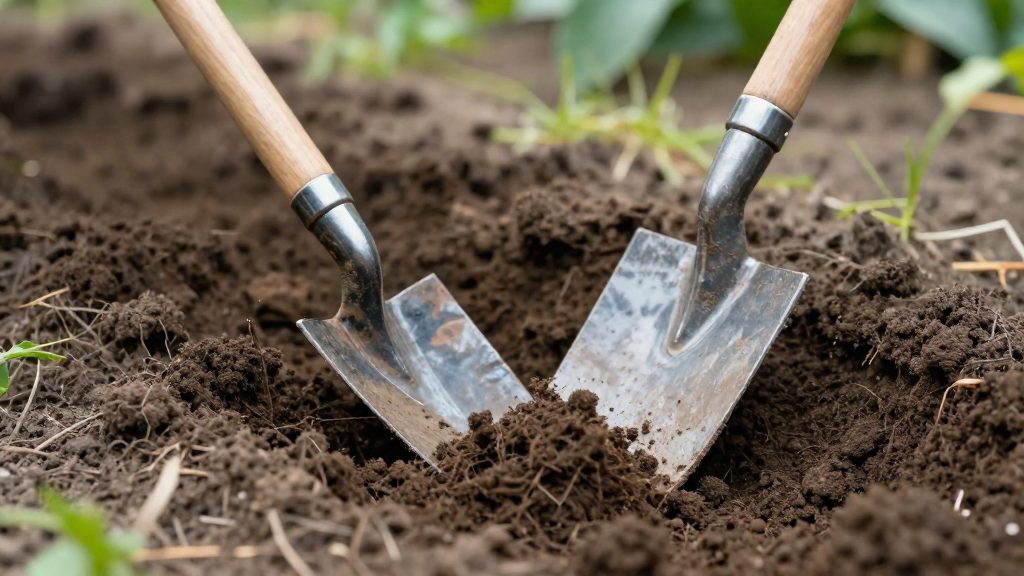
Double digging needs two hand tools and a specific soil condition. According to the Royal Horticultural Society (UK) (2026), double digging means digging to twice the depth of a spade, about 50 cm, while single digging reaches about 25 cm (10 in). The spade therefore sets the working depth, since each trench is cut and lifted to that level.
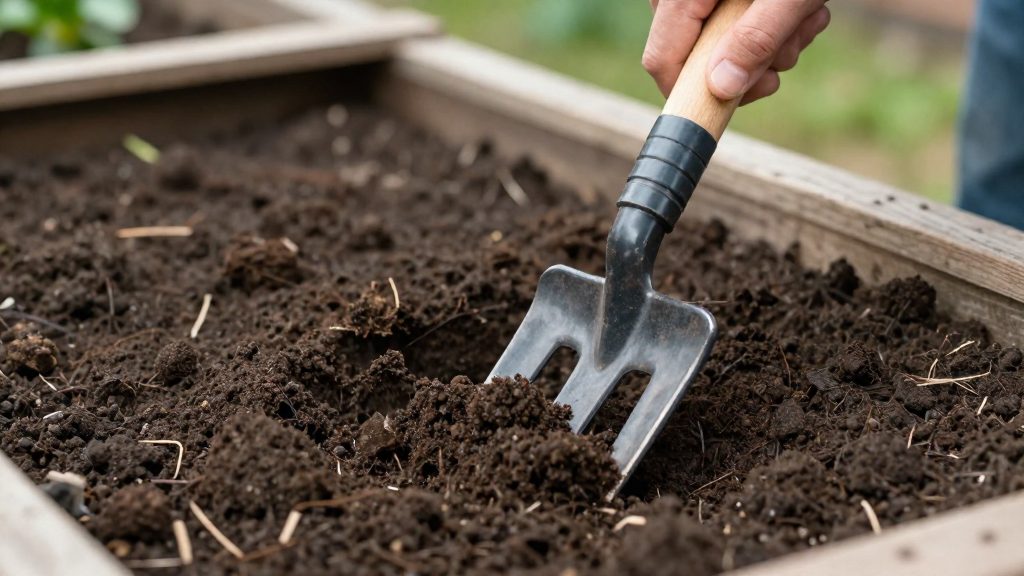
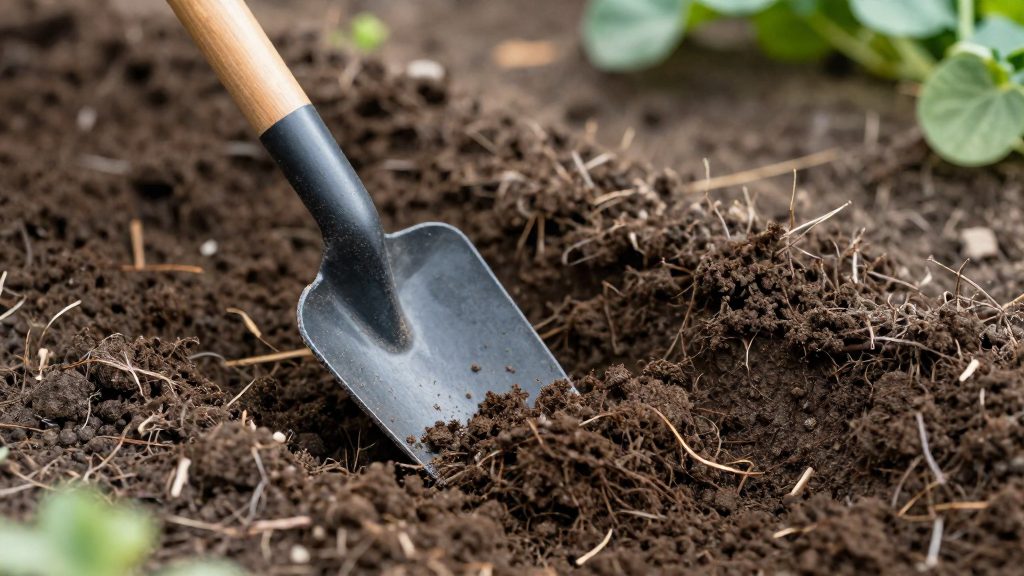
The spading fork handles the loosening step. The NC State Extension Master Gardeners of Mecklenburg County describe working the fork into the trench bottom to loosen it.
Before you start, check that the soil is in the right condition:
- Moist but not waterlogged: dig when the soil is damp. Waterlogged soil is a reason to postpone (Royal Horticultural Society (UK), 2026).
- Not frozen: frozen ground cannot be dug safely or effectively (Royal Horticultural Society (UK), 2026).
- Timing window: the Royal Horticultural Society (UK) (2026) recommends digging in late winter or early spring. The official sources consulted do not specify exact calendar dates, so the right week depends on your region and local climate.
If the soil is too wet, too cold, or frozen, wait for better conditions rather than forcing the work. Digging in those conditions damages the soil structure you are trying to improve.
How do you double dig a garden bed step by step?
Double digging loosens soil to about twice the depth of a spade, roughly 50 cm, according to the Royal Horticultural Society (RHS, 2026). The method works by digging one trench at a time and turning each new trench’s soil into the one before it, so the layers stay in order. Before you start, mark out a bed about 1 to 1.2 m (3 to 4 ft) wide, so you can reach the center from either side without stepping on the soil you have dug, as recommended by NC State Extension Master Gardeners of Mecklenburg County.
Step-by-step method
| Step | Action | Key detail |
|---|---|---|
| 1 | Dig the first trench | Dig across the bed to a depth of about 30 cm, following the NC State Extension method. |
| 2 | Set the soil aside | Keep the topsoil from the first trench in a separate pile, for example on a tarp, to refill the last trench. |
| 3 | Fork the trench base | Loosen the bottom of the trench with a spading fork. Do not turn the soil over or mix it with the topsoil. |
| 4 | Add compost | Spread compost over the forked base, then work it in lightly. |
| 5 | Dig the next trench | Dig alongside the first trench and turn its soil into the first trench, on top of the compost layer. |
| 6 | Repeat down the bed | Continue fork, compost, and dig steps until you reach the far end. |
| 7 | Refill the last trench | Fill the final trench with the set-aside topsoil from step 2. |
Working tips
- Work backward so you never walk on dug soil. The NC State method describes this approach.
- Loosen the trench base without inverting it. This keeps the deeper layer in place while still improving drainage and root penetration.
When double digging is worth it
Double digging is most useful for:
- Adding organic matter for deep-rooted crops such as asparagus
Which compost and amendments should you add?
Compost is the main amendment for a double-dug bed. The Royal Horticultural Society (2026) recommends adding compost at about one bucketful per square metre to the base of each trench, after forking it over. NC State Extension Master Gardeners of Mecklenburg County recommends a surface layer of 2 to 3 cm of quality compost spread before digging. The two sources use different units, and the official sources consulted do not specify the bucket volume, so the RHS rate cannot be converted into litres.
| Stage | Compost rate | Source |
|---|---|---|
| Worked into the trench base during double digging | About one bucketful per square metre | Royal Horticultural Society (2026) |
| Spread on the surface before digging | 2 to 3 cm; a 1 m x 3 m bed needs about 90 litres | NC State Extension Master Gardeners of Mecklenburg County |
For the 90-litre figure, the calculation is area × thickness: 3 m² × 0.03 m = 0.09 m³, or 90 litres.
Organic matter is one of the specific reasons to double dig. The RHS lists adding organic matter for deep-rooted crops such as asparagus as a valid use of the method. Asparagus is a long-term crop, so the bed should be prepared before planting.
For organic fertiliser alternatives to synthetic products, the sources consulted name compost as the main input. Lime and phosphate are the other amendments mentioned, and they should only be applied after a soil test. The official sources consulted do not specify application rates for other organic fertilisers, such as well-rotted manure, so use the compost rates above as your baseline and adjust according to your soil test results.
How often should you double dig?
Repeat double digging is not a routine task. The useful question is not how often to dig, but whether a specific problem justifies another deep pass.
Re-digging is rarely needed on a fixed schedule
Double digging means working the soil to about 50 cm, or twice a spade’s depth.
NC State Extension Master Gardeners of Mecklenburg County say to repeat a full double dig only every 3 to 5 years, adding 1-2 cm of compost in the years between. The RHS adds that re-digging is not needed regularly.
Triggers for repeat deep work
Deep work is justified when a problem is confirmed, not when a calendar date arrives. The main triggers are:
- Compaction below 25 cm that returns after earlier loosening.
- Drainage problems that reappear in the bed.
| Situation | Repeat double digging? |
|---|---|
| Routine upkeep, no confirmed problem | Not needed on a regular schedule |
| Compaction or poor drainage below 25 cm returns | Yes, to address that depth |
| Heavily worked bed, long-term interval | Every 3 to 5 years, with 1-2 cm compost between |
Working between full passes
Adding compost between years is an organic way to maintain structure without disturbing the lower soil.
No-dig and broadfork alternatives
The three approaches below cover the main alternatives: loosening the soil with a broadfork, building organic layers on the surface, and raising the bed above the existing ground.
| Method | How it works | Suited to |
|---|---|---|
| Broadfork | Loosens the soil while the layers stay in place | Compacted ground and established beds |
| No-dig mulch | Organic layers are added on the surface | Beds you want to improve without digging |
| Raised bed | The growing soil is built above ground level | Poor drainage and a deeper root zone |
Broadfork: loosening without inverting layers
A broadfork is a long-handled tool with several tines. The basic gesture is as follows:
- Push the tines fully into the ground.
- Rock the handle back to lift and fracture the soil, without turning it over.
- Step back and move along the bed.
Because the topsoil is not turned, the subsoil stays where it is. This is the main difference from the trench method.
No-dig: surface compost and mulch layering
No-dig gardening builds the soil from the top down instead of turning it. The method is as follows:
- Remove existing weeds before adding anything.
- Spread a layer of quality compost evenly over the surface.
- Cover the compost with an organic mulch.
- Plant into the layers, or pull the mulch aside at planting time.
The official sources consulted do not specify a single fixed compost depth for this method, so adjust the layer to the state of your bed.
Raised beds: drainage and root depth
A raised bed places new growing soil above the existing ground. They are useful where the ground does not drain well.
To check whether drainage is a problem before choosing a method:
- Dig a 50 cm pit.
- Fill it with water and leave it overnight.
- If half or more of the water remains the next day, drainage is a problem, according to the Royal Horticultural Society (UK) (2026).
Frequently asked questions
Do I really need to double dig my vegetable garden?
For most home gardeners, no. The Royal Horticultural Society (UK) (2026) notes that the method is slow and physically demanding, and that it disturbs soil fungi and fauna. No-dig methods, single digging, or raised beds often deliver similar benefits, so reserve double digging for compacted subsoil, poor drainage, or a new bed built from scratch.
How can I tell whether my soil has a drainage problem?
Dig a pit about 50 cm deep, fill it with water, and leave it overnight. The Royal Horticultural Society (UK) (2026) describes this as a drainage test: if half or more of the water remains the next day, drainage is poor and deeper work may help.
How often should a bed be double dug again?
A full double dig is needed for a new bed or one that has not been deeply worked in three or more years. According to NC State Extension Master Gardeners of Mecklenburg County, the full process only needs repeating every 3 to 5 years, with 1-2 cm of compost added to the surface in the years between.