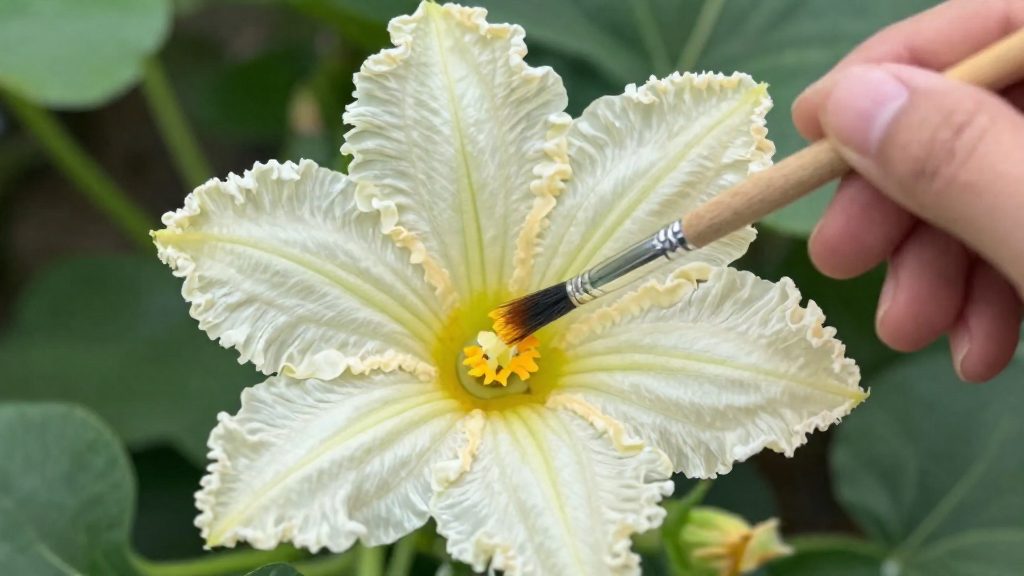
Squash sometimes needs human help, because a garden with few visiting insects may not deliver enough pollen. When pollination fails, the flowers drop or the fruit does not fully develop, according to Epic Gardening (2023-10-19). Hand pollination is a short manual step that moves pollen from an open male flower to an open female flower, and it is most useful where natural visits are scarce.
Why hand pollinate squash?
Squash plants produce separate male and female flowers, and pollen must reach the female flower for it to develop into fruit. Insects normally carry that pollen. When they are scarce, fruit set can be incomplete, and hand pollination provides a backup.
Low pollinator visits in covered or urban gardens
- Epic Gardening (2023-10-19) lists fewer pollinators and enclosed spaces such as greenhouses among the causes of pollination failure.
- Covered or urban plots are the practical case to check. If you see few bees or other insects at the open flowers, hand pollination is a reasonable response.
- Enclosed beds keep insects out, so the gardener becomes the only pollen carrier.
Incomplete pollination and poorly developed fruit
When a female flower receives too little pollen, the fruit may not fully develop. Epic Gardening (2023-10-19) advises removing immature fruit that stops growing, because it rots. The official sources consulted do not specify the exact shape that partly pollinated fruit will take.
A successful pollination shows within a couple of days. Swelling at the base of the female flower is the sign to look for (Epic Gardening, 2023-10-19).
Weather and pollen viability
| Situation | Documented effect | Source |
|---|---|---|
| Enclosed spaces such as greenhouses | Pollination can fail | Epic Gardening (2023-10-19) |
| Fewer pollinators | Pollination can fail | Epic Gardening (2023-10-19) |
| Weather | Pollination can fail | Epic Gardening (2023-10-19) |
Male vs. female squash flowers
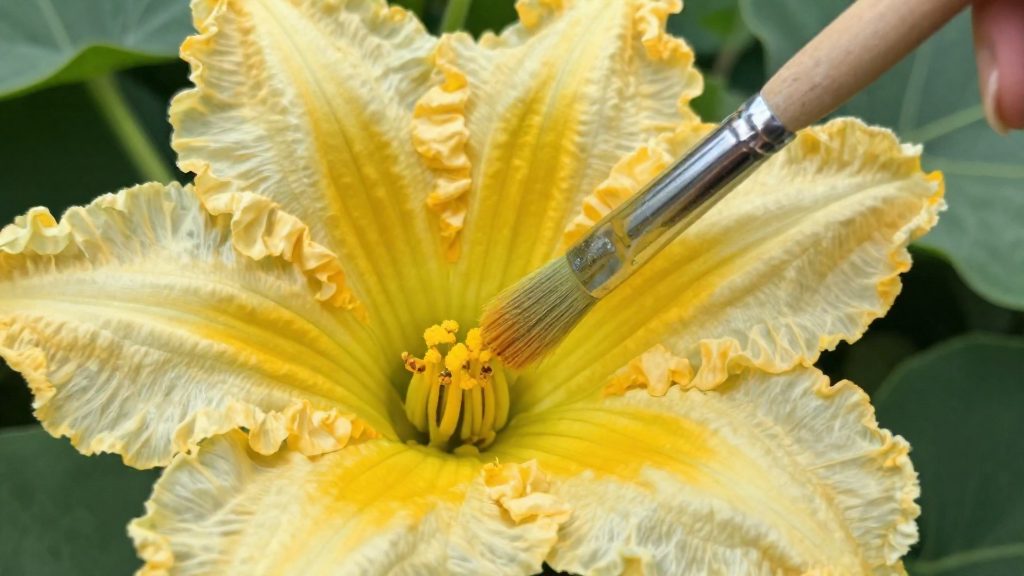
Male and female squash flowers can be told apart by the ovary at the base of the bloom. A female flower has a small ovary below the petals that looks like a tiny squash, while a male flower has no ovary at all. This structural difference is the most reliable way to sort the two sexes on the plant, and it is what gardeners check before they choose which flowers to use.
Before a bud opens, its colour is the visual cue. According to Mother Earth News (2015-10-08), buds about to open are greenish or creamy yellow. Colour tells you a bud is close to opening, but the ovary is what identifies its sex.
The two sexes compare as follows:
| Feature | Male flower | Female flower |
|---|---|---|
| Ovary below the petals | None | Small ovary that looks like a tiny squash |
| Bud before opening | Greenish or creamy yellow | Greenish or creamy yellow |
| Sex identified by | Absence of ovary | Presence of ovary |
Checking the base of each open flower takes only a few seconds. If you see a small swelling that resembles a miniature squash, the flower is female. If the stem simply ends below the petals, the flower is male. Sorting flowers this way before you work on the plant helps you avoid mistakes when you pollinate by hand.
When is the best time to pollinate?
Squash flowers open for a short window each day, and the timing of that window decides whether hand pollination works. Each female flower is open for only one day, and the pollen used to fertilize it stays viable for just a few minutes after removal, so the job belongs in the early part of the day. According to Mother Earth News (2015-10-08), the flowers usually stay open until early afternoon, and the pollination round should start soon after dawn while they are still open.
Daily window
The morning window is the most reliable time to work. Pollinate soon after dawn, when the flowers are fully open, and finish before the flowers close in early afternoon. Pollen stays viable only a few minutes after removal, so use it right away and never hold it for hours.
Seasonal and flowering order
Male and female flowers do not open at the same time. According to Garden Betty (2025), male flowers usually appear first, and female flowers follow about 1–2 weeks later. Check the plant daily during the flowering period so you can see when male flowers begin to open and when female flowers appear. The sources consulted do not give a calendar date, because the timing depends on the variety, sowing date, and local climate.
Temperature limits
Heat affects the pollen itself. Garden Betty (2025) states that daytime highs above 90°F or nights above 70°F can reduce pollen viability. The sources consulted do not specify how much viability drops at a given temperature, or what to do beyond working in the early morning when the temperature is still lower.
| Factor | Timing or threshold | Source |
|---|---|---|
| Male flowers | Usually appear first | Garden Betty (2025) |
| Female flowers | About 1–2 weeks after males | Garden Betty (2025) |
| Female flower open period | One day | Garden Betty (2025) |
| Flowers open until | Early afternoon | Mother Earth News (2015-10-08) |
| Pollen viability after removal | A few minutes | Garden Betty (2025) |
| Daytime heat limit | Highs above 90°F | Garden Betty (2025) |
| Night heat limit | Nights above 70°F | Garden Betty (2025) |
How to hand pollinate squash step by step
Hand pollinating squash means moving pollen from an open male flower onto the stigma of an open female flower. According to Epic Gardening (2023), the job takes about five minutes.
Telling the flowers apart
- Male flower: no ovary below the petals; the pollen-bearing stamen sits in the centre of the bloom.
- Female flower: a small ovary below the petals that looks like a tiny squash.
Step 1: pick an open male flower and expose its stamen
Choose a male flower that is fully open and carrying visible pollen. Gently pull back or remove the petals so the stamen is exposed. Work promptly, because pollen loses viability quickly once the flower is picked.
Step 2: rub the pollen onto the open female stigma
Find an open female flower, which is identifiable by its small ovary. Rub the exposed anthers across the stigma, the sticky central structure of the female flower, so that pollen transfers to it. Repeat the contact across the stigma surface rather than touching a single point.
Step 3: check for swelling at the base of the female flower
Within a couple of days, look for swelling at the base of the female flower, which shows the pollination worked. Note which flowers you pollinated so you can compare them later.
| Step | Action | What to check |
|---|---|---|
| 1 | Pick an open male flower and expose its stamen | Visible pollen on the stamen |
| 2 | Rub pollen onto the open female stigma | Pollen transferred across the stigma |
| 3 | Check the female flower base | Swelling within a couple of days |
Timing and conditions
In hot weather, work during the cooler part of the day and pollinate promptly after picking.
Paintbrush or male flower: which method?
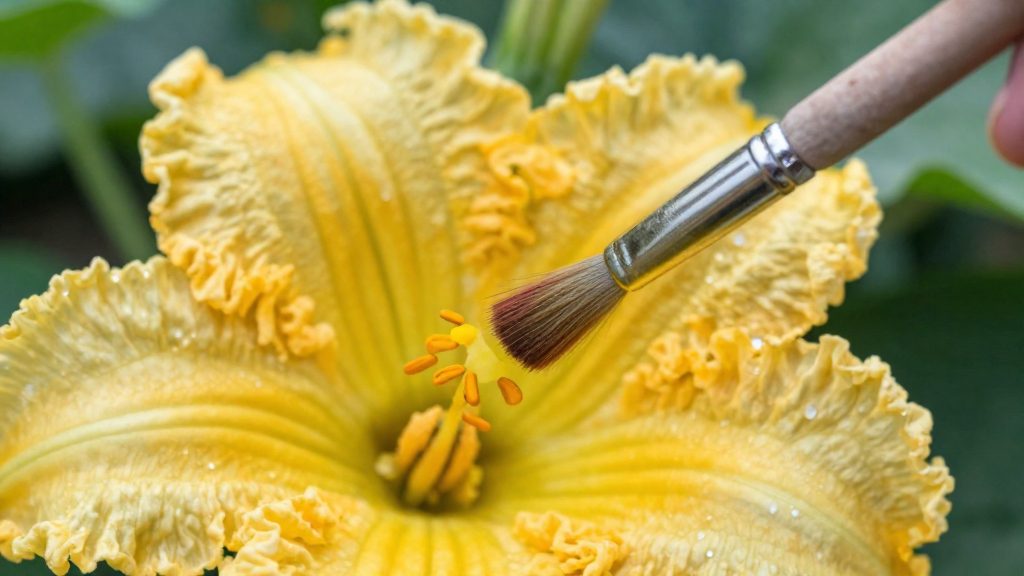
The male flower method and the soft paintbrush both move pollen from the anthers of a male flower to the stigma of an open female flower. For eating squash the choice is mostly a matter of preference, while the sources describe only the male flower route for seed saving. According to Epic Gardening (2023), for eating squash you pick an open male flower, expose its stamen, and rub the pollen onto an open female flower. The same source notes that a soft paintbrush can be used instead and leaves the flowers on the plant.
Comparing the two transfer methods
| Criterion | Male flower method | Soft paintbrush |
|---|---|---|
| Pollen source | Stamen of an open male flower | Pollen collected from the anthers with the brush |
| Male flower afterwards | Picked from the plant | Stays on the plant |
| Flower preservation | One male flower is used per transfer | The plant keeps its flowers |
| Suited to | Eating squash; seed saving (Mother Earth News, 2015) | Eating squash |
Speed does not clearly separate the two methods, and the sources consulted do not give a separate time for the brush. The main practical difference is that the brush keeps the male flower on the plant, while the male flower method removes it.
Choosing the method by harvest goal
- Eating squash: either method works. Use the paintbrush if you want to keep every male flower on the plant, or the male flower method if you prefer direct contact with the stamen.
- Seed saving: the sources consulted describe the male flower route. Mother Earth News (2015) recommends using pollen from 2 or 3 males per female, and pollinating at least four times as many flowers as the fruits you want to keep for seed. The sources consulted do not describe the paintbrush for seed saving.
How to pollinate squash for seed saving
Saving squash seed true to type depends on controlling which pollen reaches each female flower. Hand pollination for seed takes two days: bud sealing happens the afternoon before, and the pollen transfer happens the next morning. According to Mother Earth News (2015), this routine isolates the flowers so that only the pollen you choose lands on the stigma.
Day 1: sealing the buds
In late afternoon, identify the male and female buds that will open the next day. Enclose each chosen bud so that no insect can reach it overnight, and keep track of which male bud belongs with which female bud.
Day 2: the pollination routine
For each female flower:
| Step | Action |
|---|---|
| 1 | Remove the petals from a sealed male flower to expose its anthers. |
| 2 | Brush pollen from the anthers over the whole stigma of the female flower. |
| 3 | Reseal the female flower tightly, with no gaps. |
Pollen sources and fruit count
Use pollen from two or three males for each female flower. Pollinate at least four times as many flowers as the number of fruits you want to keep for seed. Not every pollinated flower will develop fully, so the extra flowers give you a margin of safe choices.
Why are my squash flowers falling off?
Squash flowers that drop before fruiting usually fall for one of these reasons: a male flower doing its normal job, a female flower that was not pollinated (few pollinators, an enclosed space or weather), or a stressed plant. The first step is to identify the flower type, then check what happens at the base of the bloom over the next few days. The sources consulted do not give a percentage of flowers expected to drop, so the signs below are the practical guide.
Normal shedding of male flowers
Because a male flower cannot become fruit, wilting and falling after opening is normal shedding and not a sign of a problem. Male flowers also carry the pollen, so leave them on the plant until they open.
Female flowers dropping without swelling
A female flower has a small ovary below the petals. If it drops without that ovary swelling, pollen most likely did not reach the stigma, which is a pollination failure.
| Flower | What you see | Likely cause |
|---|---|---|
| Male | No ovary; falls after opening | Normal shedding |
| Female | Ovary swells within a couple of days | Pollination worked |
| Female | Drops with no swelling | Pollination failure |
In a greenhouse or other enclosed space, where pollinators may be scarce, hand pollination is the reliable way to set fruit. If pollination fails and the fruit stops growing and begins to rot, remove it, as the sources recommend (Epic Gardening, 2023-10-19).
Water and nutrient imbalance
Flowers can also abort when the plant lacks water or nutrients. The sources consulted do not specify thresholds for this, so judge by the soil and the plant:
- Water at the base of the plant so the soil stays moist, not soggy. Waterlogged soil and uneven watering both stress the plant.
- Mulch the bed with straw or compost to keep soil moisture more even.
- Feed the plant with well-rotted compost or another organic amendment rather than a synthetic fertiliser.
- Plant in a sunny spot with good drainage, so water and nutrients are available without stagnation.
If flowers keep dropping after you have corrected watering and feeding, and the female flowers show no swelling, return to the pollination check above.
Frequently asked questions
How can I tell male and female squash flowers apart?
A female flower has a small ovary below the petals that looks like a tiny squash, while a male flower has no ovary at all. Buds about to open look greenish or creamy yellow, so check the base of each bud before you pick one (Mother Earth News, 2015-10-08).
What time of day and weather suit hand pollination?
Work in the morning, while the female flower is open, since each female flower stays open for only one day. Pollen loses its viability within a few minutes of removal, and daytime highs above 90°F or nights above 70°F can reduce it further (Garden Betty, 2025).
How do I know whether pollination worked, and what should I do if it did not?
Look for swelling at the base of the female flower within a couple of days, which indicates a successful transfer (Epic Gardening, 2023-10-19). If a small fruit stops growing and starts to rot, remove it so the plant can put its energy into the fruit that is developing.