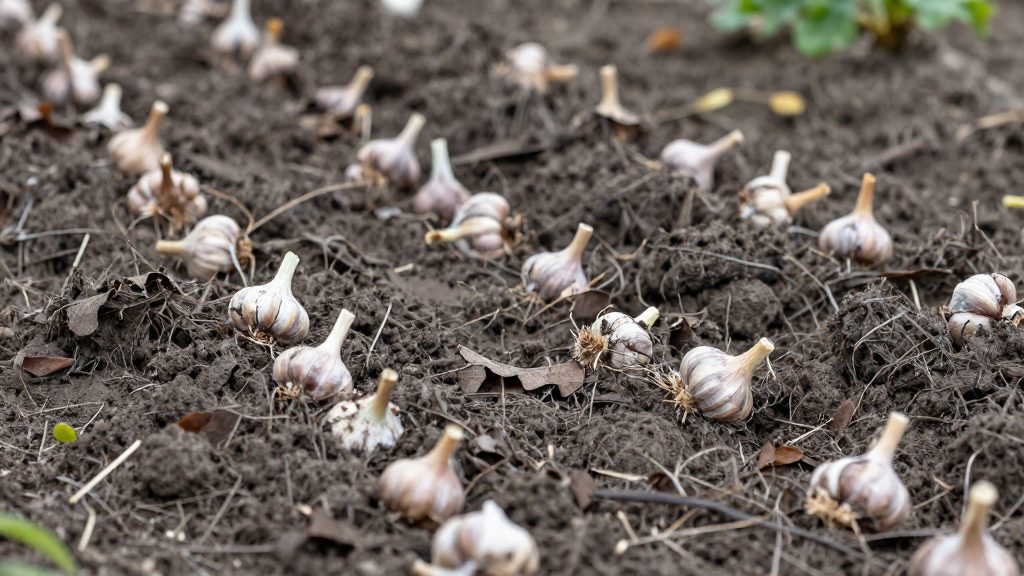
Plant garlic about 4–6 weeks before the first hard frost in your area. According to the Old Farmer’s Almanac (2026), the general fall planting window runs from late September through November, adjusted to local first-frost dates. Because those local dates set the final timing, the window shifts from one region to another, and the calendar range is only a starting point.
When to plant garlic in fall
The general window
Garlic is planted in fall, with the general window running from late September through November. Within that range, the exact week depends on when frost is expected where you garden, not on the month alone.
The 4–6 week rule
Count back from the first hard frost date for your location:
- Start: 6 weeks before the first hard frost.
- End: 4 weeks before the first hard frost.
As an illustration only, if the first hard frost is expected around 1 November, the planting window falls between about 20 September and 4 October.
Why local first-frost dates set the timing
Local first-frost dates determine the final timing, so two gardens in the same month can need different planting dates. Regional extension guidance varies, as the table below shows.
| Source (year) | Region | Stated planting guidance |
|---|---|---|
| Farmers’ Almanac (2026) | Minnesota | 1–2 weeks after the first killing frost |
| Farmers’ Almanac (2026) | Oregon State | September–November |
| Farmers’ Almanac (2026) | Georgia | Late September–November |
| Farmers’ Almanac (2026) | Santa Clara County, CA | Mid-October–November |
| Farmers’ Almanac (2026) | Florida | October–January |
The Minnesota entry counts from the first killing frost rather than before it, which is why the general rule above does not apply everywhere in the same way.
Does your hardiness zone change the date?
Yes. Your USDA hardiness zone is the first factor to check when setting a garlic planting window, because zones group regions by how cold their winters typically are. According to Epic Gardening (2024), the recommended planting month moves later as the zone number rises. Colder zones (0 to 4) plant in September, while the mildest zones (10 to 11) plant in December or January. Your zone gives you a starting range, and your state or county extension calendar then narrows it to dates that fit local conditions.
Planting windows by USDA zone
| USDA zone | Planting window |
|---|---|
| 0–4 | September |
| 5–7 | October |
| 8–9 | October or November |
| 10–11 | December or January |
Epic Gardening (2024) gives these ranges. Zones 8 to 11 cover the widest span, running from October to January, so zone alone is not enough to pick a date in warm regions.
How state extension calendars change the window
State and county extension services publish local guidance that often differs from a zone-only estimate. Farmers’ Almanac (2026) lists the following examples:
| Region | Recommended window |
|---|---|
| Minnesota | 1–2 weeks after the first killing frost |
| Oregon State | September to November |
| Georgia | Late September to November |
| Santa Clara County, CA | Mid-October to November |
| Florida | October to January |
Florida’s October-to-January window shows how wide a warm-state calendar can be, while Minnesota’s guidance is tied to the first killing frost instead of a calendar month. The two approaches answer the same question in different ways.
How to apply the zone and the local calendar
- Find your USDA hardiness zone and note the planting window listed for it.
- Look up your state or county extension guidance for garlic.
- Compare the two. If the extension calendar gives a specific local window, use it as your primary target.
- Record the chosen window so you can plant within it each year.
How close to the first frost should you plant?
Epic Gardening (2024) uses a different reference point from the 4–6 week rule above: it advises planting hardneck garlic right around the first fall frost, so the two rules give different dates. According to Epic Gardening (2024), it should be planted right around the first fall frost, which gives it 4–8 weeks of cold exposure afterward. The planting date is therefore the starting point for the cold period, not a date chosen independently of the weather.
Hardneck garlic at the first frost
- Plant on or near the date of the first fall frost in your area.
- Count on 4–8 weeks of cold after planting, the period the timing is designed to provide.
Mild climates: a wider window
In mild climates, Epic Gardening (2024) advises planting 2–3 weeks before or after the first fall frost. Because the first frost is less of a fixed event in these regions, the window gives growers a range of days to choose from instead of a single target date.
Comparing regional guidance
Extension guidance is not uniform. The table below shows how different sources place planting relative to the first frost.
| Source | Climate or region | Planting time relative to first frost |
|---|---|---|
| Epic Gardening (2024) | Hardneck garlic, general | Right around the first fall frost |
| Epic Gardening (2024) | Mild climates | 2–3 weeks before or after the first fall frost |
| Farmers’ Almanac (2026) | Minnesota | 1–2 weeks after the first killing frost |
How do you plant garlic cloves?
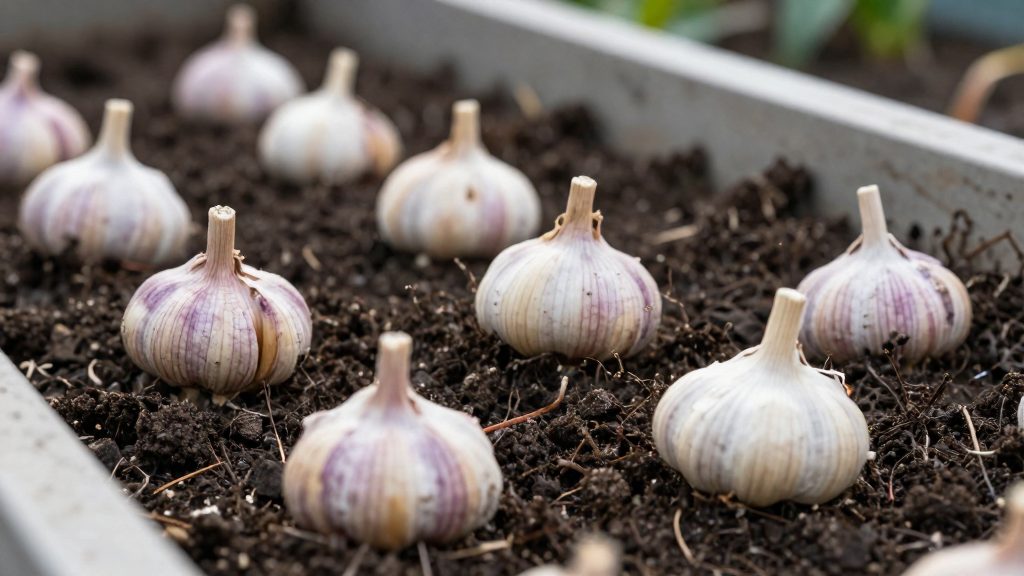
Place each clove with the pointed side up and the flat root end down. According to The Old Farmer’s Almanac (2026), cloves go about 2 inches deep, spaced 4–6 inches apart within each row, with rows 12–18 inches apart. Following these measurements gives each bulb room to develop and keeps the bed easy to weed and inspect.
Placement steps
- Mark the rows. Run a string or stake line across the bed at 12–18 inch intervals so the rows stay straight and evenly spaced.
- Open a hole for each clove. Use a dibber, a dowel, or a finger to make a hole about 2 inches deep in loosened soil.
- Check the orientation. Confirm that the pointed tip faces up before you set the clove in the hole.
- Space the cloves. Keep 4–6 inches between cloves in the same row. Tight spacing reduces the room each bulb has to grow.
- Cover gently. Push soil back over the clove and press it lightly with your hand. Avoid stamping, which compacts the soil and slows drainage.
- Repeat row by row. Work across the bed in one direction so you do not step on newly planted rows.
Layout summary
| Element | Specification | Source |
|---|---|---|
| Clove orientation | Pointed side up | The Old Farmer’s Almanac (2026) |
| Planting depth | About 2 inches | The Old Farmer’s Almanac (2026) |
| Spacing within a row | 4–6 inches | The Old Farmer’s Almanac (2026) |
| Distance between rows | 12–18 inches | The Old Farmer’s Almanac (2026) |
Adjust spacing within the ranges above to suit the size of the cloves and the width of your beds. Wider rows suit larger hardneck bulbs, while closer spacing fits smaller beds where you need to use every square foot.
Soil and mulch for organic garlic
According to the Old Farmer’s Almanac (2026), garlic does best in well-drained soil, and disease is more of a problem in poorly draining ground. For an organic fall planting, the bed itself is the first decision. Choose a spot where water does not stand after autumn rain, or loosen heavy soil before planting so excess water can move through it. Improving drainage is a non-chemical measure that works from the start, without synthetic inputs.
Bed selection matters as much as soil structure. The same source advises avoiding beds where wireworms or nematodes have been a problem. Before you commit a bed, check for signs of these pests from previous seasons. The official sources consulted do not specify how many years a bed should rest before it can be planted with garlic again, so use your own observations of past damage to decide.
Once the cloves are in, cover the bed with seedless straw mulch at a depth of 5–8 inches. Specifying seedless straw keeps the mulch from introducing unwanted plants into the bed. Spread it evenly over the whole bed so the surface is fully covered, and do not leave bare patches.
| Bed condition | Suitability for organic garlic |
|---|---|
| Well-drained soil | Recommended; disease is less of a problem |
| Poorly draining, wet soil | Higher disease risk |
| Past wireworm or nematode problems | Avoid |
Common fall planting mistakes
Fall-planted garlic depends on timing relative to cold, and three errors weaken it most often before winter. Each one comes from trusting the calendar over local conditions. The points below describe what goes wrong and how to avoid it.
Planting too early
When cloves go into soil that is still warm, shoot emergence can start before winter arrives. Early top growth is the main risk of planting ahead of the recommended window, so stay within the timing for your area. Wait until the soil is cooling and the first frost is approaching, and follow the window for your zone and local frost date rather than planting during unseasonably warm weather.
Planting too late
Garlic needs time for root establishment before the ground freezes. A planting made close to or after a hard freeze leaves cloves little time to anchor, and the bed may freeze before growth gets going.
Relying on one calendar date
A fixed date such as “October 15” ignores that the local first-frost date varies with latitude, elevation and local weather. Regional extension guidance cited by the Farmers’ Almanac (2026) shows how much timing differs from place to place:
| Region | Recommended timing |
|---|---|
| Minnesota | 1–2 weeks after the first killing frost, clove base 2–3 inches deep |
| Oregon State | September to November |
| Georgia | Late September to November |
| Santa Clara County, CA | Mid-October to November |
| Florida | October to January |
The USDA zone guidance from Epic Gardening (2024) follows the same logic. Zones 0–4 plant in September, zones 5–7 in October, zones 8–9 in October or November, and zones 10–11 in December or January.
Winter and spring care after fall planting
Once fall-planted garlic is in the ground, the work shifts from planting to monitoring. The main tasks in spring are checking the emerging shoots, removing the winter mulch in stages, feeding and watering during early growth, and, for hardneck types, removing the flower stalks in late spring.
Monitoring spring shoots
- Walk the bed every few days once green shoots appear through the mulch.
- Look for even, upright growth. Shoots that stay pale, yellowed, or stunted can signal a drainage or nutrient problem worth investigating.
- Check the rows for pests such as wireworms and nematodes, which the Old Farmer’s Almanac (2026) identifies as a problem in some soils. If either has been a problem in the bed before, look for them early.
Removing mulch gradually
- Pull the straw back from the plants in stages rather than all at once. This lets the soil warm gradually and protects the young shoots from sudden frost or sun exposure.
- Keep the pulled straw nearby so you can reapply it between the rows to limit weeds and help retain soil moisture during dry spells.
Feeding and watering in early spring
- Water when the top layer of soil has dried out, and soak the bed deeply rather than sprinkling it lightly.
- Avoid saturating the soil. Waterlogged beds encourage disease, so water in the morning and let the surface dry between sessions.
- For organic feeding, apply well-rotted compost or a natural fertilizer such as composted manure around the plants as growth starts, keeping it off the leaves.
Removing scapes from hardneck varieties
- In late spring, hardneck garlic sends up a flower stalk called a scape. Snap or cut it off while it is still curled, so the plant directs its energy into the bulb.
- Use the removed scapes in the kitchen, since they are edible.
Preparing for harvest
- As the lower leaves begin to yellow, reduce watering so the bulb skins can dry.
- Harvest when the leaves are turning, and cure the bulbs in a dry, shaded, ventilated place before storage.
Frequently asked questions
I’m a beginner and don’t know my first frost date. How do I find it?
Look up the average first hard frost date from your local extension service or a weather station record for your area. Then count back 4 to 6 weeks to set your garlic planting window. The Old Farmer’s Almanac (2026) gives this 4 to 6 week rule as its starting point.
Does my USDA hardiness zone change when I should plant garlic?
Yes. Epic Gardening (2024) lists planting by USDA zone: zones 0 to 4 in September, zones 5 to 7 in October, zones 8 to 9 in October or November, and zones 10 to 11 in December or January. In mild climates, Epic Gardening suggests planting hardneck garlic 2 to 3 weeks before or after the first fall frost.
How deep and how far apart should I plant garlic cloves?
Plant each clove pointed side up, 2 inches deep, with 4 to 6 inches between cloves and 12 to 18 inches between rows, according to the Old Farmer’s Almanac (2026). Then cover the bed with 5 to 8 inches of seedless straw mulch, an organic option that protects the cloves over winter.