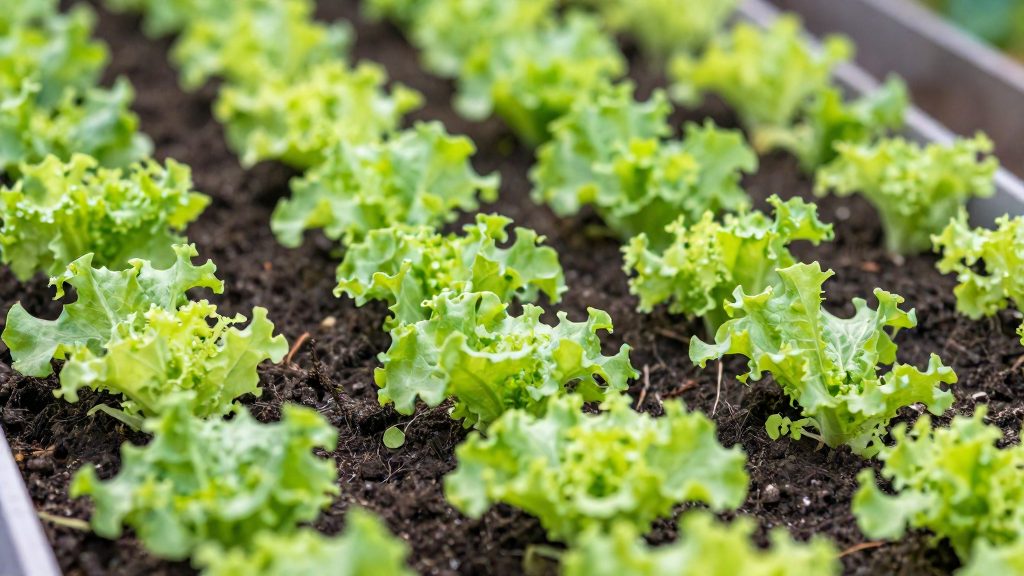
Succession planting lettuce means sowing small, repeated batches instead of one large sowing, so heads reach harvest across several weeks rather than all at once. A single batch matures together, which produces a glut followed by an empty bed. According to the University of Florida IFAS Extension (Gardening Solutions), repeated smaller plantings are preferred over one large batch. Staggering the sowings spreads maturity over time, limits the surplus at any one moment, and fills the gaps between harvests.
Why succession plant lettuce?
Why one batch matures all at once
Lettuce sown in one batch reaches maturity at roughly the same time across the whole planting. The single batch therefore gives one concentrated harvest. Every head is ready in the same week, so the kitchen receives more than it can use before the leaves are at their best.
The cost of this approach is a timing mismatch. The official sources consulted do not specify how long a mature lettuce head holds its quality in the bed, so the safe planning assumption is that a single batch offers one window, not a supply. Once that window closes, the bed has nothing left to give until the next planting.
The short harvest window of each planting
Each sown planting has a limited harvest window. Cutting or picking lettuce from a batch reduces what remains, and the planting cannot be extended by waiting. Staggered sowing turns one short window into several, each starting at a different point in the season.
Succession advice of this kind is not specific to lettuce, but the principle applies directly: smaller plantings overlap in time and keep a bed producing.
Gaps between harvests that staggered sowing fills
A single batch leaves the bed empty once harvested. Staggered sowing fills those gaps because a new planting is already growing when the previous one finishes. Using the same logic within lettuce itself, each successive planting takes over as the earlier one is consumed.
| Approach | Harvest timing | Result |
|---|---|---|
| One large batch | All heads mature together | One concentrated harvest, then an empty bed |
| Staggered batches | Maturity spread across successive plantings | Harvest continues, with smaller amounts at a time |
How often should you sow lettuce?
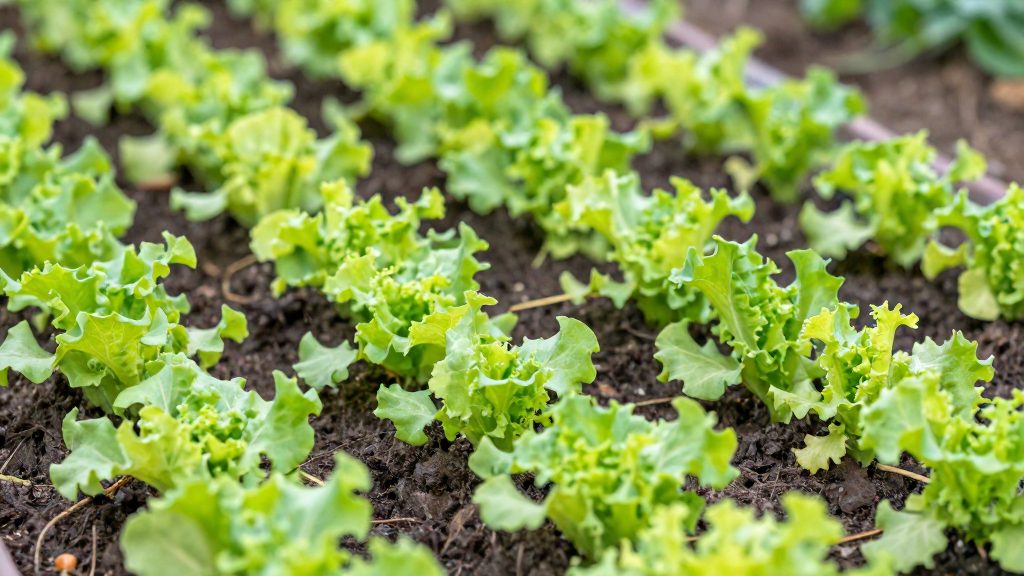
Lettuce supplies are steadier when you sow in small batches than when you sow the whole bed at once. The University of Maryland Extension suggests, as general succession advice, planting a portion of the space every two weeks; the University of Florida IFAS Extension suggests a couple of rows every month. Choose the interval that fits your household’s consumption. The University of Maryland Extension presents this as general succession advice, not guidance specific to lettuce, and links it to a continuous harvest. Instead of sowing the full bed on one day, divide it into sections and sow one section at each interval. This is the core of succession sowing.
Why repeated sowings work better
- Spread-out harvests: plants from one sowing reach harvest size at about the same time, so sowing in several batches is what spreads the harvest across weeks.
- Continuous supply: sowing a new section at each interval means some plants are always at a harvestable stage.
- Simpler management: each section has a known sowing date, which makes it easier to track watering, thinning, and harvest.
Two rows per month as a small-batch example
The University of Florida IFAS Extension (Gardening Solutions) suggests planting a couple of rows every month instead of one large batch. In a bed, this becomes a fixed monthly routine: sow two rows, record the date, and sow the next two rows the following month.
| Method | Sowing interval | Source |
|---|---|---|
| One large sowing | Once for the whole bed | Approach the sources advise against |
| Portion of the bed | Every two weeks | University of Maryland Extension (general succession advice) |
| Two rows per month | Monthly | University of Florida IFAS Extension (Gardening Solutions) |
How the sowing dates are spaced across beds
The University of Maryland Extension sample plan sows lettuce on March 20 in one bed and sows leafy greens, including lettuce, on April 15 in another. This shows that successive sowings can also be spread across separate beds, with each bed following its own schedule.
Which lettuce varieties suit each season?
Lettuce varieties fall into two groups for planning: cool-season varieties for spring and autumn sowings, and heat-tolerant varieties for summer sowings. According to the University of Vermont Extension, choosing the group that matches the sowing window is the simplest way to keep a succession running without relying on one type all year.
| Sowing window | Variety group | Source |
|---|---|---|
| Spring | Cool-season | University of Vermont Extension |
| Autumn | Cool-season | University of Vermont Extension |
| Summer | Heat-tolerant | University of Vermont Extension |
Cool-season varieties for spring and autumn
- Sow cool-season types in spring and again in autumn, when temperatures are milder.
- Choose these varieties for the cooler parts of the year, when summer heat is not a factor.
Heat-tolerant varieties for summer
- Switch to heat-tolerant types for summer sowings, following the same Vermont guidance.
- The official sources consulted do not name specific heat-tolerant cultivars or their harvest times. Ask a local seed supplier or your regional extension office for varieties tested in your area.
Head, loose-leaf and romaine types by season
The official sources consulted do not rank head, loose-leaf or romaine types against each other for a given season. Within the right group, pick the type that fits your harvest plans and your local conditions. Regional timing also matters: the University of Florida IFAS Extension (Gardening Solutions) states that in Florida, lettuce can be planted from October through February, so the calendar you follow depends on where you garden.
What does a spring-to-fall schedule look like?
A spring-to-fall lettuce schedule is built from several dated sowings rather than one large sowing. The sources support a framework rather than a complete calendar: the University of Maryland Extension sample plan sows lettuce on March 20 in one bed and leafy greens, including lettuce, on April 15 in another. Fill in the remaining sowings using an interval of two weeks or one month, with cool-season varieties in spring and fall and heat-tolerant varieties in summer.
The Maryland sample: two beds, two dates
| Bed | Crop | Sowing date | Source |
|---|---|---|---|
| Bed 1 | Lettuce | March 20 | University of Maryland Extension |
| Bed 2 | Mixed leafy greens, including lettuce | April 15 | University of Maryland Extension |
This plan separates the lettuce into distinct beds, so each sowing can be harvested and replanted on its own timing.
Step-by-step: laying out the calendar
- Draw a bed map showing each bed or block and its dimensions.
- Assign a sowing date to each block, starting with the March 20 lettuce bed as the first anchor and the April 15 leafy greens bed as the second.
- Mark the next sowing dates in spring and early summer, placing each new block so it is not sown on the same day as an existing one.
- Record the variety next to each block, so you can check it against the temperatures at the time of harvest.
- Replant the emptied block with the next planned sowing once the previous crop is harvested.
Spring and early summer starts by month
The University of Maryland sample gives only the two dates above. The official sources consulted do not specify a full month-by-month sowing list for lettuce. Your local extension service or frost dates will determine the exact months for your region.
Matching the variety to the sowing date
According to University of Vermont Extension, cool-season lettuce varieties suit spring and fall sowings, while heat-tolerant varieties suit summer. The sources consulted do not give cutoff dates for switching between the two types, so check the variety descriptions on your seed packets and adjust to your local weather.

Succession planting lettuce in warm climates
In warm regions, the usable growing season for lettuce is set by the calendar of heat rather than by a fixed spring date. According to University of Florida IFAS Extension (Gardening Solutions), lettuce can be planted in Florida from October through February. Within that Florida sowing window, staggering sowings keeps harvests coming without a single large batch maturing at once. Other warm US regions have different windows, so check your local extension office.
Adjusting the sowing window
- Plan the calendar around the cooler months, and treat the hot season as a break in sowing rather than an extension of it.
- Start the first sowings as the cool period begins, then continue through the winter window.
- Shift the spring sowings earlier where the heat arrives early, so plants mature before the hottest weeks.
Staggering sowings for continuous harvest
To keep a bed producing, the University of Vermont Extension suggests starting lettuce in spring and early summer and following it with greens such as kale, mizuna or pak choi in late summer. In Florida, stagger sowings across the October-through-February window rather than sowing one large batch. In other warm regions, check your local extension office for the sowing window.
Summer protection with shade cloth
Shade cloth is a non-chemical way to reduce the heat that stresses lettuce beds in summer. Stretch the cloth on a simple frame over the bed during the hottest part of the season, and keep it raised so air circulates around the leaves. The official sources consulted do not specify a shade cloth density, the exact months of use, or the hours of coverage, so adjust these to your local conditions and observe how the plants respond.
Hot soil also slows germination, so keep seedbeds covered and sow when the surface is cooler. Shade cloth and the timing of sowing work together: a shaded bed sown on schedule gives seedlings a better start than an exposed bed sown during a heat wave.
How do you avoid bolting and bitter leaves?
Lettuce bolts when it shifts from producing leaves to producing a flower stalk, and the leaves that remain often taste sharper. Harvest method and watering are the two habits you control most directly. They work best alongside the timing choices covered elsewhere in this guide.
Harvest the outer leaves first
Picking the outer leaves and leaving the central crown intact keeps the plant in its leafy growth stage for longer. Pick the largest, outermost leaves as needed, and leave the small inner leaves to keep growing. A whole-head harvest ends the plant’s productive life at once, while outer-leaf picking spreads the harvest over several weeks.
- Pick in the cool part of the day, when leaves are turgid and crisp.
- Remove leaves with a clean cut or a gentle twist, without tearing the crown.
- Harvest a little often rather than all at once, so the plant keeps a full canopy of young leaves.
Water evenly and mulch the soil
Bitterness rises with heat, plant age and dryness. Irregular watering, where soil swings between soggy and bone-dry, pushes lettuce toward stress and bolting. Water the soil at the base of the plant, not the leaves, and aim for steady moisture rather than occasional heavy soakings. Avoid waterlogging, which weakens roots and can stress the plant as much as drought.
A thick organic mulch, such as straw, dry grass clippings or leaf mould, keeps the root zone cooler and holds moisture between waterings. Keep mulch an inch or two away from the stems to limit rot. During hot spells, a shaded or partly shaded spot helps, and bare, sun-baked soil is best avoided.
Summary of stressors and responses
| Stressor | Effect on lettuce | Organic response |
|---|---|---|
| Heat | Accelerates bolting and bitterness | Mulch, partial shade, regular watering |
| Dryness | Leaves turn bitter and tough | Consistent moisture at the root zone |
| Plant age | Older leaves taste sharper | Harvest outer leaves early and often |
| Irregular watering | Triggers stress and premature bolting | Water on a steady schedule |
Crops to follow lettuce in the bed
Lettuce is typically the first crop in a bed’s spring-to-summer sequence, and the cleared space can carry a second group of leafy greens in late summer. According to the University of Vermont Extension, you should start lettuce in spring and early summer, then follow it with greens such as kale, mizuna or pak choi in late summer. These three are the successor crops the source names, and they are the most directly supported options for this slot in the bed.
Late-summer successor crops
- Kale: named by the University of Vermont Extension as a late-summer green to plant after lettuce.
- Mizuna: named by the same source for the same late-summer slot.
- Pak choi: named by the same source for the same late-summer slot.
Replanting after the final lettuce harvest
- Harvest the last lettuce, then pull the spent plants and their roots so the bed surface is clear.
- Loosen the top layer of soil by hand or with a hand fork before sowing. Avoid chemical herbicides for clearing weeds; manual removal is the organic alternative.
- Sow or transplant the successor greens once the bed is clear, within the late-summer window named by the University of Vermont Extension.
The sources consulted do not give a fixed number of days between the last lettuce harvest and the next sowing. Adjust the timing to your region’s climate and the weather at the time.
Crops to avoid after lettuce
The sources consulted do not specify whether other members of the Asteraceae family, such as chicory and endive, should follow lettuce in the same bed. Do not assume they can replace the successor greens listed above. Check a regional extension service before planting them in a bed that has just held lettuce.
Frequently asked questions
How often should I sow lettuce for succession planting?
The University of Maryland Extension suggests, as general succession advice rather than lettuce-specific guidance, planting a portion of the space every two weeks. The University of Florida IFAS Extension instead suggests sowing a couple of rows every month. These are two separate suggestions, so choose the interval that matches how quickly your household eats lettuce.
Which lettuce varieties should I choose for each season?
According to the University of Vermont Extension, cool-season varieties suit spring and fall, while heat-tolerant varieties suit summer. The same source advises starting lettuce in spring and early summer, then following it with kale, mizuna or pak choi in late summer to keep the bed productive.
When should I sow lettuce in a warm climate?
The October-through-February sowing window comes from the University of Florida IFAS Extension and applies to Florida only, so other warm US regions will have different dates. During hot spells, a shaded or partly shaded spot is general practice to reduce stress on the plants. For the sowing window in your area, check your local extension office.