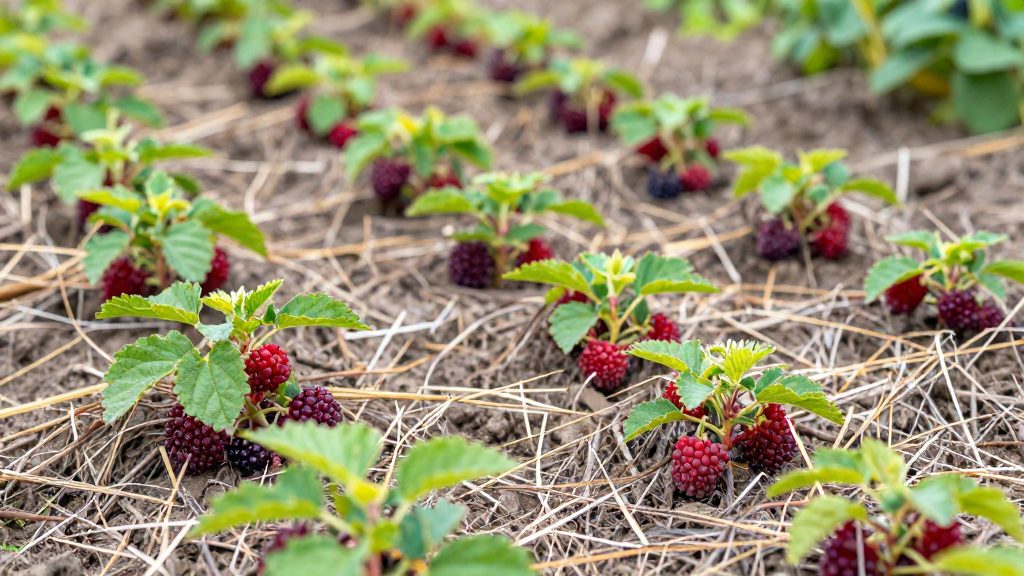
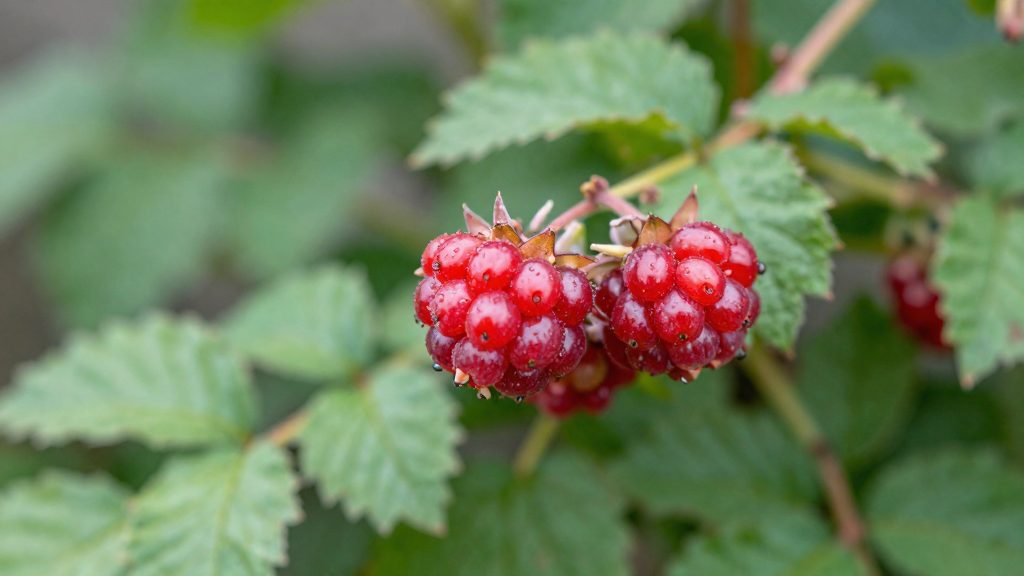
Raspberries suit cold northern gardens because they are perennial: the planting persists from year to year, so once it is established the same bed keeps producing instead of being replanted each season. According to Alberta Agriculture and Forestry (2019), alternating warm and cold spells in late winter and early spring can cause severe cane losses, and in northern Alberta these losses usually come from canes that did not mature in fall. The official sources consulted do not quantify the annual labour of raspberries against annual vegetables, so the comparison below is qualitative.
Why choose raspberries in cold climates?
Perennial canes carry the crop over many seasons. The official sources consulted describe a planting that is renewed rather than rebuilt: each spring, the grower keeps a set number of sturdy canes and removes the rest. According to Alberta Agriculture and Forestry (2019), this means leaving 9 to 10 sturdy canes per metre, at least 15 cm apart, and removing dead, weak and surplus canes at ground level. The bed therefore keeps its structure and yield potential from one year to the next.
Hardiness is what makes this repeat yield possible in cold climates. Alternating warm and cold spells in late winter and early spring can cause severe cane losses. Keeping canes healthy through winter is the central task of the planting.
Low input comes mainly from the one-time soil preparation and a small set of recurring tasks. The ideal soil is a loam high in organic matter, and peat moss or well-rotted manure is added the year before planting. After that, the recurring tasks are as follows:
| Annual task | Guidance (Alberta Agriculture and Forestry, 2019) |
|---|---|
| Spring cane selection | Keep 9 to 10 sturdy canes per metre, at least 15 cm apart; remove dead, weak and surplus canes at ground level |
| Support | Posts with two wires per side, set at 60 to 90 cm high |
| Winter cover | Leave old canes standing to trap snow; where snow is scarce, bend canes over, cover tips with soil and uncover in late April |
| Watering | Withhold water from mid-August to late fall; water well after leaf drop |
For short-season fruiting value, the benefit lies in starting from an established planting. An established planting is maintained each year and not replanted, but the sources consulted do not say when it will fruit. The official sources consulted do not give harvest dates or yields per metre for northern regions, so timing should be checked against local frost and season length before planting.
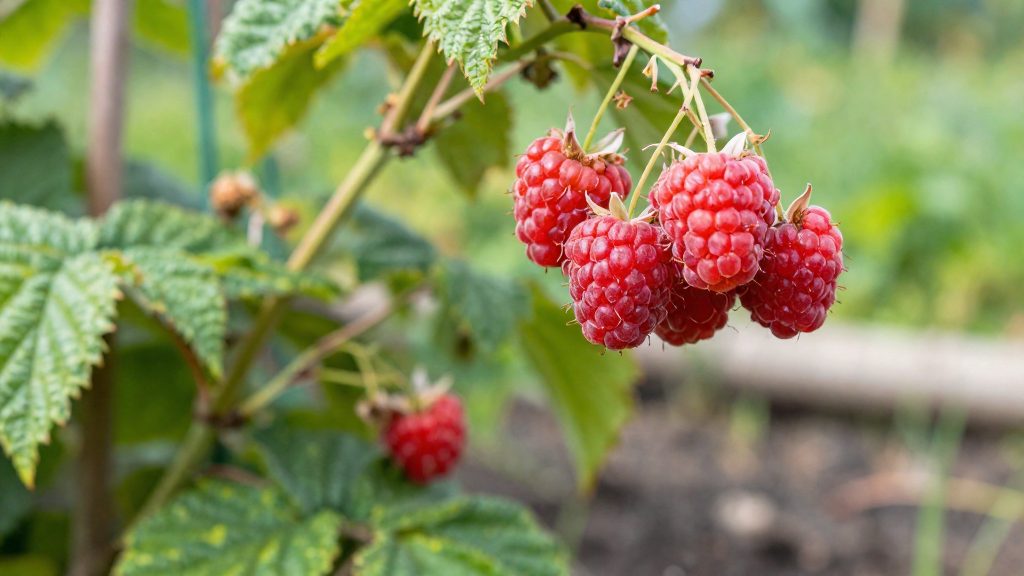
Hardy varieties recommended for Alberta winters
Cultivar choice is one of the main levers for limiting winter injury on raspberry canes. According to Alberta Agriculture and Forestry (2019), growers should grow hardy varieties as one of several measures against winter damage. Selection comes down to two questions: which fruiting type suits your harvest and pruning routine, and which cultivars are recommended for your local climate.
Summer-bearing versus fall-bearing cultivars
The sources consulted divide raspberries into summer-bearing cultivars and fall-bearing cultivars. Their management differs, so the choice affects your pruning calendar. For fall-bearing types, Alberta Agriculture and Forestry (2019) advises cutting primocane canes to the ground each March or April. The official sources consulted do not give harvest dates for each type in colder regions.
| Bearing type | Cultivars named by Alberta Agriculture and Forestry (2019) |
|---|---|
| Summer-bearing | Boyne, Festival, Killarney, Honeyqueen (yellow), SK Red Mammoth |
| Fall-bearing | Red River, Double Delight, Summit, Autumn Bliss, Fallbrook |
Hardy examples for cold winters
Boyne and Killarney are listed among the hardy summer-bearing cultivars recommended for Alberta. Festival and SK Red Mammoth appear in the same recommendation list, so they are also worth considering if your region is similar. Among the fall-bearing options, the same source lists Red River, Summit and Autumn Bliss, among others.
Colour matters for winter hardiness. According to Manitoba Co-operator (Glacier FarmMedia, 2016), yellow or gold types such as Honeyqueen are relatively cold-tolerant. The official sources consulted do not specify the winter hardiness of Latham, so check a regional recommendation before planting it in a cold site.
Matching cultivar ratings to local winter lows
The official sources consulted do not give minimum winter temperatures for each cultivar, so no threshold can be quoted here. A practical method:
- Check the recommendation list from your provincial agriculture department or local extension service for your area.
- Record the lowest winter temperatures in your own garden over several seasons, since a sheltered spot can be milder than the regional average.
- Favour cultivars named as hardy for your region, and move toward the more cold-tolerant yellow types if your winters are severe.
- Buy from local nurseries that sell plants proven in your climate.
Choosing the right site and soil
Site and soil set the conditions raspberry canes face through winter, so they matter before any planting begins. According to Alberta Agriculture and Forestry (2019), the site should combine good air circulation with wind protection, avoid frost-prone hollows, and stay clear of the south side of east-west fences and shelterbelts. The same source identifies loam high in organic matter as the ideal soil, prepared the year before planting.
Air circulation and wind protection
Look for a spot where air moves freely through the planting while strong winds are broken by a hedge, a building or a shelterbelt. Good air circulation and wind protection are recommended together, not as alternatives. A site that is fully open to prevailing winds offers little shelter, while a site with no airflow at all is not recommended either.
Avoiding frost pockets
Frost pockets form in depressions, where cold air settles on still, clear nights. Before planting, observe the plot on a calm evening to see where frost collects first, and place the canes on higher, better-drained ground. Low corners that stay cold longest are the poorest choice.
Fences and shelterbelts
Avoid the south side of east-west fences and shelterbelts. These structures can create winter heat traps, where warm air and reflected heat are held against the canes and encourage early growth that is then damaged by cold returning. Keep rows clear of these structures rather than planting directly against them.
| Site factor | Recommendation |
|---|---|
| Air and wind | Good air circulation with wind protection |
| Low ground | Avoid frost pockets in depressions |
| East-west fences or shelterbelts | Avoid the south side |
| Soil type | Loam high in organic matter |
| Soil amendment | Peat moss or well-rotted manure, added the year before planting |
Soil preparation
Aim for a loam with high organic matter. Add peat moss or well-rotted manure the year before planting, so the material has time to integrate into the bed. Organic sources such as well-rotted manure supply nutrients gradually, which suits this goal.
Planting and spacing
Cold-climate raspberry plantings are set out with wide rows and generous plant spacing so that each cane gets light, air movement and room to grow. According to Alberta Agriculture and Forestry (2019), rows should be 3 to 4 m apart, with plants spaced 60 to 100 cm apart within each row. The same source recommends a post-planting cutback of new canes to 13 to 15 cm once the plants are in the ground.
Spacing for the planting layout
| Parameter | Recommended value |
|---|---|
| Distance between rows | 3 to 4 m |
| Distance between plants in a row | 60 to 100 cm |
- Space rows far enough apart to walk between them and handle the canes without damaging the plants.
- Within each row, keep plants at a consistent distance so that growth is even along the line.
- Good spacing also supports the air circulation that cold-climate sites need. Avoid crowding plants into a dense block, which slows drying after rain or dew.
Cutting new canes back after planting
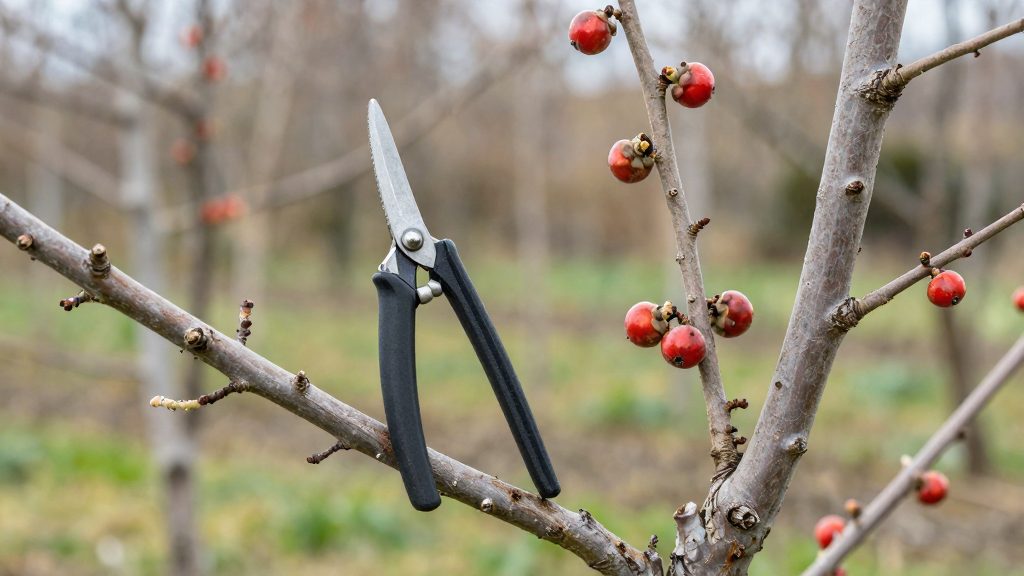
Right after planting, cut the new canes back to 13 to 15 cm. This is a one-time step for the newly set plants. Use clean, sharp pruners so each cut is smooth and the plant is not crushed or torn.
Plan the planting and the cutback so the new canes have a full growing season ahead of them.
How should you prune and trellis canes?
Spring cane management on raspberries comes down to three tasks: thinning the planting to a set number of canes, removing dead, weak and surplus canes at the base, and supporting the remaining canes on a two-wire trellis. According to Alberta Agriculture and Forestry (2019), each spring you should leave 9 to 10 sturdy canes per metre of row, spaced at least 15 cm apart. This spacing keeps the planting open to air and light and gives each cane room to carry fruit.
Thinning the canes
- Walk the row in spring and count the canes in each metre.
- Keep the sturdiest canes, the thickest and firmest ones, and make sure the ones you keep stand at least 15 cm apart.
- Cut the surplus canes so the planting falls within the 9 to 10 cane target.
Removing dead, weak and surplus canes
- Remove dead canes first, since they add no fruiting potential.
- Remove weak canes, which compete with stronger ones for space and resources.
- Cut all removed canes at ground level, leaving no stubs above the soil.
Setting up the two-wire trellis
- Install posts along the row to hold the wires.
- Fix two wires per side, positioned 60 to 90 cm above the ground.
- Tie the retained canes to the wires so they stay upright and do not sprawl.
| Task | Target |
|---|---|
| Canes retained per metre of row | 9 to 10 |
| Minimum spacing between retained canes | 15 cm |
| Wires per side | 2 |
| Wire height above ground | 60 to 90 cm |
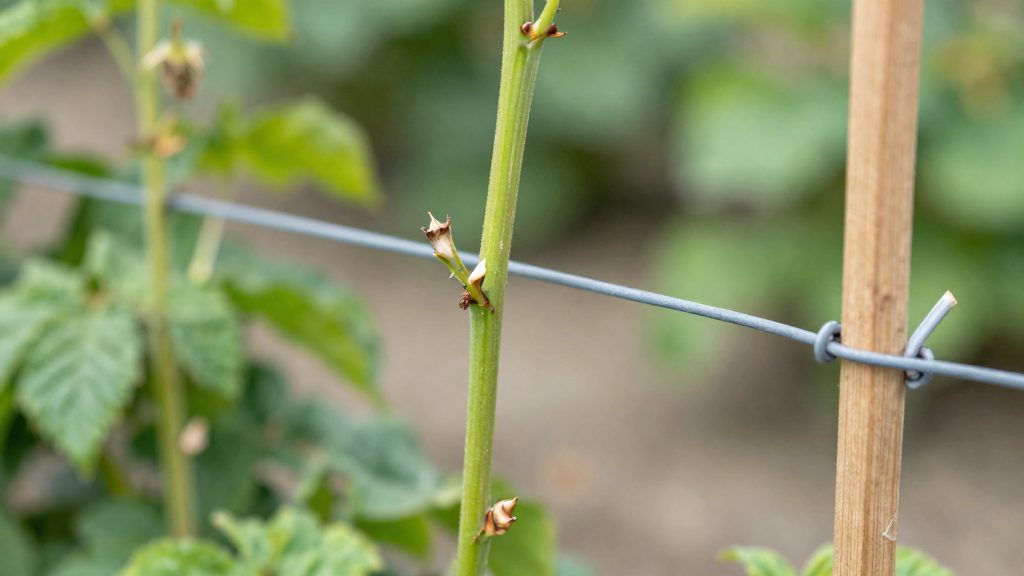
Protecting canes through winter
Winter protection for raspberry canes relies on snow and soil rather than manufactured covers. According to Alberta Agriculture and Forestry (2019), old canes left standing trap snow, which acts as an excellent natural mulch. Keeping last season’s canes in place is the simplest protection method, and it costs nothing beyond leaving the rows undisturbed in autumn. Where snow is scarce, a second method applies: bending the canes down and burying their tips.
| Method | Condition | Action |
|---|---|---|
| Leave old canes standing | Reliable snow cover | Keep canes uncut so they trap snow |
| Bend canes and cover tips | Snow is scarce | Bend canes down and cover the tips with soil |
| Uncover tips | Spring | Uncover the tips in late April |
Leaving old canes standing to trap snow
Standing canes work as a natural snow fence. Snow caught among them builds up around the base and lower stems, forming the insulating layer that the source describes as an excellent natural mulch. If you plan to rely on this method, leave the old canes in place through autumn and winter. Cutting them down removes the structure that holds the snow.
Bending canes and covering tips with soil
Where snow cover is unreliable, the source recommends bending the canes over and covering the tips with soil. This keeps the most exposed growth out of the cold, dry air above the ground. Work along the row and bend the canes down as a group, pressing soil over the tips so they stay buried. Handle the canes gently, because stiff or dry canes can snap at the bend. Use only the soil from the bed, which keeps the method free of any synthetic material.
Uncovering tips in late April
According to Alberta Agriculture and Forestry (2019), the tips should be uncovered in late April. Lift the soil gradually from the tips, then check the canes for damage before they are straightened. The official sources consulted do not specify how this timing should be adjusted for sites with a warmer or colder spring, so observe local conditions before uncovering the entire row.
What mistakes cause winter dieback?
Winter dieback in raspberries, where canes die back or fail to survive the cold season, is linked in the sources to three factors: freeze-thaw swings in late winter, canes that have not hardened before autumn, and trimming new canes after July 1. According to Alberta Agriculture and Forestry (2019), alternating warm and cold spells in late winter and early spring can cause severe cane losses, and in northern Alberta those losses usually come from canes that did not mature in fall. Knowing which of these problems applies to your planting tells you what to change.
| Cause | What it looks like | Prevention |
|---|---|---|
| Late-winter thaw cycles | Warm and cold spells alternate in late winter and early spring | Plant hardy cultivars suited to your climate |
| Canes not maturing before fall frost | Losses concentrated on canes that stayed soft and green into autumn | Choose varieties that harden off in time for your first frost |
| Trimming new canes after July 1 | Winter injury on canes cut late in the growing season | Stop trimming new canes by July 1 |
Alternating warm and cold spells in late winter
Repeated thaws and refreezes in late winter and early spring stress canes that are already weakened. The official sources consulted do not specify the temperature thresholds or number of cycles that cause damage, so monitor your own site rather than relying on a fixed figure.
The main gesture here is cultivar choice. Alberta Agriculture and Forestry (2019) lists hardy summer-bearing options such as Boyne, Festival, Killarney, Honeyqueen and SK Red Mammoth, and fall-bearing options such as Red River, Double Delight, Summit, Autumn Bliss and Fallbrook. According to Manitoba Co-operator (Glacier FarmMedia, 2016), black and purple raspberries are the least cold-hardy types and often die in harsh Prairie winters even with protection, while yellow or gold types such as Honeyqueen are relatively cold-tolerant.
Canes that do not mature before fall frost
Cane maturation is the process by which canes harden and become able to survive winter. Alberta Agriculture and Forestry (2019) identifies immature canes as the usual source of losses in northern Alberta. Canes that are still soft and green when frost arrives are the most exposed.
To reduce the risk:
- Note the average first-frost date for your area from a local extension service, since the official sources consulted do not give a date for your region.
- Select cultivars that finish their growth early enough for your season.
- Examine canes in early spring and record which ones were damaged, so you can compare varieties and sites over several years.
Trimming new canes after July 1
Alberta Agriculture and Forestry (2019) recommends not trimming new canes after July 1 to limit winter injury. The source gives this date as one of the measures to limit winter injury, without detailing the mechanism.
Mark July 1 on your garden calendar as the last date for trimming new canes, and schedule any necessary cutting before that date.
Organic care and mulching
Organic care for cold-climate raspberries rests on three levers: a mulch layer around the canes, moderate nitrogen, and a watering schedule that stops in mid-August and resumes after leaf drop. According to Alberta Agriculture and Forestry (2019), avoiding excess nitrogen and withholding water from mid-August to late fall are two measures that limit winter injury. The official sources consulted do not specify compost rates or mulch thicknesses, so the methods below describe the principles and timing, not exact quantities.
Organic mulch around the canes
- Spread a layer of organic mulch over the root zone of the raspberry rows to keep the soil more even and to suppress weeds.
- Keep the mulch away from the base of the canes so that stems do not stay wet against the bark.
- Common organic mulches include straw and shredded bark. Choose a material you can refresh each year as it breaks down.
Managing nitrogen with compost
Compost is the usual organic source of nutrients, but too much nitrogen pushes soft growth that does not harden before winter. Alberta Agriculture and Forestry (2019) lists excess nitrogen among the factors that increase winter injury, so the aim is steady, moderate feeding rather than heavy top-dressing.
- Apply compost in modest amounts and avoid large late-season applications.
- Observe the canes: lush, pale growth in late summer suggests the plants have received too much nitrogen.
- Use a soil test where available to decide whether any nutrient is actually lacking.
Late-season watering schedule
| Period | Watering action | Reason given |
|---|---|---|
| Mid-August to late fall | Withhold water | Limits winter injury |
| After leaf drop | Water well | Supports the plants before winter |