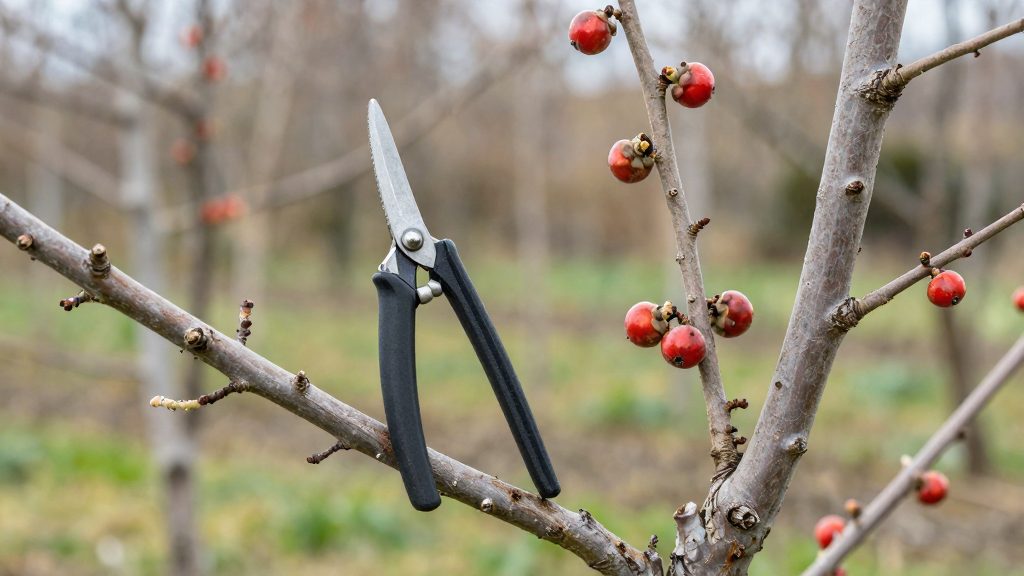
Late winter, just before spring growth begins, is the period recommended for pruning apple trees, according to Oregon State University Extension Service (2026). Pruning while the tree is dormant lets you shape the growth that follows in spring, so the cuts you make now set the framework the tree will carry through its fruiting years. In an organic orchard, careful timing and correct cut selection also reduce the wounds the tree has to heal, and pruning itself requires no chemical product.
Why prune apple trees in late winter?
Dormant pruning gives you control over the structure of the tree while it is still dormant. Oregon State University Extension Service (2026) identifies late winter as the best time for this work, because the tree is still dormant and the new spring growth can be directed where you want it.
On young trees, the leader is the main upright shoot that forms the central axis. Once it reaches the height you want, cut it back to a lateral branch. The lateral branches should form a wide angle of about 60° with the leader. Narrow angles trap bark in the crotch and may split as the tree grows, so favouring wider angles is a structural goal from the first pruning.
Established trees need a different approach. Remove limbs that cross, compete with the leader, or shade the centre of the tree. An open centre lets light and air reach the fruiting wood.
| Situation | Pruning action |
|---|---|
| Young tree, leader at the desired height | Cut back to a lateral branch |
| Lateral branches forming a narrow angle | Favour wider-angled branches to avoid trapped bark and splitting |
| Crossing, competing or shading limbs | Remove them to open the centre |
For organic practice, use clean, sharp secateurs and loppers. Adapt the timing to your region and local climate, since the late winter window depends on when your trees come out of dormancy.
When is the best time to prune in Canada?
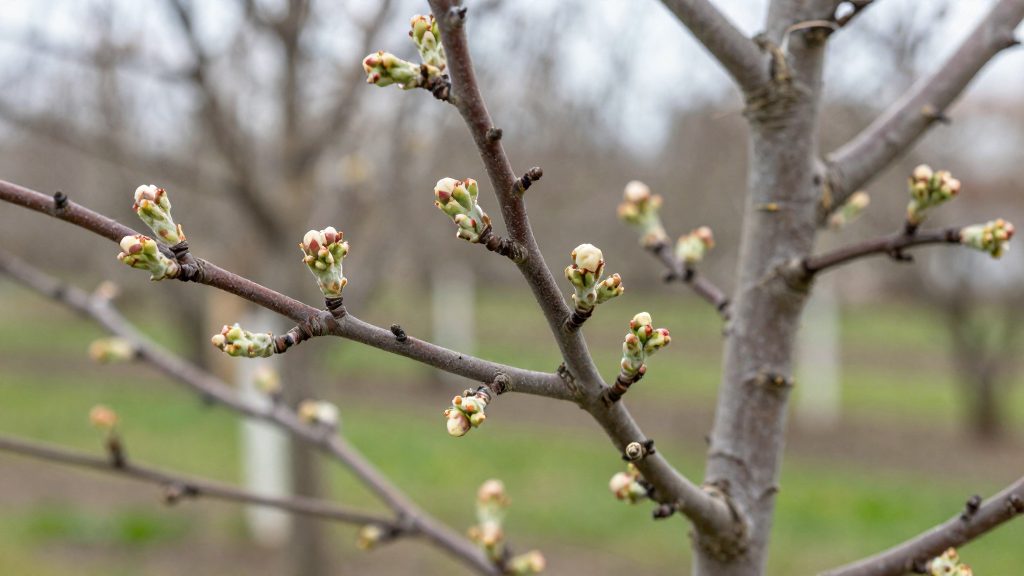
According to Oregon State University Extension Service (2026), late winter, just before spring, is the best time to prune apple trees. Pruning while the tree is dormant lets you shape the growth that follows in spring. The official sources consulted do not give a Canadian pruning calendar, and this recommendation comes from a US source, so the exact timing should be adapted to your own region and local climate. Judge the window by the tree’s condition, staying within the dormant period, rather than by a fixed date.
Pruning steps for young trees
- Leader: once the central leader reaches the desired height, cut it back to a lateral branch.
- Branch angle: aim for an angle of about 60° between the leader and the lateral branches. Narrow angles trap bark and may split.
- Crossing or crowded limbs: remove limbs that cross, compete with each other, or shade the centre of the tree.
| Task | Guidance from the source |
|---|---|
| Cut back the leader | Once it reaches the desired height, cut to a lateral branch |
| Set branch angles | Aim for about 60°; narrow angles trap bark and may split |
| Remove problem limbs | Cut those that cross, compete, or shade the centre |
Tools and disinfection: the essentials
Clean cuts depend on sharp, clean tools. Most late-winter pruning jobs on an apple tree need three types of tool, and each should be checked and cleaned before you start.
Choosing your cutting tools
- Hand pruners (secateurs): for thin shoots that you can hold in one hand.
- Loppers: for limbs too thick for hand pruners, using long handles for leverage.
- Pruning saw: for heavier limbs that loppers cannot cut cleanly.
Use bypass-style blades where possible, since they cut like scissors. Keep every blade sharp so each cut stays clean.
Checks before the first cut
- Look for limbs that cross, compete with the leader, or shade the centre of the tree. These are usually the first cuts to make.
- Confirm whether the variety is spur-bearing or tip-bearing, as the Oregon State University Extension Service (2026) recommends, so you know which wood carries fruit.
- On young trees, once the leader reaches the desired height, cut it back to a lateral branch. Aim for a wide angle of about 60° between the leader and the laterals, because narrow angles trap bark and may split.
Cleaning tools and disinfecting with rubbing alcohol
Clean tools between trees, and always after cutting wood that looks diseased. The official sources consulted do not specify a tool-disinfection protocol, so the steps below reflect general organic practice:
| Step | Method | Purpose |
|---|---|---|
| 1. Remove residue | Scrub with warm water and soap | Removes sap and plant debris |
| 2. Dry | Wipe dry with a clean cloth | Reduces rust on blades |
| 3. Disinfect | Wipe blades with rubbing alcohol | Reduces carry-over between trees without synthetic sprays |
Avoid chemical sprays on tools you use in an organic orchard. If you use rubbing alcohol, check that it is acceptable under your organic certification, if you have one.
Which branches to remove first?
Start with the branches that work against the shape of the tree. On a young apple tree, once the leader (the main upright stem) reaches the height you want, cut it back to a lateral branch that will take over as the new top. According to Oregon State University Extension Service (2026), the lateral branches should leave the leader at a wide angle of about 60°. Narrow angles trap bark and may split later, so a lateral branch with a tight crotch should be reviewed before it becomes a weak point.
Then remove the limbs that cross, compete or shade the centre of the tree. The same source lists these three categories as the limbs to remove.
| Branch to remove | Criterion | Action |
|---|---|---|
| Leader on a young tree | Has reached the desired height | Cut back to a lateral branch |
| Lateral branch at a narrow angle | Angle well below about 60° with the leader | Remove or shape out, since narrow angles may split |
| Crossing limb | Crosses another limb | Remove |
| Competing limb | Competes with the main framework | Remove |
| Shading limb | Shades the centre of the tree | Remove |
Before making any cut, identify whether the variety is spur-bearing or tip-bearing, and avoid removing the fruiting wood it produces. The official sources consulted do not describe how to tell these two types apart in detail, so check the variety information from your nursery or local extension service. The official sources consulted also do not specify a cutting order, so the sequence above is a practical guide rather than a sourced rule.
Pruning cuts require only hand tools and no chemical product. The official sources consulted do not specify any wound-dressing product, so if you want to protect large cuts, choose an organic option and check its approved use for fruit trees in your region.
Pruning a Young Apple Tree: Angles and Framework
Training a young apple tree means building a sound main framework early. According to Oregon State University Extension Service (2026), pruning while the tree is dormant lets you shape the growth that follows in spring, so the cuts you make now set the tree’s structure for years. The goal is a central leader with well-spaced lateral branches that can carry fruit without splitting or crowding one another.
Setting the leader and laterals
The leader is the main upright stem. Once it reaches the height you want, cut it back to a lateral branch. This stops vertical growth and lets the lateral branches take over the work of carrying the canopy.
Oregon State University Extension Service (2026) recommends aiming for a wide angle of about 60° between the leader and the lateral branches. When checking each branch:
- Look at the angle where it leaves the leader or trunk.
- Keep branches that spread outward at a wide angle.
- Remove or reshape branches that grow almost parallel to the leader.
Narrow angles trap bark where the two stems meet, and the joint may split as the branches thicken.
Removing problem limbs
Some limbs work against the framework and should be removed. Oregon State University Extension Service (2026) identifies three types:
| Limb type | Problem it causes | Action |
|---|---|---|
| Crossing limbs | Cross other limbs | Remove one of the pair |
| Competing limbs | Vie with the leader or another main branch | Remove the weaker one |
| Shading limbs | Block light from reaching the centre of the tree | Remove or shorten |
Step back often to judge the overall shape.
Identify the fruiting wood first
Before making any cut, check whether the variety is spur-bearing or tip-bearing. Oregon State University Extension Service (2026) advises this step so you do not cut off the wood that will carry the crop. Confirm the bearing habit of your variety before pruning, especially if you are unsure which wood produces fruit.
How to Prune an Old Apple Tree
According to Oregon State University Extension Service (2026), late winter, just before spring, is the best time to prune apple trees. Pruning while the tree is dormant lets you shape the spring growth that follows. On an older tree, the aim is to open the centre, remove wood that works against the tree’s structure, and keep the crop-bearing wood, rather than to build a framework from scratch.
Step 1: Check the variety before cutting
Before making any cut, identify whether the variety is spur-bearing or tip-bearing. Oregon State University Extension Service (2026) advises this check so you do not remove fruiting wood along with the branches you intend to cut.
Step 2: Remove the limbs that cause problems
Work through the tree and remove the following:
| Limb type | Action |
|---|---|
| Crossing limbs | Remove one of the two so they no longer rub |
| Competing limbs | Remove the one that competes with the main structure |
| Limbs shading the centre | Remove them to let light reach the middle of the tree |
Use clean, sharp hand tools. Pruning itself does not require any chemical product, which keeps the operation consistent with organic practice.
Step 3: Favour wide branch angles
On young wood, Oregon State University Extension Service (2026) describes cutting the leader back to a lateral branch once it reaches the desired height. When choosing which laterals to keep, look for branches that leave a wide angle with the leader.
Work gradually. Removing a large share of the canopy in one season is less controlled than spreading the cuts over several winters, and the official sources consulted do not specify a fixed proportion to remove in a single session.
Common pruning mistakes to avoid
Most pruning errors involve the points covered in the Oregon State University Extension Service (2026) guidance: narrow branch angles, removal of fruiting wood, and limbs left crossing or shading the centre of the tree. Each can be prevented with a quick check before the cut.
| Mistake | What to do instead |
|---|---|
| Leaving narrow angles between the leader and lateral branches | Aim for a wide angle of about 60° between them |
| Cutting the leader before it reaches the desired height | Once it reaches that height, cut back to a lateral branch |
| Cutting fruiting wood without knowing the variety | Check whether the variety is spur-bearing or tip-bearing first |
| Leaving limbs that cross, compete or shade the centre | Remove them to keep the centre open |
Narrow angles need the most attention on young trees. According to Oregon State University Extension Service (2026), narrow angles trap bark and may split as the tree grows, so a wider crotch angle is the safer structure.
Before any cut, identify the bearing habit. Oregon State University Extension Service (2026) advises checking whether the variety is spur-bearing or tip-bearing so that fruiting wood is not removed by mistake. Spur-bearing and tip-bearing varieties carry their fruit in different places, so correct identification helps protect the crop.
When removing limbs, prioritise those that cross, compete with the leader or shade the centre of the tree, as the Oregon State University Extension Service (2026) guidance lists them.
The official sources consulted do not specify wound treatment or post-pruning watering schedules, so this section gives no figures for aftercare. Pruning itself requires no chemical product. Adapt timing and details to your region and climate.
Frequently asked questions
When exactly should I prune my apple tree in late winter?
Oregon State University Extension Service (2026) recommends pruning in late winter, just before spring growth begins, while the tree is still dormant. The sources consulted do not give a fixed calendar date, so adjust the timing to your local climate and the state of the buds.
How do I shape a young apple tree with its leader and side branches?
Once the leader (the main upright shoot) reaches the height you want, cut it back to a lateral branch. Favour lateral branches that form a wide angle of about 60° with the leader, because narrow angles trap bark and can split as the tree grows.
How do I avoid cutting off the fruit when pruning?
Before making any cut, identify whether your variety is spur-bearing or tip-bearing, since each type fruits on different wood. Then remove limbs that cross, compete with the leader, or shade the centre of the tree to keep it open to light and air.