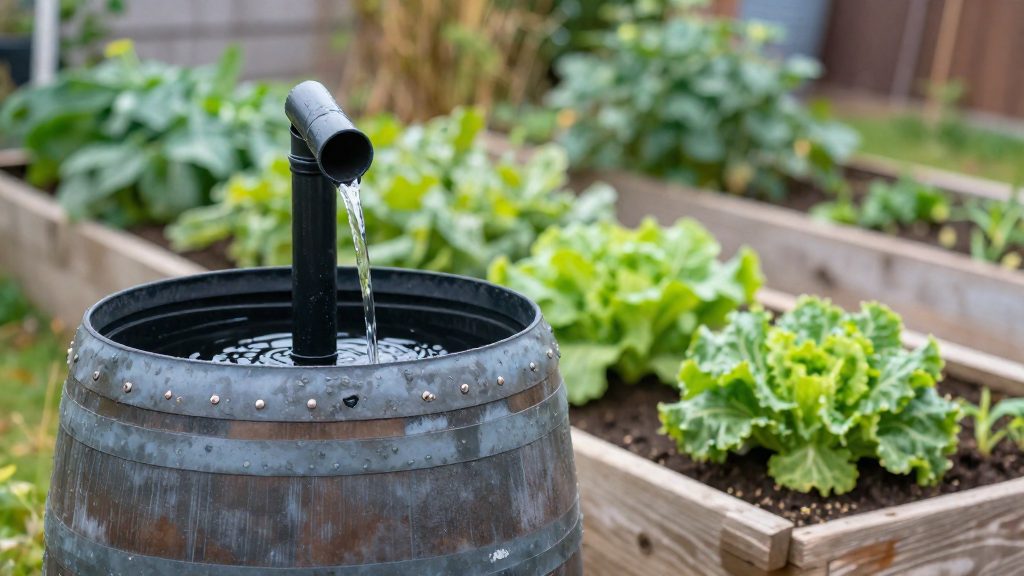
Rainwater harvesting in a small backyard garden means collecting runoff from a roof gutter into a sealed container and using it later for watering. According to the University of Saskatchewan – Gardening Saskatchewan, an average year in Saskatoon lets a 1,000 sq ft (about 93 m²) roof fill a 55-gallon (about 208 L) barrel roughly 110 to 125 times during the gardening season. Harvested water is not drinking water under either Saskatoon or Calgary guidance, so it is used for outdoor watering.
Why Collect Rainwater for the Vegetable Garden
Collected rainwater reduces the amount of tap water a garden needs during dry spells, and it is available close to the beds. Both local guidance sources consulted describe the same basic setup: a barrel placed under a downspout, an overflow route away from the house, and watering methods that keep water off edible leaves and fruit.
Water Volume a Rain Barrel Can Supply
The two sources measure this differently, so their figures should not be compared directly:
- Saskatoon: a 1,000 sq ft roof can fill a 55-gallon barrel about 110 to 125 times during the gardening season, in an average year (University of Saskatchewan – Gardening Saskatchewan).
- Calgary: a standard barrel can be filled and emptied 8 times or more per summer, and it saves at least 2,000 L of water per summer. It works better for manual watering than for automated irrigation (City of Calgary, YardSmart).
Where the Water Can and Cannot Go
Rain barrel water is non-potable in both cities. It is meant for outdoor use, and it should be applied to the soil rather than to the plant itself.
Watering at the base keeps water off leaves and fruit and delivers it to the root zone.
Setting Up the Barrel
Placement and overflow are the main points of attention:
- Place the barrel about 10 cm from the house or garage (University of Saskatchewan – Gardening Saskatchewan).
- Direct the overflow at least 6 ft (about 1.8 m) away from any foundation.
- Send the overflow toward a permeable surface such as a lawn, a planting bed, or a tree, away from foundations (City of Calgary, YardSmart).
- Use a sealed barrel and a fine mesh screen on the downspout inlet to limit mosquitoes (City of Calgary, YardSmart).
Mosquito Control
Standing water attracts mosquitoes, which lay eggs in it. To prevent this, mosquito control depends on keeping the lid and overflow screens intact. Bti mosquito dunks are a biological option: they are described as harmless to people, animals, and plants (University of Saskatchewan – Gardening Saskatchewan).
Winter and Off-Season Care
- Before winter, empty the barrel completely. Pour the water onto trees or shrubs.
- Remove unsecured taps and overflow devices, rinse the barrel, and store it upside down or in a sheltered place (University of Saskatchewan – Gardening Saskatchewan).
- In Calgary, disconnect a barrel placed directly under a gutter in winter, restore the original downspout, and set any diverter to winter mode (City of Calgary, YardSmart).
How much water can a rain barrel provide?
The yield of a rain barrel depends mainly on roof area and local rainfall. Two municipal sources give concrete figures for different climates. In an average year in Saskatoon, a 1,000 sq ft roof (about 93 m²) can fill a 55-gallon barrel (about 208 L) roughly 110 to 125 times during the gardening season, according to University of Saskatchewan – Gardening Saskatchewan. In Calgary, the City of Calgary (YardSmart) states that a standard barrel can be filled and emptied 8 or more times per summer, saving at least 2,000 L of water per summer.
| Location | Publisher | Figure | Conditions |
|---|---|---|---|
| Saskatoon | University of Saskatchewan – Gardening Saskatchewan | 1,000 sq ft roof fills a 55-gallon barrel about 110–125 times per growing season | Average year |
| Calgary | City of Calgary (YardSmart) | Standard barrel filled and emptied 8 or more times per summer | Saves at least 2,000 L per summer; works better with manual watering than automated irrigation |
These numbers are estimates for their respective cities. The official sources consulted do not specify the rainfall totals behind them, so a garden in another region should expect a different yield. Watering by hand with a can or a hose from the barrel is the method the Calgary guidance favors.
Installation rules that affect how much you collect
- Place the barrel directly under the downspout, about 10 cm (4 in) from the house or garage.
- Direct the overflow at least 6 ft (about 1.8 m) away from any foundation.
- Send the overflow onto a permeable surface such as a lawn, a flower bed, or a tree.
- Fit a fine mesh over the downspout inlet to limit mosquitoes.
- Keep the lid and overflow screens intact so mosquitoes cannot lay eggs in the water.
Using the water in the vegetable garden
- Water the soil at the base of plants with a watering can or drip system.
- Avoid wetting leaves and fruit, and wash harvested produce well.
- Treat the water as non-potable. It is suitable for outdoor use only.
Organic mosquito control
Bti mosquito dunks are a biological larvicide that is harmless to people, animals, and plants, according to University of Saskatchewan – Gardening Saskatchewan. They are a chemical-free alternative to insecticide for standing water.
Winter preparation
- Empty the barrel completely before freezing weather.
- Pour the water onto trees or shrubs.
- Remove loose taps and overflow fittings, rinse the barrel, and store it upside down or in a sheltered spot, following University of Saskatchewan – Gardening Saskatchewan.
- In Calgary, disconnect a barrel placed directly under a gutter, restore the original downspout, and set any diverter to winter mode, according to the City of Calgary (YardSmart).
Choosing and Installing Your Rain Barrel
A rain barrel suits a small garden when its capacity matches the roof area and the watering routine. According to the University of Saskatchewan – Gardening Saskatchewan, in an average year in Saskatoon a 1,000 sq ft roof can fill a 55-gallon (about 208 L) barrel 110 to 125 times during the growing season. The City of Calgary (YardSmart) reports that a standard barrel can be filled and emptied 8 times or more per summer, saving at least 2,000 L of water. Calgary’s guidance also notes that rain barrels work better for hand watering than for automatic irrigation.
Key figures at a glance
| Element | Guidance | Source |
|---|---|---|
| Capacity reference | 55-gallon barrel; 1,000 sq ft roof fills it 110 to 125 times per growing season (average year, Saskatoon) | University of Saskatchewan – Gardening Saskatchewan |
| Refill frequency | 8 or more fill-and-empty cycles per summer | City of Calgary (YardSmart) |
| Water saved | At least 2,000 L per summer | City of Calgary (YardSmart) |
| Overflow distance | At least 6 ft (about 1.8 m) from any foundation | University of Saskatchewan – Gardening Saskatchewan |
| Overflow discharge | Permeable surface such as lawn, flower bed or tree | City of Calgary (YardSmart) |
| Mosquito control | Lid and overflow screens kept intact; fine mesh on the downspout inlet | Both sources |
Choosing the barrel
- Choose a sealed barrel. The City of Calgary (YardSmart) specifies a watertight barrel, which limits mosquito entry.
- Match the size to your roof. Estimate your roof area and your watering needs before buying. A barrel that fills and empties often suits hand watering of vegetable beds.
- Check the lid and fittings. The lid and overflow screens must stay intact, because they keep mosquitoes from laying eggs in the water.
Installing the barrel
- Place it below the downspout on a level, stable base, close to the beds you plan to water.
- Fit a fine mesh screen over the downspout inlet to limit mosquito access.
- Route the overflow to a permeable surface, at least 6 ft (about 1.8 m) from foundations.
- Fit a tap near the base so you can fill cans or hoses without lifting the barrel.
Winter preparation
Before freezing weather, empty the barrel completely. The University of Saskatchewan – Gardening Saskatchewan suggests pouring the water onto trees or shrubs, then removing loose taps and overflow fittings, rinsing the barrel, and storing it upside down or under shelter. In Calgary, a barrel placed directly under a gutter must be disconnected, the original downspout restored, and any diverter set to winter mode, according to the City of Calgary (YardSmart).
Is rainwater safe for vegetables?
Rainwater collected from a roof is not drinking water, and the sources consulted treat it as water for outdoor use only. The University of Saskatchewan’s Gardening Saskatchewan program states that barrel water is not potable, and the City of Calgary (YardSmart) states that collected rainwater is for outdoor use and must not be used on edible parts eaten raw. For a vegetable garden, the practical question is therefore not whether rainwater is safe to drink, but how to apply it to the soil so that the harvest stays clean.
The rules below are the ones the sources give for food plants:
| Point | What the sources say | Source |
|---|---|---|
| Drinking | Barrel water is not potable | University of Saskatchewan – Gardening Saskatchewan |
| Edible parts eaten raw | Do not use collected rainwater on them | City of Calgary (YardSmart) |
| Watering method | Water the soil at the base, by can or drip, without wetting leaves or fruit | City of Calgary (YardSmart) |
| Harvest hygiene | Wash produce thoroughly | City of Calgary (YardSmart) |
Watering at the base of the plant is the central gesture. A watering can or a drip line delivers water to the root zone, which keeps foliage and fruit dry. Apply the water to the soil only, with a watering can or drip line, and keep leaves and fruit dry.
Mosquito control is a separate safety point for the barrel itself. The sources recommend keeping the lid and overflow screens intact so mosquitoes cannot lay eggs in the water. Bti mosquito dunks are described as harmless to people, animals, and plants, which makes them an organic option for treating standing water.
The official sources consulted do not specify water testing procedures or the presence of particular contaminants in rooftop runoff, so this section does not describe them. Do not use barrel water on the edible parts of crops eaten raw. The Calgary guidance rules this out.
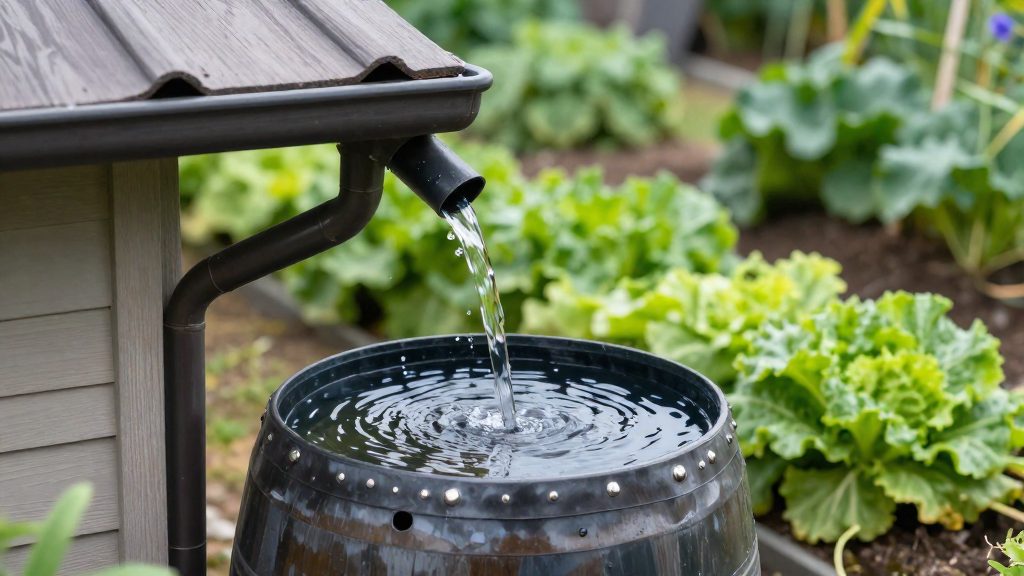
Managing overflow the permaculture way
Overflow is water the barrel cannot hold, so it needs a planned route: toward a lawn, a planting bed or a tree, and away from foundations. According to the University of Saskatchewan – Gardening Saskatchewan, a 1,000 sq ft roof in an average year in Saskatoon can fill a 55-gallon barrel about 110 to 125 times during the growing season, so the overflow path matters as much as the barrel itself. Route it to a planted or lawn area, away from the building, and keep the barrel water for outdoor use.
Where the overflow should go
- Permeable surface: Direct the overflow to a lawn, a planting bed, or a tree, as recommended by the City of Calgary (YardSmart).
- Distance from the building: Keep the outlet at least 6 ft (about 1.8 m) from any foundation, according to the University of Saskatchewan – Gardening Saskatchewan.
- Barrel placement: The same source places the barrel about 10 cm from the house or garage.
- Downspout inlet: Fit a fine mesh screen on the downspout inlet to limit mosquitoes, per the City of Calgary (YardSmart).
Keeping mosquitoes out
Standing water attracts egg-laying mosquitoes, so the lid and overflow screens must stay intact. The University of Saskatchewan – Gardening Saskatchewan notes that Bti dunks (sold as “mosquito dunks”) are an organic option: they are harmless to people, animals, and plants. Bti is a biological larvicide, so it fits a chemical-free approach.
What the barrel water can be used for
Calgary guidance (City of Calgary (YardSmart)) sets clear limits:
| Target | Guidance |
|---|---|
| Edible plants, parts eaten raw | Do not use the rainwater |
| Food plants in general | Water the soil at the base with a watering can or drip line; keep leaves and fruit dry; wash produce well |
| Ornamental and non-food plants | Outdoor use only |
A standard barrel can fill and empty 8 times or more per summer, saving at least 2,000 L of water per summer. It works better for manual watering than for automated irrigation.
Winter shutdown
Before freezing weather, empty the barrel completely. Water from the barrel can be poured onto trees or shrubs. The University of Saskatchewan – Gardening Saskatchewan recommends the following steps:
- Remove loose spigots and overflow fittings.
- Rinse the barrel.
- Store it upside down or under cover.
In Calgary, a barrel placed directly under a gutter must be disconnected and the original downspout restored. Any diverter should be set to winter mode (City of Calgary (YardSmart)).
Avoiding mosquitoes
An open rain barrel can become a breeding site, since mosquitoes lay eggs in standing water. The University of Saskatchewan – Gardening Saskatchewan advises keeping the lid and overflow screens intact so that mosquitoes cannot reach the water. The barrel’s water is also not drinkable, so it should be used only for outdoor watering.
The City of Calgary (YardSmart) recommends a watertight barrel with a fine mesh screen over the inlet of the downspout. The overflow should drain onto a permeable surface, such as a lawn, a flower bed or the base of a tree, and stay away from the foundations of the house.
Overflow placement matters for both moisture and pests. The University of Saskatchewan – Gardening Saskatchewan states that the overflow should be directed at least 6 ft (about 1.8 m) from any foundation.
Bti mosquito dunks are another option. The University of Saskatchewan – Gardening Saskatchewan describes them as harmless to people, animals and plants, which makes them a practical choice in a vegetable garden where chemical treatments are not wanted.
| Measure | Purpose | Source |
|---|---|---|
| Keep the lid and overflow screens intact | Stops mosquitoes from laying eggs in the barrel | University of Saskatchewan – Gardening Saskatchewan |
| Fine mesh screen on the downspout inlet | Limits mosquito entry | City of Calgary (YardSmart) |
| Watertight barrel | Limits mosquito entry | City of Calgary (YardSmart) |
| Bti mosquito dunks | Larval control, described as harmless to people, animals and plants | University of Saskatchewan – Gardening Saskatchewan |
Preparing your system for the Canadian winter
Winter storage is the step most often skipped, and it matters because a rain barrel that stays full or connected through freezing weather can be damaged or lose its function. According to the University of Saskatchewan – Gardening Saskatchewan, a 1,000 sq ft roof in an average year in Saskatoon can fill a 55-gallon barrel roughly 110 to 125 times during the gardening season, so the barrel works through the gardening season and needs a proper shutdown before freezing weather.
According to the University of Saskatchewan – Gardening Saskatchewan, the standard autumn routine is:
- Drain the barrel completely. Pour the water onto trees or shrubs rather than letting it go to waste.
- Remove taps and loose overflow fittings so that nothing is left exposed to the cold.
- Rinse the barrel to clear sediment and debris.
- Store it upside down or under cover until spring.
Calgary guidance from the City of Calgary (YardSmart) addresses a different setup: a barrel placed directly under a gutter. In winter, that barrel must be disconnected and the original downspout restored. If a diverter is installed, it should be set to winter mode. The same source notes that a standard barrel can be filled and emptied eight or more times per summer and saves at least 2,000 L of water per summer, which is why reconnecting it in spring is worthwhile.
Before reconnecting in spring, check that taps and overflow fittings are secured again and that the overflow discharges onto a permeable surface, such as a lawn, a border or a tree, at least 6 ft (about 1.8 m) from any foundation, as the University of Saskatchewan – Gardening Saskatchewan recommends.
Frequently asked questions
Can I use rain barrel water on my lettuce and tomatoes?
Rain barrel water is non-potable, so it should only be used outdoors. According to the City of Calgary’s YardSmart guidance, it should not be applied to edible parts eaten raw. Water food plants at the soil base with a watering can or drip system, and wash your harvest well before eating.
How do I stop mosquitoes from breeding in my barrel?
Keep the lid and the overflow screens intact, since open water is where mosquitoes lay their eggs. The University of Saskatchewan – Gardening Saskatchewan notes that Bti mosquito dunks are harmless to people, animals, and plants, which makes them a suitable biological option. A fine mesh over the downspout inlet adds another barrier.
What should I do with my barrel before winter?
Empty the barrel completely and pour the water onto trees or shrubs. Remove any loose taps or overflow fittings, rinse the barrel, and store it upside down or under cover to prevent freeze damage. In Calgary, the YardSmart guidance also recommends reconnecting the original downspout and setting any diverter to winter mode.