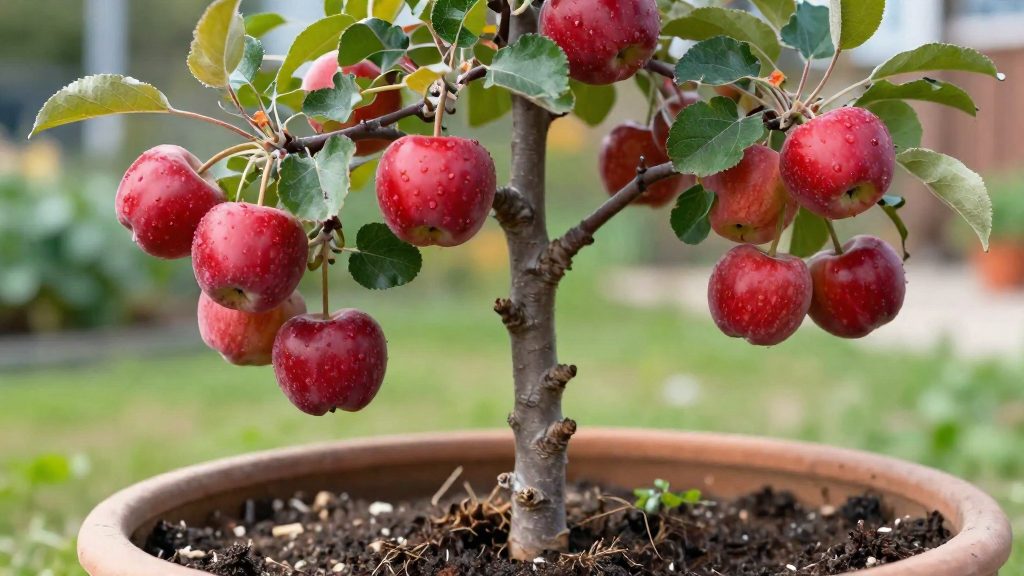
Dwarf fruit trees suit small yards because their compact size makes them easier to manage, they start producing fruit sooner than standard-size trees, and their fruit is easier to reach at harvest time. According to Iowa State University Extension and Outreach (2026), dwarf and semi-dwarf trees are easier to prune, spray and harvest, suit small residential yards, and start fruiting sooner than standard trees. For a home grower with limited space, these practical points often matter more than the tree’s final size alone.
Why choose dwarf fruit trees for a small yard?
Compact size fits limited space
Standard-size trees can dominate a small plot and shade neighboring beds. Dwarf and semi-dwarf trees are grafted onto dwarfing rootstocks, which keeps them much smaller (Iowa State University Extension and Outreach, 2026). The official sources consulted for this section do not give mature dimensions for every variety, so check the rootstock and expected size on the nursery label before planting.
Practical steps for a compact plot:
- Measure the planting area and leave clear access on all sides for pruning and picking.
- Choose a sunny spot, and keep the tree away from paths where fallen fruit can attract pests.
- Water deeply and regularly without letting the root zone become waterlogged.
Earlier fruiting
Earlier fruiting shortens the wait between planting and the first harvest. The exact timing depends on variety, rootstock and climate, and the consulted sources do not give a fixed number of years, so use the nursery’s stated timeframe as a guide.
Easier harvesting from ground level
Dwarf and semi-dwarf trees are easier to harvest than standard trees (Iowa State University Extension and Outreach, 2026). At about 10 to 15 feet tall, some fruit may still need a ladder or step stool, so plan safe access and pick gently to avoid bruising. Pick fruit at the stage recommended for each species, and handle it gently to avoid bruising.
Suitability for compact residential yards and gardens
Dwarf trees fit residential yards and gardens where space is limited. Several common examples are reported as self-pollinating: Damson plum, Stella cherry, Meyer lemon, Dancy tangerine and Washington Navel orange (Epic Gardening, 2026). Meyer lemon can also be grown in a container and brought indoors where winters are colder than zone 8 (Epic Gardening, 2026), which makes it an option for patios or balconies.
Other dwarf examples listed by Epic Gardening (2026) include Ice Cream mango and Kazake pomegranate, though the source’s details for these are limited to their general size category.
How big do dwarf fruit trees really get?
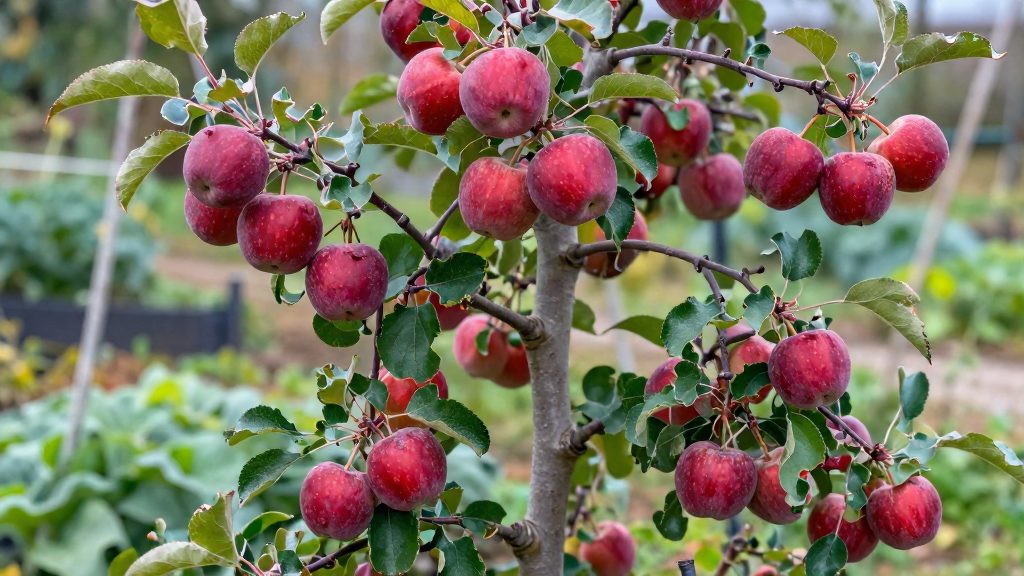
Mature height depends mainly on the dwarfing rootstock and the species, so the word “dwarf” on a label does not tell you how large the tree will become. According to Iowa State University Extension and Outreach (2026), standard-size trees eventually reach 25 to 30 feet tall, while dwarf and semi-dwarf trees grafted onto dwarfing rootstocks generally stay around 10 to 15 feet. These are ranges, so the actual size of a given tree varies with its rootstock and species. Before planting any dwarf tree, check the mature height on the nursery label or catalogue entry and compare it with the vertical space you have.
Standard versus dwarf height
Standard-size trees are considerably taller than dwarf and semi-dwarf trees at maturity. A tree planted for a small yard should be chosen by its expected adult height, not by how small it looks at purchase. Young nursery trees rarely show their final size.
How dwarfing rootstock controls size
Dwarf and semi-dwarf trees are grafted onto dwarfing rootstocks, which limit how large the fruiting top grows. Practical steps before buying:
- Read the rootstock or size designation on the label, if the seller provides one.
- Treat “semi-dwarf” and “dwarf” as different designations: the Iowa State source gives one combined range (about 10 to 15 ft), so check the expected mature height for the specific tree.
- Ask the nursery for the expected mature height in your region, because growth depends on local conditions.
Mature heights of common dwarf species
| Tree | Mature height | Source |
|---|---|---|
| Standard-size fruit tree | 25 to 30 ft | Iowa State University Extension and Outreach (2026) |
| Dwarf and semi-dwarf tree (general) | About 10 to 15 ft | Iowa State University Extension and Outreach (2026) |
| Most dwarf varieties in Epic Gardening’s list (a curated list, not a general range) | 8 to 10 ft | Epic Gardening (2026) |
| Columnar apple | 8 to 10 ft | Epic Gardening (2026) |
| Ice Cream mango | About 6 ft | Epic Gardening (2026) |
| Kazake pomegranate | About 6 ft | Epic Gardening (2026) |
| Meyer lemon | 4 to 6 ft | Epic Gardening (2026) |
Hardiness also matters: Epic Gardening (2026) lists zones 8 to 11 for Meyer lemon, zones 4 to 10 for Kazake pomegranate, and zones 4 to 9 for columnar apple. Check your zone before selecting a species, because a tree that stays small in one climate may not survive in another.
Best dwarf apple and pear trees
For apples and pears in a small plot, the main question is which cultivar stays manageable in your climate. The sources consulted name only two options in this range: the columnar apple and the Conference pear. They do not list dwarf pear cultivars, so this section is limited to those two trees.
Columnar apple cultivars
Columnar apples have a narrow, upright habit that suits narrow beds, fence lines and the edges of vegetable plots. According to Epic Gardening (2026), columnar apples reach 8 to 10 feet and are listed for hardiness zones 4 to 9. They need a second tree nearby for pollination (Epic Gardening, 2026), so plan space for two trees.
Conference pear
Epic Gardening (2026) lists Conference pear as needing a second tree nearby for pollination. The official sources consulted do not specify a mature height or rootstock for Conference pear, so they cannot confirm that it is a compact tree. Before buying, ask the nursery for the expected mature height and rootstock, and compare that height with the space you have.
Choosing cultivars by climate
Selecting a cultivar adapted to your local conditions is a practical organic step, because it reduces the need for corrective treatments later. Work through these points before ordering:
- Confirm your hardiness zone for your garden. The columnar apple range cited here is zones 4 to 9.
- Check the rootstock on the label. Dwarfing rootstocks produce the compact size; standard rootstocks do not.
- Match the tree to your space. Allow room for the mature width and height stated by the supplier.
- Ask a local nursery which cultivars perform well in your region, especially if you live outside zones 4 to 9.
Best dwarf plums and cherries
Plums and cherries can be grown as dwarf trees in a small garden, but their size and ease of care depend on the rootstock and the variety. Epic Gardening (2026) lists most of its dwarf varieties at 8 to 10 feet, which makes them practical for a limited plot.
Damson plum
Damson plum is one of the dwarf options named by Epic Gardening (2026). The source does not give a separate height for this variety, so it should be checked against the nursery’s specifications before planting.
Stella cherry
Stella cherry also appears in the Epic Gardening (2026) dwarf list. The consulted sources do not specify its growing requirements beyond its listing. For a sweet or sour cherry in a small space, the practical priorities are a sunny position and a planting site where the tree can be pruned and harvested without a ladder, which the dwarf habit makes easier.
Fig cultivars for compact planting
The official sources consulted do not specify fig cultivars or their dimensions for compact planting. The general principles still apply:
- Choose a sunny spot with room to reach every side of the tree.
- Water deeply enough to moisten the root zone, but avoid keeping the soil waterlogged.
- In a container, use a pot with drainage holes so excess water can leave.
Which dwarf trees work in containers?
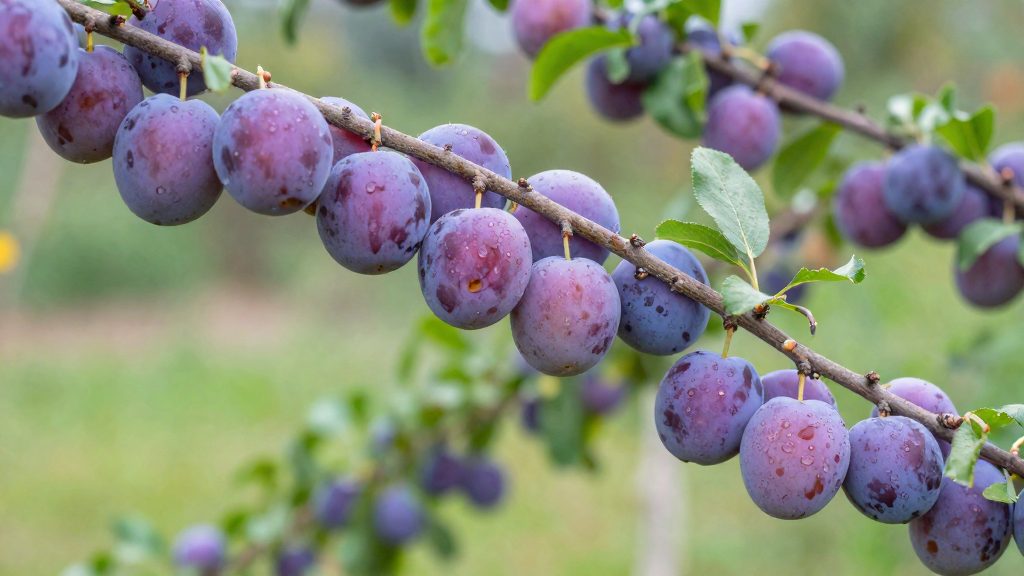
Dwarf fruit trees suit pots better than standard trees because they stay compact. According to Epic Gardening (2026), the dwarf varieties it lists include Meyer lemon, Ice Cream mango and Kazake pomegranate, and Meyer lemon can be grown in a container and brought indoors. The three trees below are the container examples for this section.
| Tree | Hardiness zones (Epic Gardening, 2026) | Container note |
|---|---|---|
| Meyer lemon | 8–11 | Can be grown in a container and moved indoors where winters are colder than zone 8 |
| Kazake pomegranate | 4–10 | Listed as a dwarf pomegranate; the official sources consulted do not specify container requirements |
| Ice Cream mango | Not specified in the sources consulted | Listed as a dwarf mango; the official sources consulted do not specify container requirements |
Meyer lemon as a container and indoor citrus
Meyer lemon is the clearest case for a potted tree. Keep it outdoors during the warm season, then move it indoors before cold weather arrives in your area. Place it in the brightest window you have, and keep it away from heating vents and cold draughts. In spring, return it outdoors once nights stay mild.
Ice Cream mango and Kazake pomegranate in pots
The sources consulted do not say whether Ice Cream mango and Kazake pomegranate suit containers, and they give no figures for pot volume, soil mix or overwintering. Confirm suitability with the nursery before potting either tree. Treat these trees as dwarf candidates, check the zone information for your region, and plan the same steps you would use for a potted citrus: a sunny position and a container you can move if needed.
Pot size, drainage and indoor overwintering
- Drainage holes are essential. Standing water around roots causes rot, so never let a pot sit in a saucer full of water.
- Water when the top layer of soil feels dry, and avoid keeping the root ball soggy.
- Choose a pot large enough for the root system and repot into a larger container as the tree grows. The official sources consulted do not specify pot dimensions.
- Feed with organic compost or a certified organic fertiliser instead of synthetic fertilisers, which is the organic alternative for container trees.
- Use zone 8 as your reference point for Meyer lemon: where winters are colder, overwinter the tree indoors.
Do you need two trees for pollination?
Whether a dwarf tree needs a second partner depends on the species. According to Epic Gardening (2026), columnar apples and Conference pears need a second tree nearby for pollination, while damson plum, Stella cherry, Meyer lemon, Dancy tangerine and Washington Navel orange are self-pollinating. A single tree of a self-pollinating type can be planted alone, so the planting decision starts with the species name.
| Dwarf tree | Needs a second tree? | Source |
|---|---|---|
| Columnar apple (8–10 ft, zones 4–9) | Yes, a second tree nearby | Epic Gardening (2026) |
| Conference pear | Yes, a second tree nearby | Epic Gardening (2026) |
| Damson plum | No, self-pollinating | Epic Gardening (2026) |
| Stella cherry | No, self-pollinating | Epic Gardening (2026) |
| Meyer lemon | No, self-pollinating | Epic Gardening (2026) |
| Dancy tangerine | No, self-pollinating | Epic Gardening (2026) |
| Washington Navel orange | No, self-pollinating | Epic Gardening (2026) |
Planting two trees for reliable fruit set
When a tree needs a second partner, place both trees close enough that pollinating insects can move between their flowers. Epic Gardening (2026) describes the partner as “nearby,” and the sources consulted do not specify a maximum distance, so choose a spot in the same part of the yard rather than at opposite boundaries.
Practical steps before buying:
- Read the pollination note on the label or catalogue listing for each variety.
- For apples and pears, buy two trees that are both suited to your yard and flower at the same time. Ask the nursery to confirm this for your chosen varieties.
- For a small yard with room for only one tree, pick a self-pollinating species from the list above.
- Keep both trees in good health and in full sun, so they flower well when the partner is present.
Organic care and support for compact trees
Compact trees stay stable and healthy when support, pruning, and pest control work together. The methods below cover support, pruning, and the organic alternatives to synthetic sprays.
Staking and trellis support for poor anchorage
Some dwarf trees have poor root anchorage, so they may need a stake or trellis for support (Iowa State University Extension and Outreach, 2026). Check anchorage at planting, after strong wind, and after heavy fruit loads.
- Install the stake at planting time, before backfilling, so the root ball is not damaged later.
- Set the stake on the side facing the prevailing wind.
- Tie the trunk loosely with a soft, flexible material that allows slight movement. A rigid tie can rub and damage the bark.
- Check ties regularly and loosen them as the trunk thickens.
- On a trellis, secure the main branches to the wires or supports, using the same loose-tie principle.
The official sources consulted do not specify stake dimensions, so size the support to the tree’s height and the local wind conditions.
Organic alternatives to synthetic pesticides and fungicides
The official sources consulted do not name specific organic products, dosages, or spray intervals for compact fruit trees, so this approach focuses on method. Regular inspection is the foundation of organic control.
- Inspect leaves, fruit, and bark on a regular schedule, and note the first signs of pests or disease.
- Remove and dispose of affected leaves and fruit rather than leaving them under the tree.
- Improve canopy airflow through pruning, which reduces damp conditions that favour disease.
- Choose products approved for organic growing in the United States (check the product label for organic approval, such as the USDA organic standards or an OMRI listing), and follow the label exactly.
- Spray in calm weather and cover the whole canopy, including leaf undersides.
Pruning routine for compact dwarf canopies
- Remove dead, damaged, or diseased wood first.
- Thin crowded branches so light and air reach the centre of the canopy.
- Keep the canopy open rather than dense, which supports both airflow and spray coverage.
- Make clean cuts just outside the branch collar or above a healthy bud.
- Adjust timing to your species and climate; the official sources consulted do not give specific pruning dates.
Frequently asked questions
How tall do dwarf fruit trees grow in a small yard?
Standard-size fruit trees can reach 25 to 30 feet, while dwarf and semi-dwarf trees generally stay around 10 to 15 feet, according to Iowa State University Extension and Outreach (2026). They stay smaller because they are grafted onto dwarfing rootstocks, so check the rootstock and expected mature height on the nursery label before buying.
Do I need two trees to get fruit?
Not for every variety. Epic Gardening (2026) lists Damson plum, Stella cherry, Meyer lemon, Dancy tangerine and Washington Navel orange as self-pollinating, while columnar apples and Conference pears need a second tree nearby. The sources consulted do not cover every variety, so ask the nursery about pollination needs for any tree not on that list.
Will a dwarf tree need a stake or trellis?
Some dwarf trees have weak root anchorage, so they may need a stake or trellis for support, according to Iowa State University Extension and Outreach (2026). Check the root habit of the variety when you buy, and set up support at planting so the young tree is held upright from the start.