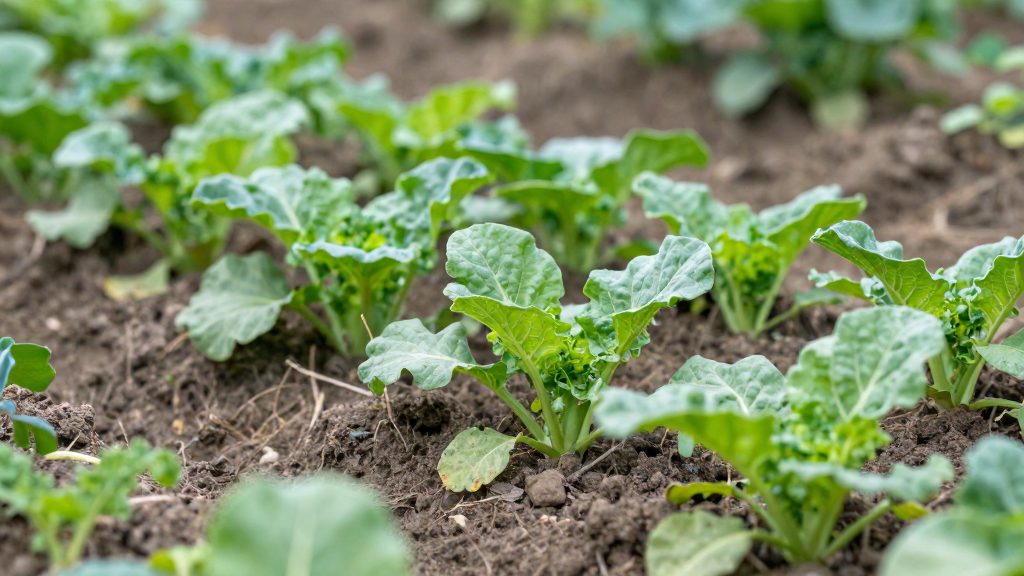
Cover crops improve garden soil by keeping it covered and biologically active between main crops. A cover crop shields the topsoil from rain and wind, adds plant residue that becomes organic matter, and supports a soil structure that holds water and air better over time. These gains build gradually across seasons rather than appearing in a single year. The official sources consulted do not specify quantified gains per season, so the figures below are qualitative, and each practical point is tied to the cited extension guidance.
Why plant cover crops in a garden?
Cover crops work as a non-chemical alternative to leaving beds bare, which helps limit weed growth between main crops. Their benefits fall into three groups: surface residue and protection, organic matter and soil structure, and the garden microbiome.
Organic matter and soil structure over seasons
When a cover crop is cut, its residue returns plant material to the bed. Repeated additions over several seasons gradually build organic matter, which supports a crumbly soil structure that drains well while still retaining moisture. The official sources consulted do not specify a set amount of organic matter gained per season, so expect progressive change rather than a fixed result.
Practical steps:
- Cut the cover crop before it goes to seed, then leave the material in place where possible.
- Repeat the practice over successive seasons rather than as a one-off.
- Keep the same bed under cover crops during the off-season to build on previous additions.
Erosion control and moisture retention
Bare soil is exposed to rain and wind, and it dries out faster. Cover crops keep the surface protected, and once mown, their residue works as a surface layer. For grains and grasses, NC State Extension (Pender County) recommends mowing them and leaving the residue on the surface for the best weed suppression, noting that this residue also acts as mulch and holds moisture.
Soil life and the garden microbiome
Iowa State University Extension and Outreach has published a home-gardener guide on using cover crops to improve soil fertility, soil structure and the garden microbiome, as reported by Iowa Farm Bureau (2026). The guide addresses the microbiome alongside soil fertility and soil structure. To apply this, plant a cover crop in beds that would otherwise sit empty, and consult the full ISU guide for region-specific details.
| Gain | Practice | Source |
|---|---|---|
| Surface protection and moisture | Mow grains or grasses and leave residue on the surface | NC State Extension (Pender County) |
| Weed suppression | Use grains and grasses as the strongest weed-suppressing option | NC State Extension (Pender County) |
| Fertility, structure and microbiome | Use cover crops to improve soil, as covered in the ISU home-gardener guide | ISU Extension and Outreach, reported by Iowa Farm Bureau (2026) |
Legumes, grasses or brassicas: which to choose?
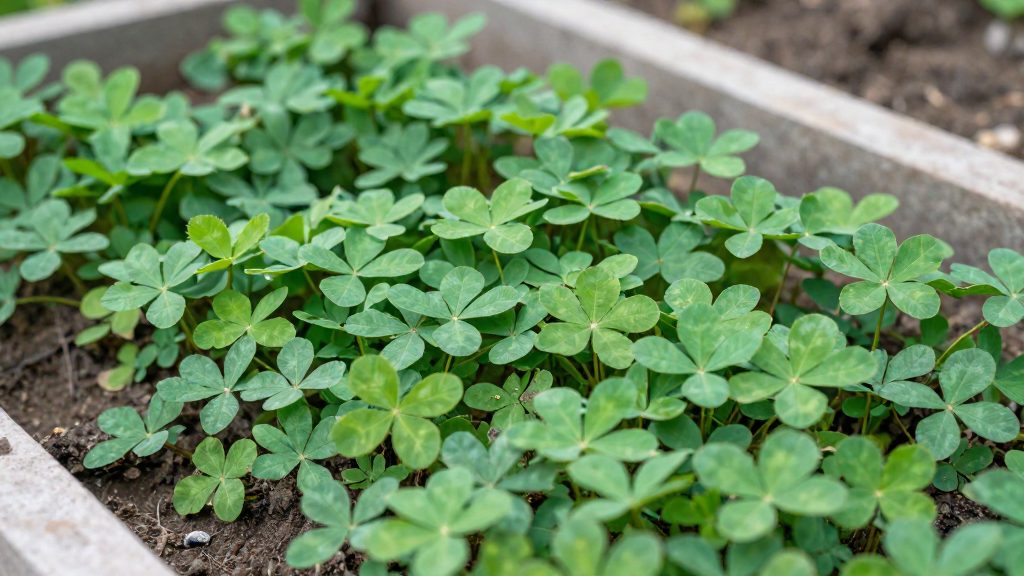
Cover crops fall into three families, and each one does a different job in a garden bed. Legumes are chosen mainly to add nitrogen, grasses for their general soil-cover role, and brassicas as a separate group of species. The choice depends on what the bed needs.
Nitrogen-fixing legumes are the family to choose when soil fertility is the priority. According to NC State Extension (Pender County), crimson clover, Austrian winter pea and hairy vetch add nitrogen, which can reduce fertilizer needs, especially in sandy soil. The source does not specify the nitrogen quantities these species supply in a given bed.
Grasses and grains are the family to choose when you need ground cover and a surface layer. Cereal rye, a grain, is the example used in the same guidance. The official sources consulted do not specify the growth habit or root biomass of these species, so avoid assuming figures for either.
Brassica cover crops include mustard, rapeseed and oilseed radish. These are distinct species within a separate botanical group, and they are not interchangeable with legumes or grasses. Their specific effects are addressed in the dedicated results section.
| Family | Example species | Main function (NC State Extension (Pender County)) |
|---|---|---|
| Legumes | Crimson clover, Austrian winter pea, hairy vetch | Add nitrogen; can reduce fertilizer needs, especially in sandy soil |
| Grasses and grains | Cereal rye | Ground cover; best for weed suppression among the families compared |
| Brassicas | Mustard, rapeseed, oilseed radish | Brassica species; distinct from legumes and grasses |
When should you sow cover crops?
Cover crops are sown in autumn, and the right date depends on the crop group. NC State Extension (Pender County) gives the reference timing for the southeastern United States: legumes should be sown by mid-October, and grains and grasses from October to mid-November. Sowing within these windows lets the plants establish before winter.
| Crop group | Reference sowing window (southeastern US) | Examples named by NC State Extension (Pender County) |
|---|---|---|
| Legumes | By mid-October | Crimson clover, Austrian winter pea, hairy vetch |
| Grains and grasses | October to mid-November | Cereal rye (a grain) |
Sowing legumes
Legumes have the earlier deadline, so they should go into the bed first when you clear it at the end of summer.
Sowing grains and grasses
Grains and grasses have a longer window, which makes them useful for beds cleared later in the season. NC State Extension (Pender County) identifies grains and grasses as the best cover crops for weed suppression.
Adapting dates to frost and soil temperature
The reference dates come from North Carolina, so they must be adjusted to your own location. The official sources consulted do not specify frost dates or soil temperature thresholds for other regions. To set your own dates:
- Ask your regional extension office for the average first frost date in your area.
- Plan sowing so the plants have time to establish before that date.
- Check soil temperature with a soil thermometer. Sow when the soil has cooled from summer but is still workable.
- In colder areas, shift both windows earlier than the reference dates. In milder areas, they can usually move later.
How do you build a winter mix?
A winter mix combines grains or grasses with legumes in one sowing, so each plant group covers a different job. Pairing the two gives you ground cover and biomass from the cereal plus nitrogen from the legume, in one planting.
The 3:2 grain-to-legume ratio
The reference mix uses a 3:2 ratio: 3 parts grain to 2 parts legume, by weight. The grain builds the standing cover and residue that suppress weeds, and the legume fixes nitrogen for the next crop. The source gives this ratio as an example mix, so treat it as a starting point and adjust it to what the bed needs.
Worked example: cereal rye and crimson clover
The NC State example sets seed rates per 1,000 square feet:
- Cereal rye (grain): 0.75 lb
- Crimson clover (legume): 0.5 lb
Check the ratio: 0.75 ÷ 0.5 = 1.5, which matches 3 parts grain to 2 parts legume.
Converting to metric beds
Use these steps to adapt the rates to a metric garden:
- Convert pounds to grams: grams = pounds × 453.6.
- Convert the area: 1,000 sq ft is about 92.9 m² (1 sq ft = 0.0929 m²).
- Divide grams by 92.9 to get grams per square metre.
- Multiply by your bed area in m².
| Seed | Per 1,000 sq ft (lb) | Per 1,000 sq ft (g) | Per m² (g) | For a 1 m × 3 m bed (g) |
|---|---|---|---|---|
| Cereal rye | 0.75 | 340 | 3.7 | 11 |
| Crimson clover | 0.5 | 227 | 2.4 | 7.3 |
Weigh seed on a kitchen or postal scale, and mix the two seeds thoroughly before broadcasting so the ratio holds across the bed.
Mow or till: how to terminate cover crops
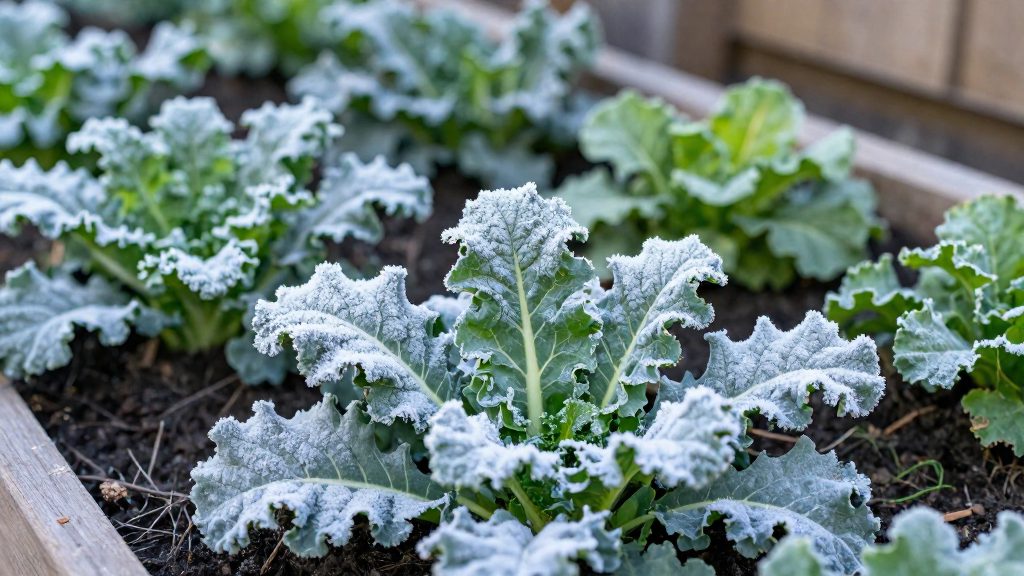
Cover crops are ended by mowing or tilling, and the right method depends on the species and on what the bed needs next. According to NC State Extension (Pender County), grains and grasses are mowed with their residue left on the surface, legumes are tilled in early spring as they begin to flower, and brassicas such as mustard, rapeseed and oilseed radish are tilled two to three months after planting. The official sources consulted do not describe rolling, so this section covers mowing and tilling only.
| Group | Termination | Main goal | Key point from the sources |
|---|---|---|---|
| Legumes (crimson clover, Austrian winter pea, hairy vetch) | Till as they begin to flower, early spring | Nitrogen | Tilling gives the greatest nitrogen gain |
| Brassicas (mustard, rapeseed, oilseed radish) | Till 2 to 3 months after planting | Nematode reduction | Planted in October in the NC example |
Mowing grasses and grains
For surface residue, mow the stand and leave the cut material where it falls. This suits beds where the next crop is sown or transplanted into a mulched surface, and where soil moisture matters. Mowing before seed heads form keeps the residue easier to manage, though the sources do not give a stage for this, so check the stand visually.
Tilling legumes at early flowering
Legumes should be tilled in early spring, as they begin to flower. Tilling at this stage gives the greatest nitrogen gain, according to NC State Extension (Pender County).
Tilling brassicas two to three months after planting
Mustard, rapeseed and oilseed radish are tilled in two to three months after planting. In the NC example they are planted in October, which places tilling in the winter months.
Mixes
For a grain-legume mix, the sources do not specify one termination method for the whole mix. Choose by goal: mow if weed suppression and surface mulch matter most, and till at early flowering if nitrogen is the priority.
Can cover crops fight weeds and nematodes?
Cover crops can suppress weeds and reduce root-knot nematodes, but the two effects come from different plant groups and both have limits. According to NC State Extension (Pender County), grains and grasses are the best cover crops for weed suppression, while mustard, rapeseed and oilseed radish are the covers linked to reducing root-knot nematodes.
| Cover crop group | Target | Method | Timing (NC, southeastern US) |
|---|---|---|---|
| Mustard, rapeseed, oilseed radish | Root-knot nematodes | Till into the soil | Plant in October; till 2 to 3 months after planting |
Competitive suppression by grains and grasses
Dense cereal and grass growth competes with emerging weeds for light and space.
Brassica-type covers against root-knot nematodes
Mustard, rapeseed and oilseed radish reduce root-knot nematodes when they are tilled in. The nematode effect is tied to incorporating the plants into the soil, so mowing them and leaving them on the surface is not the method described for this purpose. The official sources consulted do not specify the size of the reduction, so no percentage should be expected from this practice.
Where the effect stops
Cover crops are a suppression tool, not an eradication method. The official sources consulted do not specify how cover crops perform against established perennial weeds or the weed seedbank in the soil. Gardeners dealing with deep-rooted perennial weeds should keep monitoring beds and removing regrowth by hand. The nematode benefit is documented for root-knot nematodes only; the sources consulted do not address other nematode types.
Common mistakes to avoid
Three common mistakes are worth avoiding: ending the crop with chemical herbicides, sowing into beds that have not been prepared, and keeping no written record of what was done. Each has a simple organic correction that needs no specialised equipment.
Killing cover crops with synthetic herbicides
Spraying a synthetic herbicide to end a cover crop works against the purpose of growing it in an organic garden. The organic alternative is mechanical termination. According to NC State Extension (Pender County), the method depends on the type of cover crop:
| Cover crop type | Organic method (NC State Extension, Pender County) | Stated effect |
|---|---|---|
| Legumes, such as crimson clover, Austrian winter pea, hairy vetch | Till in | Greatest nitrogen gain |
| Mustard, rapeseed, oilseed radish | Till in | Reduces root-knot nematodes |
Choose the method that matches the crop before planting the bed, so that the termination step is already planned when the time comes.
Sowing into waterlogged or compacted beds
The official sources consulted do not specify soil moisture or compaction thresholds, so the following is a general field method. Before sowing, check drainage: if water stands on the bed for a long time after rain, wait for the soil to drain rather than working it while wet. Test workability by squeezing a handful of soil. If it forms a sticky ball, leave it; if it crumbles, it can be worked.
Compacted beds that are not loosened first give seed poor contact with the soil and leave roots little room to grow.
Forgetting to log sowing and termination dates
Without records, a grower cannot repeat what worked or explain what failed. Keep a yearly notebook or spreadsheet that records:
- Crop species and, where known, the variety
- Sowing date and the sowing window used
- Bed location and size
- Seed mix and ratio
- Termination date and the method used
Mixes are easier to reproduce when the ratio is written down. Regional calendars vary, so record the dates from your own garden rather than copying another region’s schedule.
Frequently asked questions
When should I sow a cover crop?
Sowing windows depend on the crop type and your climate. In the southeastern US (North Carolina), legumes should go in by mid-October, and grains and grasses from October to mid-November, according to NC State Extension (Pender County, 2022). The official sources consulted do not give sowing dates for other climates, so check local extension guidance for your region.
Should I mow or till my cover crop before planting?
It depends on the species. For grains and grasses, NC State Extension (Pender County, 2022) recommends mowing and leaving the residue on the surface, where it suppresses weeds and acts as mulch that holds moisture. Legumes such as crimson clover are tilled in early spring, as they begin to flower, because tilling gives the greatest nitrogen gain.
Which cover crops should I choose for soil fertility or pest problems?
Legumes such as crimson clover, Austrian winter pea and hairy vetch add nitrogen, which can reduce fertilizer needs, especially in sandy soil. Mustard, rapeseed and oilseed radish help reduce root-knot nematodes when they are tilled in, 2 to 3 months after October planting. A grain-legume blend is another option, for example cereal rye and crimson clover at a 3:2 grain-to-legume ratio.