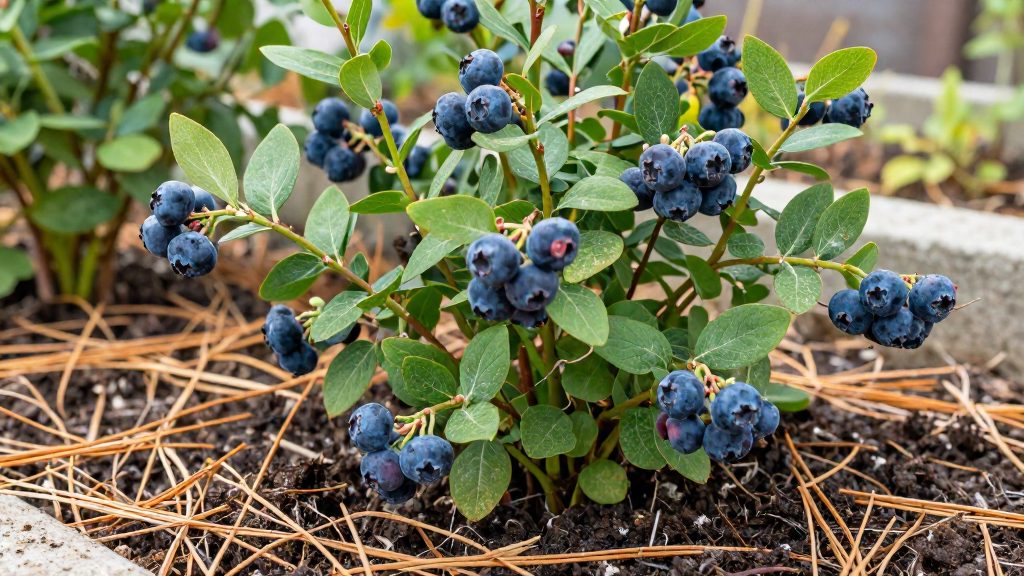
Blueberries are ericaceous plants that grow best in acidic soil, and their shallow, fibrous roots leave them dependent on the topsoil for iron and other nutrients. The Ohio State University Extension (CFAES) recommends a pH range of 4.5 to 5.5 for highbush blueberries, with 4.5 as the ideal, and advises testing the soil before planting. Yellowing of young leaves is a common sign that the soil is not acidic enough for the plants to take up iron.
Why do blueberries need acidic soil?
Blueberries are ericaceous plants, a group that grows best in acid conditions. The official sources consulted do not describe in detail the relationship between blueberry roots and mycorrhizal fungi, so this section focuses on what the extension services do document about root structure and nutrient availability.
Shallow, fibrous roots
According to the University of Illinois Extension, blueberries are shallow-rooted. Their fine root system stays close to the soil surface, so the plants depend on the top layer of soil for water and nutrients. Because the roots cannot reach deep reserves, conditions in the upper soil matter more for blueberries than for many other crops.
This shallow root habit explains several care recommendations:
- Mulch soon after planting. The University of Illinois Extension advises 4 to 6 inches of organic mulch such as sawdust, leaves, wood chips or straw. Illinois research found that mulched plants gave significantly larger yields.
- Water consistently. The same source recommends about 1 inch of water per week with free drainage, since shallow roots dry out quickly and do not tolerate waterlogging. Ohio State University Extension (CFAES) advises 1 to 2 inches per week for highbush blueberries, so adjust within that range to the weather and your soil.
Iron availability
Iron is the nutrient most clearly linked to soil pH in the sources consulted. The University of Illinois Extension states that yellowing, mottled young leaves, known as iron chlorosis, often signal that soil pH is too high. In practice, a blueberry planted in soil that is not acidic enough may show yellowing, mottled young leaves.
The official sources consulted do not specify the exact chemical reactions that make iron less available as pH rises, so growers should rely on the observable symptom and on a soil test.
Manganese and aluminum
The sources consulted do not give details on how manganese or aluminum availability changes in acid soil. What they do state is that aluminum sulfate should be avoided, since the University of Illinois Extension describes it as toxic to blueberries.
For practical purposes, the key point is that blueberries rely on acid soil to keep their nutrient supply in a usable state, and that their shallow roots leave little margin for error when conditions drift.
Ideal soil pH for organic blueberries
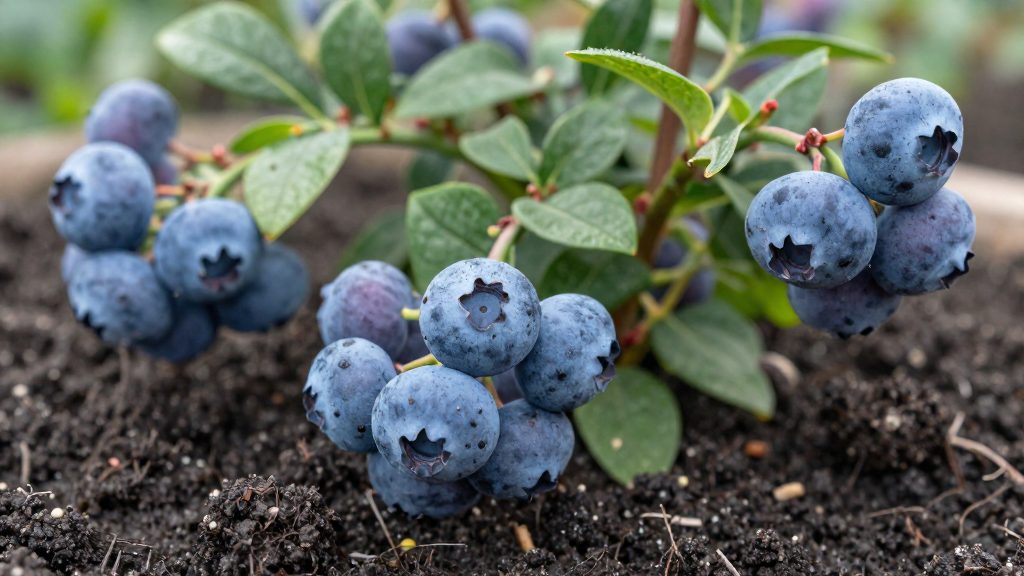
Blueberry bushes need strongly acidic soil, but the exact target depends on which extension service you follow. The Ohio State University Extension (CFAES) gives two ranges for highbush blueberries, and the University of Illinois Extension recommends a narrower band. Both sources place the target in the acidic range, but they state different limits.
| Source | Stated pH range | Detail |
|---|---|---|
| Ohio State University Extension (CFAES), introduction | 4.0–5.2 | General guidance |
| Ohio State University Extension (CFAES), site section | 4.5–5.5 | 4.5 given as the ideal |
| University of Illinois Extension | 4.8–5.2 | Recommended narrow range |
Why the sources disagree: The Ohio State page itself gives two different ranges, one in its introduction and one in its site section, so the figure is not fixed even within a single publication. The official sources consulted do not explain the reason for the difference. Illinois’ 4.8–5.2 band falls inside both Ohio State ranges, so it is a narrower recommendation rather than a conflicting one.
Practical points for organic growers:
- Test your soil before planting and compare the result against the range you choose.
- The ranges above apply to highbush blueberries. The official sources consulted do not specify a separate pH range for lowbush blueberries, so do not assume the same figures apply to them.
How to test soil pH
Testing the soil before planting replaces guesswork with a measured value. Because blueberries are shallow-rooted, the sample should come from the layer where their roots will grow.
Sampling the soil
- Take several cores. Collect samples from different spots across the planting area, since pH can vary within a bed. The official sources consulted do not specify an exact number of cores.
- Sample the root zone. Blueberry roots sit close to the surface, so take cores from the upper soil layer the plants will occupy. The consulted sources do not give a specific sampling depth for pH tests.
- Avoid unrepresentative spots. As a general precaution, skip spots with recent fertilizer, compost, or surface mulch, which can distort the reading.
- Mix into one composite sample. Combine the cores in a clean plastic or stainless container, break up clumps, and remove stones and debris. Then follow the drying and packaging instructions of the lab or kit.
- Label each area. If you test several beds, keep a separate composite sample for each one.
Lab tests versus home kits
Both options measure the same property, but they suit different decisions.
| Testing option | Strength | Limitation |
|---|---|---|
| Laboratory test | Analyses a composite sample under controlled conditions; suited to planting decisions | Slower, and requires sending the sample |
| Home pH meter or kit | Gives an immediate result; suited to repeat checks | Accuracy depends on calibration and technique; the consulted sources give no accuracy figure |
Use a lab test before planting, and use a home meter or kit for follow-up checks between tests. Calibrate a meter as its manufacturer describes before each use.
Interpreting results
- Compare the reading with the target range for blueberries.
- Note the calcium level if you have it.
- Record the date and location of each result so you can compare future readings with this baseline.
When to retest
- Before planting. Test before you set plants.
- After adding organic matter. Retest once the material has had a year to break down, before planting.
- After adding organic matter or any other amendment. Retest once it has had time to act, before you set plants.
The consulted sources do not specify a retesting interval for established plantings.
How do you lower soil pH organically?
Elemental sulfur is the amendment that Ohio State University Extension (CFAES) recommends for lowering soil pH in highbush blueberry beds. Soil bacteria convert it into sulfuric acid over time, so the change is gradual and must be planned before planting. The official sources consulted do not specify the certification status of elemental sulfur under organic standards, so check the product label against your certifying body’s approved input list before buying.
Test the soil before you amend it
- Send a soil sample to a lab or use a reliable test kit to measure your current pH.
- Note the calcium level if the lab reports it, because high calcium changes the timing (see below).
- Calculate the amount needed to move from your measured pH to your target, not from a generic starting point.
The rates below are for lowering pH from 6.0 to 4.5. If your soil starts at a different pH, the required amount will differ.
Sulfur rates by soil type
Ohio State University Extension (CFAES) gives the following amounts of elemental sulfur needed to lower pH from 6.0 to 4.5, per 100 square feet:
| Soil type | Elemental sulfur per 100 sq ft (lowering pH from 6.0 to 4.5) |
|---|---|
| Sand | 1.2 lb |
| Loam | 3.5 lb |
| Clay | 3.7 lb |
Sandy soils need the least sulfur for this change, while loam and clay need roughly three times as much. Clay and loam also hold more buffering capacity, which is why the amounts are higher.
Mix the sulfur into the top 4 inches
- Spread the measured amount evenly over the planting area.
- Work it into the top 4 inches of soil with a garden fork or tiller. Sulfur sitting on the surface does little for the root zone.
- Water the bed after mixing so the sulfur begins to react with the soil.
Time the application
Ohio State University Extension (CFAES) advises mixing elemental sulfur into the soil about three months before planting. This gives the soil time to acidify before roots arrive.
Allow extra lead time when pH is above 6 with high calcium
When soil pH is above 6 and calcium is high, the same source recommends applying the sulfur the year before planting. High calcium resists acidification, so a single application close to planting may not move the pH far enough in time.
Mulch and organic matter for acid soil
Blueberry bushes need soil with a high organic matter content, and the organic matter also helps hold the acidity steady. Ohio State University Extension (CFAES) gives a target of 4 to 7 percent or more soil organic matter. A soil test that reports organic matter tells you where your bed stands before you add anything. Adding organic matter in three stages (before planting, right after planting, and as an ongoing maintenance layer) covers the whole life of the planting.
| Stage | Material | Method | Source |
|---|---|---|---|
| Before planting | Peat moss, aged wood chips, or leaf mold | Work into the soil to a depth of 4–6 inches, at least one year before planting | Ohio State University Extension (CFAES) |
| Soon after planting | Sawdust, leaves, wood chips, or straw | Spread 4–6 inches of organic mulch over the root zone | University of Illinois Extension |
| Maintenance | Sawdust or wood chips | Keep a band at 2–4 inches over the life of the planting | Ohio State University Extension (CFAES) |
Incorporating organic matter before planting
Blank beds need the most preparation. Work peat moss, aged wood chips, or leaf mold into the top 4 to 6 inches of soil. Ohio State University Extension (CFAES) recommends doing this at least one year before planting, which gives the material time to break down and integrate with the soil. Use aged wood chips rather than fresh ones, since fresh material ties up nitrogen as it decomposes.
Mulching after planting
Once the bushes are in the ground, spread 4 to 6 inches of organic mulch over the root zone. University of Illinois Extension lists sawdust, leaves, wood chips, and straw as suitable options. Illinois research found that mulched plants gave significantly larger yields. Blueberries are shallow-rooted, so this layer also protects the roots from drying out between waterings.
Maintenance band over the life of the planting
Ohio State University Extension (CFAES) describes a maintenance band of sawdust or wood chips, applied in a band around the plants and kept at 2 to 4 inches. Top it up as the layer thins through decomposition. Keep the mulch a few inches away from the stems and avoid piling it against the trunk.
Watering and feeding organic blueberries
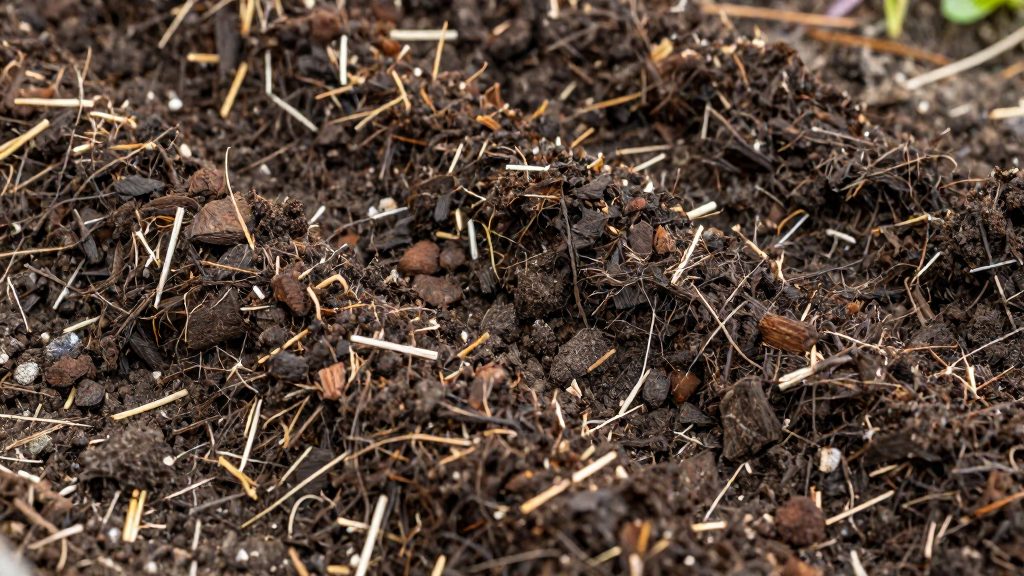
Organic blueberry bushes depend more on steady moisture and an acidic root zone than on heavy feeding. Ohio State University Extension (CFAES) advises 1 to 2 inches of water per week for highbush blueberries, and keeping the soil moist but not soggy through late summer, when next year’s flower buds form. In practice, aim for the lower end of the Ohio range in cool or wet seasons and the upper end during hot, dry spells.
Weekly water volume and soil moisture
- Apply water slowly at the base of the bush so it soaks into the root zone rather than running off.
- Check moisture a few inches down before watering. Water when the soil feels dry at that depth, not on a fixed calendar.
- Avoid waterlogging. Blueberry roots need air as well as moisture, so beds or planting holes must drain freely.
- Keep moisture steady through late summer. Drought stress or saturated soil at that stage can affect next year’s flowering.
Acidifying nutrition without synthetic inputs
Blueberries perform best in soil with a pH of 4.5 to 5.5.
The main organic tools for lowering pH are elemental sulfur and organic matter. The rates below show the amount needed to lower pH from 6.0 to 4.5 per 100 square feet:
| Soil type | Elemental sulfur needed |
|---|---|
| Sand | 1.2 lb |
| Loam | 3.5 lb |
| Clay | 3.7 lb |
The official sources consulted do not specify a fertilizer rate or a feeding interval for organic blueberries, so any feeding plan should be based on a soil test and observed plant growth.
Can you grow blueberries in containers if soil pH is high?
Yes. When garden soil tests above pH 6.2, University of Illinois Extension recommends growing blueberries in buried containers instead of planting them into the native ground. Blueberries prefer acidic soil, and high-pH soil makes it hard for the plant to absorb iron.
A buried container lets you control the medium around the roots, so the plant does not depend on the alkaline soil around it.
When a buried container is the right choice
Use this method when a soil test shows pH above 6.2. Below that level, the native soil is not the deciding factor in the same way, and the container approach is not the recommended route.
Container size and drainage
- Volume: at least 25 gallons.
- Drainage: the container needs drainage holes. Blueberries are shallow-rooted and need free drainage, so water must leave the pot instead of pooling at the base.
- Placement: bury the container in the ground so the rim sits at soil level. Choose a sunny spot and water without saturating the root zone.
Filling the container with an acidic medium
Fill the container with acidic soil that contains 10 to 15% peat by volume. For a 25-gallon container, that means peat makes up roughly one-tenth to one-seventh of the total volume, with the rest made of acidic soil.
| Component | Specification |
|---|---|
| Container volume | At least 25 gallons |
| Drainage | Holes in the container |
| Medium | Acidic soil with 10 to 15% peat by volume |
The official sources consulted do not specify a peat substitute, so the 10 to 15% peat ratio is the reference point for this method.
Signs of pH problems
Soil pH problems show up mainly in leaf colour and growth, but no single symptom is conclusive. A soil test is the only reliable way to confirm the cause.
Yellowing, mottled young leaves
Start by looking at the newest growth, as opposed to older leaves changing colour. Compare the new leaves with the older ones on the same plant, and check several bushes, since one plant alone can be misleading.
Distinguishing pH stress from other problems
- pH stress: the pattern shows up on new growth, and a soil test shows a reading outside the target range.
- Overwatering: the soil stays wet or soggy rather than moist.
- Nitrogen deficiency: the official sources consulted do not specify visual symptoms for this problem, so a soil test and a review of your feeding practice are the only checks these sources support.
Reading the soil test
| Measured soil pH | Source | Action given by the source |
|---|---|---|
| Above 6.2 | University of Illinois Extension | Grow in buried containers of at least 25 gallons with drainage holes, filled with acidic soil that is 10–15% peat by volume |
| 5.2–6.2 | University of Illinois Extension | Mix equal parts sphagnum peat and topsoil in the planting hole |
| 4.8–5.2 | University of Illinois Extension (recommended range) | Maintain conditions in this range |
| 4.5–5.5, with 4.5 ideal | Ohio State University Extension (CFAES) | Ideal: 4.5 |
The official sources consulted do not describe specific visual symptoms of soil that is too acidic, so rely on the pH reading in that case.
Frequently asked questions
What pH should soil for blueberries be?
Extension sources give slightly different ranges. Ohio State University Extension (CFAES) lists 4.5 to 5.5 for highbush blueberries, with 4.5 as the ideal, while the University of Illinois Extension recommends 4.8 to 5.2. Test your soil before planting and aim for the lower end of the range.
My soil is alkaline. How can I make it more acidic naturally?
Work elemental sulfur into the top 4 inches about 3 months before planting, or the year before if your pH is above 6 with high calcium. Add organic matter such as peat moss, aged wood chips or leaf mold to 4 to 6 inches deep. If your pH is above 6.2, grow blueberries in buried containers of at least 25 gallons filled with acidic soil that is 10 to 15% peat. Illinois Extension advises against aluminum sulfate, which is toxic to blueberries.
Why are the young leaves on my blueberry bush turning yellow?
Yellowing young leaves with a mottled pattern is a sign of iron chlorosis, which often means the soil pH is too high for the plant to absorb iron. The University of Illinois Extension links this symptom to pH above the target range. Test the soil before applying iron fertilizer, because lowering the pH usually addresses the root cause.