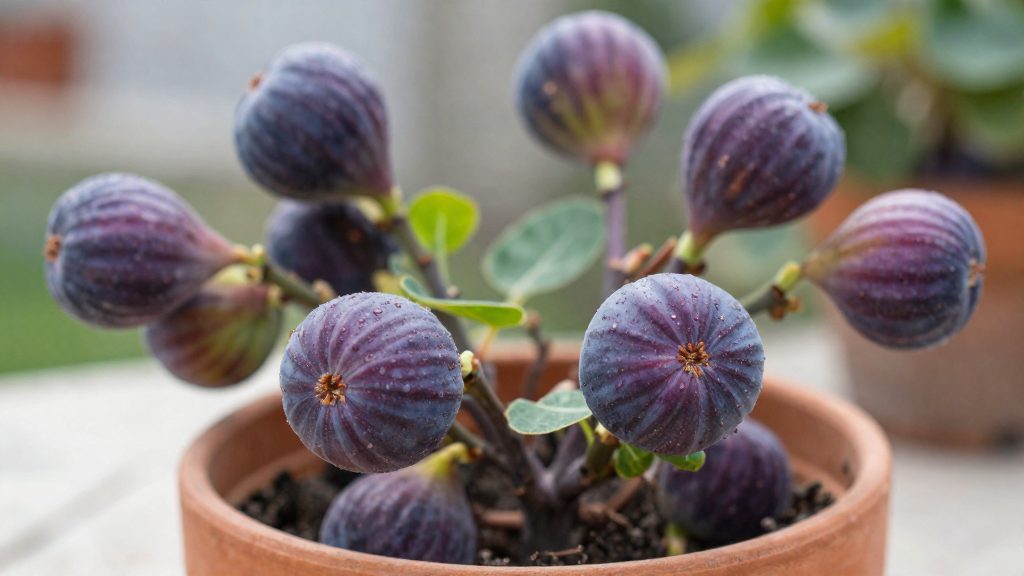
Fig trees can be grown in containers where winters are hard, provided the pot is large enough and the plant spends the coldest months in a cool, sheltered spot. A container limits how far roots can spread, gives you control over where the plant sits in the sun, and lets you choose a size that suits your space. Ground planting gives roots more room but offers fewer options for managing size and position. The University of Maryland Extension (2026-01-20) and Iowa State University Extension (2022-09-08) both address container culture for figs, and the points below set out the benefits and limits.
Why grow figs in containers in cold climates?
Fruit ripening in full sun
Place the pot in full sun, in the most open and sunny position available to you. The official sources consulted do not specify how much earlier fruit ripens in pots than in ground-planted figs, so no timing figure is given here. To judge the difference in your own garden, note the first ripe fruit each season and compare it with a neighbouring fig if you have one.
Root restriction as a size control
A fixed pot caps how far roots can spread, and this root restriction is the main way container culture keeps a fig manageable. Iowa State University Extension (2022-09-08) recommends large containers for figs. For plants that need to stay compact, the University of Maryland Extension (2026-01-20) lists dwarf varieties as the appropriate choice. The sources do not state how much a given container limits the final size of the plant.
Pot culture versus ground planting
| Approach | Point documented in the sources | Source |
|---|---|---|
| Pot culture | Brunswick is recorded as good in containers | University of Maryland Extension (2026-01-20) |
| Ground planting | Protection can use cut-back stems, burlap, or surrounding leaves or straw | University of Maryland Extension (2026-01-20) |
- Pot culture gives you direct control over root space and placement, but the root volume is fixed by the container you choose.
- Ground planting offers the protection methods listed above.
- The official sources consulted do not compare fruit yield between potted and ground-planted figs.
Best fig varieties for pots
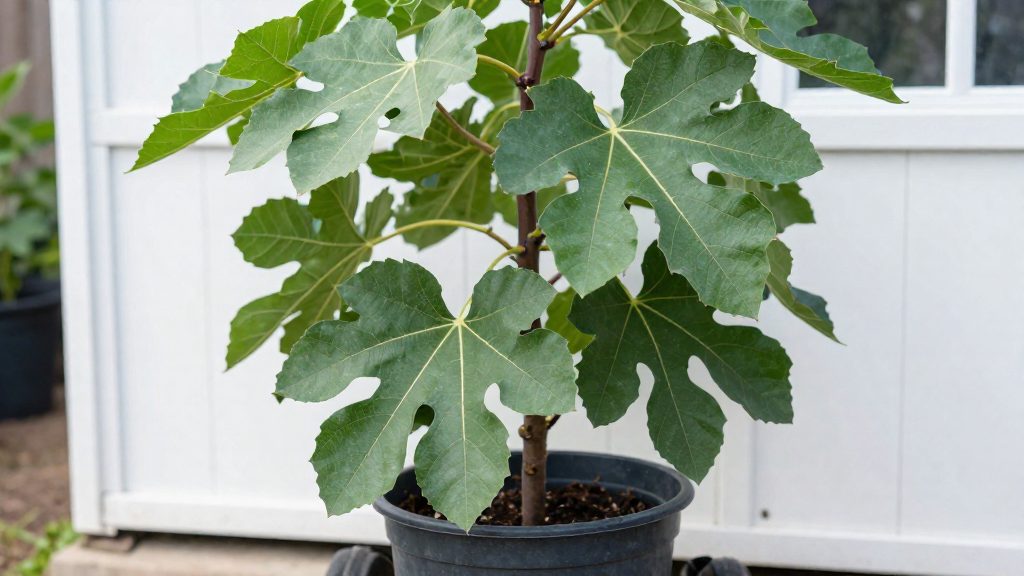
Choosing the right cultivar is the first decision when growing figs in containers in a cold climate. The University of Maryland Extension (January 2026) recommends Brunswick, Celeste, Chicago Hardy, Brown Turkey and Marseilles, and identifies two options for pot culture: Brunswick, described as good in containers, and Petite Negri, a dwarf type suited to containers.
Recommended cultivars at a glance
| Cultivar | What the University of Maryland Extension documents |
|---|---|
| Brunswick | Good in containers |
| Petite Negri | Dwarf type suited to containers |
| Celeste | Recommended variety; container suitability not specified |
| Chicago Hardy | Recommended variety; container suitability not specified |
| Brown Turkey | Recommended variety; container suitability not specified |
| Marseilles | Recommended variety; container suitability not specified |
Selecting cultivars that stay compact
For a potted fig, start with the cultivars documented as container-suited or as dwarf types. A compact plant is easier to manage on a patio or balcony and easier to relocate. Brunswick and Petite Negri are the most direct choices from the sources consulted. For the other recommended varieties, check the nursery description for mature size before buying, since the sources consulted do not specify it.
Multi-stem bush versus single-stem tree
A fig trained as a multi-stem bush, with several stems rising from the base, is easier to protect over winter than a single-stem tree, according to the University of Maryland Extension (January 2026). For a container plant, this means selecting a bush form from the outset rather than a young plant with one dominant trunk. When buying, look at the plant’s training and ask the grower whether it was raised as a bush.
Practical selection checklist
- Fit the pot with wheeled casters so it can be moved to a cool, insulated spot in winter.
Choosing the right container and soil
In cold climates, container size, material, drainage, and mobility determine whether a fig’s roots stay healthy and whether the pot can be moved as conditions change. Iowa State University Extension (2022) recommends growing figs in large containers in areas where common figs are not dependably winter-hardy. The University of Maryland Extension (2026) gives a concrete minimum size, along with guidance on bag type, drainage, and casters.
Container volume
Use a container of at least 15 gallons. A smaller pot limits the root space the plant can use, and the root system is what the tree depends on for growth through the season.
Material: fabric grow bags
Fabric grow bags limit root circling. Roots that wrap around the inside of a rigid pot can become tangled, so a breathable fabric container helps keep the root mass more even.
Drainage and soil mix
Raise the pots a few inches off the ground so roots do not grow through the drainage holes. For the growing medium, use a 50:50 mix of compost and soilless medium.
Mobility: wheeled casters
Fit wheeled casters to the base of each pot. A pot filled to 15 gallons is heavy, and casters let you move it without lifting it.
Varieties suited to containers
| Variety | Container suitability (per University of Maryland Extension, 2026) |
|---|---|
| Brunswick | Good in containers |
| Petite Negri | Dwarf type suited to containers |
Feeding and watering container figs
Container figs depend entirely on their pot for nutrients and water, so feeding and watering need a plan. According to the University of Maryland Extension (2026), container figs should be fertilized monthly from May through July, which covers their main growing period. The official sources consulted do not specify an organic fertilizer dosage or a fixed watering interval, so the practices below rely on timing and on checking the pot before each action.
Organic fertilizer schedule
Start feeding in May, once the fig is actively leafing out, and continue once a month through July.
| Period | Feeding action | Reference |
|---|---|---|
| May | First organic fertilizer application of the season | University of Maryland Extension (2026) |
| June | Second monthly application | University of Maryland Extension (2026) |
| July | Third monthly application, the last one in the source’s schedule | University of Maryland Extension (2026) |
To apply the feed:
- Choose an organic fertilizer labeled for fruit or vegetables, and follow the dosage printed on the package.
- Spread the granules evenly over the surface of the medium, keeping them an inch or two from the stem.
- Water the pot lightly after application so the nutrients move into the root zone.
- Avoid synthetic fertilizers. Organic options such as compost or plant-based granular feeds provide an alternative that suits organic growing.
Watering by checking the medium
Water based on the condition of the medium, not on a calendar:
- Push a finger about 1 inch into the medium. Water only when the top inch feels dry.
- Water thoroughly until liquid runs out of the drainage holes, then empty any saucer after a few minutes.
- Check more often during hot, dry spells, when the medium dries faster, and less often during cool, damp weather.
- Keep the pot from sitting in standing water, since waterlogged roots suffer even when the plant looks healthy.
Compost tea and other organic liquid feeds
Compost tea is a liquid made by steeping finished compost in water, then diluting it before use. It can supplement granular feeds during the monthly schedule. The official sources consulted do not give a dilution ratio or application frequency for compost tea on figs. Follow the producer’s directions for any commercial product, or make your own from mature compost and test it on one plant before treating the whole collection. Apply it to moist medium, as described above, and keep it as a supplement to the monthly organic fertilizer rather than a replacement.
How do you overwinter a potted fig?
Overwintering a potted fig means moving the whole plant into a cool, unheated space for the cold months.
Choosing the winter location
- Attached unheated garage: one of the two spots named by Iowa State University Extension (2022-09-08).
- Cool basement: the second option from the same source.
- Keep the plant out of heated living areas, since the goal is a cool, insulated space rather than warmth.
The official sources consulted do not specify exact temperatures for these spaces, so check the location with a simple thermometer before moving the plant in.
Recognizing dormancy and timing the move
The official sources consulted do not list specific signs of dormancy or a fixed date for relocation. As a practical approach, move the plant indoors to its winter space before cold weather arrives in your area, and adjust the timing to your local climate rather than the calendar.
Moving heavy pots safely
The sources do not give weight figures or lifting guidance, so these are general handling practices:
- Clear the route first: doorways, thresholds, and steps.
- Slide a hand truck or dolly under the pot instead of lifting it by the rim.
- Ask a second person to help on stairs, especially when moving from a basement.
- Move the pot when the soil is only lightly moist, since saturated soil adds considerable weight.
What temperatures can figs survive?
Common figs are not dependably winter-hardy in Iowa, according to Iowa State University Extension (2022). The temperature a fig can tolerate depends on the cultivar and on which part of the plant is exposed: the aboveground stems, the roots, or the whole plant in a container. The figures below are the thresholds given by the consulted sources and are the starting point for deciding whether a potted fig can stay outdoors or must move to a cool, sheltered spot for winter.
Documented thresholds by plant part
| Plant part | Threshold | Source |
|---|---|---|
| Chicago Hardy stems | Tolerate about 10°F | Iowa State University Extension (2022) |
| Chicago Hardy roots | Tolerate about 15 to 20 degrees below zero | Iowa State University Extension (2022) |
| Aboveground fig wood (general) | Can be injured or killed by sustained temperatures below 20°F | University of Maryland Extension (2026) |
Stems: the aboveground limit
The stems are the most exposed part of the plant. According to University of Maryland Extension (2026), sustained winter temperatures below 20°F can injure or kill aboveground fig wood. The sources use the word “sustained,” so a brief cold dip is not described as the same risk as a prolonged cold period. The sources consulted do not specify how many hours or days of cold produce damage.
Even the hardiest cultivar named in the sources has a limit. Chicago Hardy stems tolerate about 10°F (Iowa State University Extension, 2022), while the University of Maryland Extension (2026) warns that sustained temperatures below 20°F can injure or kill aboveground fig wood in general. Growers in cold areas should plan protection before temperatures approach these levels.
Roots: a much wider tolerance
Roots tolerate far colder conditions than stems. Iowa State University Extension (2022) gives a root tolerance of about 15 to 20 degrees below zero for Chicago Hardy. The sources do not say that this figure applies to roots in a container, where they are more exposed to cold. Do not rely on it to leave a potted fig outdoors.
Which cultivars and sites are at risk
- Cultivar risk: Chicago Hardy is described by Iowa State University Extension (2022) as one of the hardiest edible cultivars. University of Maryland Extension (2026) recommends Brunswick, Celeste, Chicago Hardy, Brown Turkey, Marseilles and the dwarf ‘Petite Negri’ for containers. The consulted sources do not give temperature thresholds for the other cultivars, so their relative hardiness cannot be ranked from these sources.
- Site risk: Figs left exposed in a site where temperatures stay below 20°F for sustained periods face injury to aboveground wood. The sources consulted do not specify thresholds for individual microclimates.
Waking figs up in spring
Once the pots leave winter storage, the first job is to find out which stems survived. The University of Maryland Extension (2026-01-20) describes a simple scrape test: lightly scrape the outer bark of a stem, and if there is green tissue underneath, the stem is alive.
Scrape test, step by step
- Use a fingernail or the tip of a clean knife, and scrape only the outer layer.
- Test several points along each main stem, from the base up toward the tips.
- Green tissue means the stem survived. Brown, dry tissue with no green beneath it means that section did not survive the winter.
- On a multi-stem bush, check every stem separately, since some may survive while others do not.
Spring pruning and dead-wood removal
Cut back each stem to the last point where the scrape test showed green tissue. This removes dead wood and leaves the living structure to regrow. Use sharp, clean pruning tools and wipe the blades between cuts.
Gradual return outdoors
Figs stored in a cool, insulated spot should not go straight into full sun and open weather. Move the pots outside in stages, starting with a sheltered, partly shaded position and increasing light exposure over several days or weeks. This gradual acclimatization helps the new growth adjust to outdoor conditions.
- The official sources consulted do not specify exact dates for this transition. Base the timing on the last spring frost period in your region.
- Use casters or a dolly to move the pots without straining the stems.
Winter protection and vole risk for in-ground figs
In-ground figs face cold damage to the aboveground wood, and the insulation used to protect them can attract voles. According to University of Maryland Extension (2026-01-20), the main in-ground options are cutting stems back, wrapping them in burlap, and surrounding them with leaves or straw. According to University of Maryland Extension (2026-01-20), the main in-ground options are cutting stems back, wrapping them in burlap, and surrounding them with leaves or straw.
Vole damage under insulation
Voles are the specific risk the University of Maryland Extension identifies for in-ground protection. The sources do not document this risk for stored potted figs. Leaves, straw, and burlap create sheltered cover at the base of the plant, and that cover can draw rodents close to the bark. Signs to check for include gnawed bark near the soil line and small surface tunnels under the mulch.
Organic fixes:
- Inspect the base of the plant regularly through the winter, not only at the start of the cold season.
- Loosen or remove the leaf or straw layer if you find signs of activity, then rebuild it once the area is clear.
- Use a physical barrier such as wire mesh around the base, which blocks access without chemicals.
- Keep the mulch loose rather than packed tight against the stems, so rodents have fewer sheltered routes.
Protection that is applied incorrectly
Protection methods work only when they are matched to the plant’s shape and left in place correctly.
| Method | How to apply it | Point to watch |
|---|---|---|
| Cutting stems back | Reduce the plant’s height before covering it | — |
| Burlap wrap | Wrap the stems loosely around the plant | Wrapping tightly can trap moisture against the wood |
| Leaves or straw | Pile around the base of the plant | — |
The official sources consulted do not specify exact dates for installing or removing these layers, so base timing on your local conditions and remove any material that stays wet for long periods. Remove any remaining damaged or dead stems in spring once the plant begins to show new growth, rather than trimming during deep cold.
Frequently asked questions
Can a fig tree survive a cold winter in a pot?
Yes, if the pot is large enough and the plant can spend the coldest months somewhere cool and sheltered. According to Iowa State University Extension (2022-09-08), common figs are not dependably winter-hardy in Iowa, so moving the container to a cool unheated space for winter is the key step.
What pot size and variety should a beginner choose?
University of Maryland Extension (2026-01-20) recommends a container of at least 15 gallons, and fabric bags help limit roots from circling inside the pot. For a more compact plant, choose a dwarf variety such as ‘Petite Negri’, or ‘Brunswick’, which that source lists as good in containers.
How can I tell whether winter cold has damaged my fig?
According to University of Maryland Extension (2026-01-20), sustained winter temperatures below 20°F can injure or kill aboveground fig wood. To run a scrape test, lightly scratch a stem: green tissue underneath means the stem survived. The official sources consulted do not specify how to care for a stem that shows no green tissue.