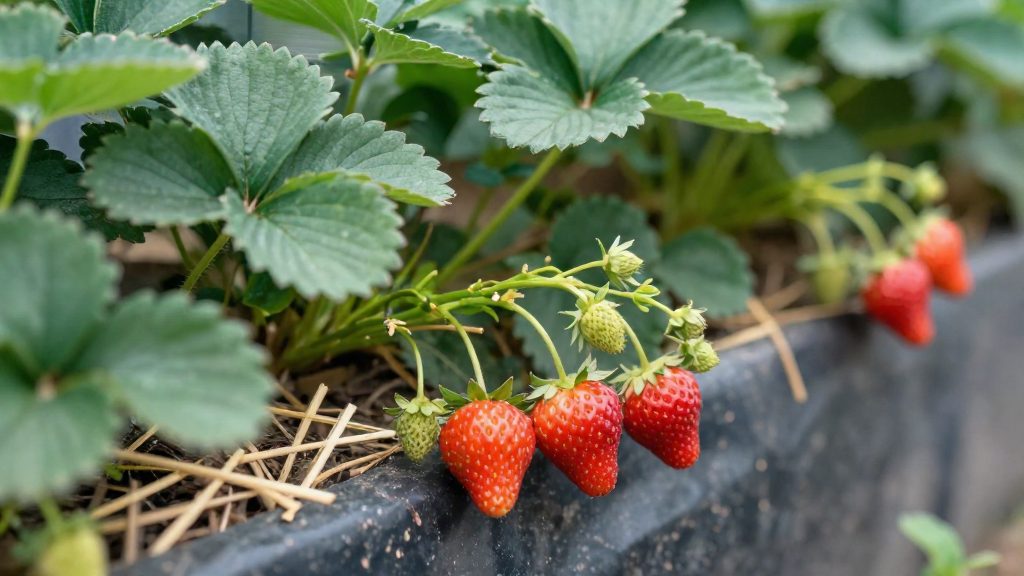
Growing strawberries organically at home means feeding the bed with compost and mulch instead of synthetic inputs, and picking the fruit yourself once it is fully ripe. According to the Alabama Cooperative Extension System (2022), strawberries are typically ready about 90–100 days after planting, when the fruit is fully red. The gains are three: fruit picked at full ripeness, a bed whose soil stays biologically active over the years, and berries that reach your plate without synthetic residues.
Why grow strawberries organically?
Flavor and freshness
The main advantage of a home bed is control over harvest timing. Fruit eaten soon after picking has not spent time in storage.
Full sun is the first condition for a well-developed crop. Utah State University Extension recommends at least 8 hours of direct sun a day, on well-drained soil.
Soil life and long-term bed fertility
An organic bed depends on organic matter rather than synthetic fertilizers. Mulch also protects the bed. In cold areas, Utah State University Extension advises covering the bed with 3–6 inches of clean straw or shredded leaves in late November and removing it in spring.
Rotation protects the soil from disease buildup. Utah State University Extension advises avoiding beds where tomatoes, peppers, potatoes, eggplant or okra grew recently, because of Verticillium risk. It also advises against keeping strawberries in the same bed for more than 5 years.
Residue-free fruit eaten fresh
Organic growing replaces synthetic sprays with cultural practices and biological alternatives. Watering correctly is the first of these. The Alabama Cooperative Extension System (2022) recommends watering 1–2 inches per week. Utah State University Extension prefers drip irrigation, and recommends running sprinklers in the morning if they are used.
When intervention is needed, the same Alabama source suggests insecticidal soap for soft-bodied insects and Bt for caterpillars.
| Practice | Organic approach | Source |
|---|---|---|
| Harvest timing | Pick when fruit is fully red, about 90–100 days after planting | Alabama Cooperative Extension System (2022) |
| Bed cover | 3–6 inches of clean straw in cold areas, removed in spring | Utah State University Extension |
| Bed rotation | Avoid recent tomato, pepper, potato, eggplant or okra beds; limit strawberries to 5 years per bed | Utah State University Extension |
| Soft-bodied insects | Insecticidal soap | Alabama Cooperative Extension System (2022) |
| Caterpillars | Bt | Alabama Cooperative Extension System (2022) |
Which strawberry type fits your garden?
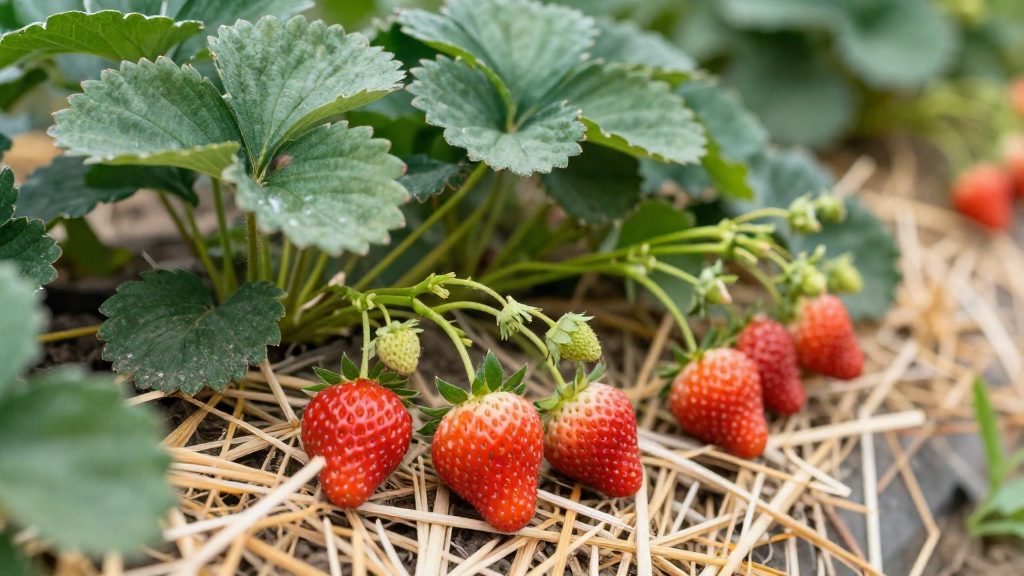
Strawberry types are grouped by when they set flower buds and how many crops they produce, and that timing determines how long you wait for fruit and how the harvest is spread across the season. According to Utah State University Extension, the main groups are June-bearers, which fruit once in late spring, and everbearing and day-neutral types, which give a spring crop plus a fall crop. Matching the type to your harvest goal, your climate and the source of your plants prevents most early disappointments.
June-bearing types set their flower buds in autumn and fruit in late spring. The first full crop comes in the second spring after planting, so this type suits gardeners who want one concentrated picking window for preserving or freezing and can wait a year for a full harvest.
Everbearing and day-neutral types produce a smaller spring crop and a fall crop, which spreads the harvest over a longer period. Their limitation is heat: they struggle in summer heat above about 75°F. In regions where summers regularly exceed that temperature, expect reduced output during the hottest weeks and plan around the spring and fall flushes.
| Type | Flower bud timing | Harvest pattern | Heat tolerance |
|---|---|---|---|
| June-bearing | Set in autumn | One crop in late spring; first full crop in the second spring | Not specified in the consulted source |
| Everbearing and day-neutral | Continuous production | Smaller spring crop plus a fall crop | Struggle above about 75°F |
Plant sourcing matters as much as the type you choose. Viruses have no cure, so start with disease-free plants and buy certified virus-free stock when possible.
How much sun and what soil do strawberries need?
Strawberries need full sun and well-drained soil, and both conditions should be settled before any plant goes into the ground. Utah State University Extension recommends at least 8 hours of direct sun a day. The Alabama Cooperative Extension System (2022-08-29) gives a lower range of 6 to 8 hours. The sources therefore differ, so aim for at least 8 hours and treat fewer hours as a compromise that may reduce the crop. Choose the most open, unshaded spot in the garden, away from trees and fences that cast shade during the day, since light drives flowering and fruit set.
| Factor | Recommendation | Source |
|---|---|---|
| Sunlight | At least 8 hours a day (Utah) or 6 to 8 hours a day (Alabama) | Utah State University Extension; Alabama Cooperative Extension System (2022-08-29) |
| Soil texture | Loamy or sandy soil works best | Utah State University Extension |
| Drainage | Well-drained soil; raised beds help in heavy clay | Utah State University Extension |
| Compost | 2 to 3 inches worked into the bed to a depth of at least 12 inches | Utah State University Extension |
| Bed history | Avoid beds where tomatoes, peppers, potatoes, eggplant or okra grew recently | Utah State University Extension |
Soil texture and drainage
Well-drained soil matters more than fertility alone. Loamy or sandy soil drains freely and warms earlier in spring. In heavy clay that holds water, raised beds are the practical alternative, because they lift the root zone above the wettest layer. Most strawberry roots stay in the top 10 to 12 inches of soil, so that layer needs to drain and stay loose.
Compost depth before planting
Work compost into the bed before planting: 2 to 3 inches of finished compost, mixed to a depth of at least 12 inches. Compost is an organic amendment that improves structure and water retention in sandy soil and loosens clay, and it replaces synthetic fertilizer as the base nutrient source for the bed.
Bed history and disease risk
Check where the bed’s previous crops grew. Tomatoes, peppers, potatoes, eggplant and okra belong to the same group of crops that carry Verticillium risk, so strawberries should not follow them in the same bed.
How do you plant strawberries in beds and pots?
Home gardeners usually choose between two bed layouts, matted-row and annual-hill, and each sets its own spacing. For matted rows, the Utah State University Extension recommends 18–24 inches between plants, with rows 3–4 feet apart. For annual-hill beds, it recommends 12–15 inches between plants and removing runners. Container planting uses different numbers, which are covered below.
Matted-row layout
In a matted-row bed, plants are set in rows and allowed to spread. Space plants 18–24 inches apart within the row and leave 3–4 feet between rows, according to Utah State University Extension. Over the season, the plants fill the space between them, which forms the continuous “mat” that gives this system its name. After harvest, June-bearing matted rows are renovated by removing weeds, narrowing the rows, fertilizing and irrigating, according to Utah State University Extension.
Annual-hill layout
In an annual-hill bed, plants are set closer together, 12–15 inches apart, and the planting is treated as a single crop cycle. Runners are removed so that only the mother plants fruit, according to Utah State University Extension. The closer spacing is compensated by removing runners, not by allowing plants to fill the bed.
Comparison
| Feature | Matted-row | Annual-hill |
|---|---|---|
| Spacing between plants | 18–24 inches | 12–15 inches |
| Spacing between rows | 3–4 feet | Not specified by the sources consulted |
| Runners | Allowed to spread into the row | Removed |
| Fruiting plants | Plants spread across the bed | Mother plants only |
Runner handling
Runners are the stems that send out new plants. In matted-row beds they are left to root and fill the row. In annual-hill beds they are removed as they appear, so the energy goes into the original plants.
Container planting
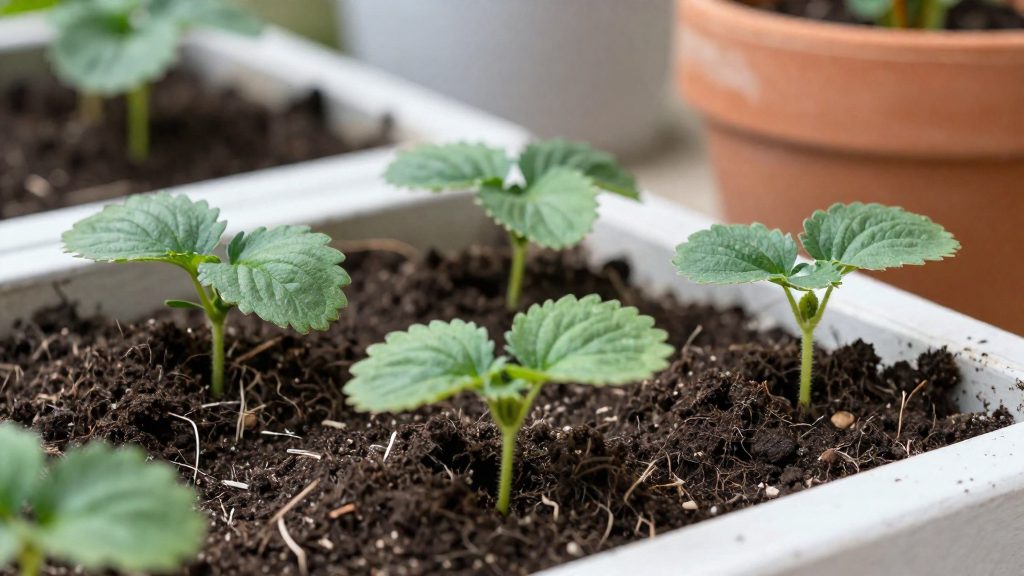
Containers follow the same principle of setting the crown at the right depth, but the density is set per pot. The Alabama Cooperative Extension System (2022-08-29) recommends planting 4 strawberry plants per 5–7 gallon pot. Set the crown level with the soil surface.
Water, mulch and natural feeding
Strawberry roots sit mostly in the root zone, the top 10–12 inches of soil, so watering should aim to wet that layer rather than the surface alone. Utah State University Extension notes that plants can use up to 2 inches of water per week in hot, dry weather. The Alabama Cooperative Extension System (2022) recommends 1–2 inches per week in general. Check soil moisture a few inches down before each watering, and adjust the amount when temperatures rise.
| Condition | Water amount | Source |
|---|---|---|
| General growing season | 1–2 inches per week | Alabama Cooperative Extension System (2022) |
| Hot, dry weather | Up to 2 inches per week | Utah State University Extension |
Drip irrigation is the preferred method, according to Utah State University Extension. It delivers water to the root zone without wetting the crowns and leaves. If you use a sprinkler, run it in the morning so the foliage dries during the day.
Keeping foliage dry matters for disease control. The Alabama Cooperative Extension System (2022) advises keeping leaves dry to reduce fungal disease. Avoid soaking the bed.
Mulch helps hold moisture in the root zone. The Alabama Cooperative Extension System (2022) notes that mulch conserves moisture and inhibits some diseases. Iowa State University Extension and Outreach (2016) recommends straw mulch because it keeps berries off damp soil, which reduces losses from gray mold. Prompt picking and removal of infected berries also limit losses.
Organic feeding
Nitrogen needs to be managed carefully. Iowa State University Extension and Outreach (2016) advises against fertilizing June-bearing strawberries in spring, because nitrogen promotes dense foliage that dries slowly and favors gray mold. Choose organic amendments with a moderate nitrogen content rather than fast-release, high-nitrogen inputs, and avoid feeding in early spring.
The official sources consulted do not specify organic fertilizer products, application rates or timing. Utah State University Extension mentions fertilizing as part of post-harvest renovation of June-bearing matted rows, but gives no quantities. Base your feeding plan on soil condition and plant vigor, and adjust gradually.
Natural pest, weed and gray mold control
Weeds are the main limiting factor in strawberry production, and gray mold (Botrytis) is the disease most likely to reduce a home harvest. According to the Utah State University Extension, weeds limit strawberry yields more than any other factor, so weed control comes first. Gray mold is favored by poor air circulation and humidity, so cultural practices are the most effective control in home gardens, according to Iowa State University Extension and Outreach (2016). Iowa State University Extension and Outreach (2016) names cultural practices as the best way to control gray mold in home gardens.
Weeds: the main limiting factor
- Mulch to suppress weeds, as the Alabama Cooperative Extension System (2022) notes, and clear weeds first when renovating old matted rows.
Gray mold prevention: airflow and sanitation
Gray mold develops most often where berries touch damp soil or other infected berries, according to Iowa State University Extension and Outreach (2016). The following practices reduce that contact and the humidity around the fruit:
- Keep fruit off damp soil with a layer of straw mulch.
- Pick ripe fruit promptly to limit the time berries spend on the plant.
- Remove infected berries from the bed and the plant so they do not spread spores to healthy fruit.
- Plant with enough space for air to move between plants.
Organic alternatives to synthetic insecticides
The sources consulted name two organic options for common strawberry pests:
| Pest type | Organic option | Source |
|---|---|---|
| Soft-bodied insects | Insecticidal soap | Alabama Cooperative Extension System (2022) |
| Caterpillars | Bt (Bacillus thuringiensis) | Alabama Cooperative Extension System (2022) |
The official sources consulted do not specify an organic fungicide product for gray mold. In that case, rely on the airflow, sanitation and mulching practices described above.
Renovation, winter care and harvest
June-bearing strawberries grown in matted rows need renovation after harvest, and in cold areas they need a protective straw layer over winter. According to Utah State University Extension, renovation means removing weeds, narrowing the rows, fertilizing and irrigating. Weeds are the biggest limiting factor for strawberries, so clearing them comes first. June-bearers set flower buds in autumn and fruit in late spring, so the post-harvest work is what prepares the plants for the next crop.
Renovating old matted rows
- Remove weeds before anything else, since they are the main limiting factor for strawberries.
- Narrow the rows by removing excess plants at the edges of the mat, as part of the renovation described by Utah State University Extension.
- Fertilize and irrigate after harvest.
- Fertilize after harvest, not in spring. The sources consulted give no organic product or rate, so base the amount on soil condition and plant vigor.
Winter straw mulch in cold areas
| Step | Timing | Practice |
|---|---|---|
| Apply mulch | Late November | 3–6 inches of clean straw or shredded leaves |
| Remove mulch | Spring | Pull the layer off the bed |
Retiring beds after five years
- Do not keep strawberries in the same bed for more than 5 years.
- Replant in a different location when a bed reaches that age.
- Start with disease-free plants, because viruses have no cure.
Harvest handling
- Pick fully red fruit. According to the Alabama Cooperative Extension System (2022), harvest comes about 90–100 days after planting, when the fruit is fully red.
- June-bearers give their first full crop in the second spring after planting.
- Everbearing and day-neutral types give a smaller spring crop plus a fall crop. They struggle in summer heat above about 75°F, so expect lower yields during hot spells.
Frequently asked questions
How much sun do strawberries need in a home garden?
Utah State University Extension recommends at least 8 hours of direct sun a day on well-drained soil. The Alabama Cooperative Extension System (2022) gives a lower range of 6 to 8 hours, so if your site gets less than 8 hours, choose the sunniest spot you have.
How do I renovate an old June-bearing strawberry bed?
Renovation takes place after harvest and starts with clearing weeds, which Utah State University Extension identifies as the biggest limiting factor for strawberries. The same source also lists narrowing the rows, fertilizing and irrigating, but the official sources consulted do not specify rates or organic products for these steps.
Which natural methods help control gray mold and weeds?
Iowa State University Extension and Outreach (2016) names cultural practices as the best way to control gray mold in home gardens, since the disease is favored by poor air circulation and humidity. The Alabama Cooperative Extension System (2022) notes that mulch suppresses weeds and inhibits some diseases, and clean straw also keeps berries off damp soil.