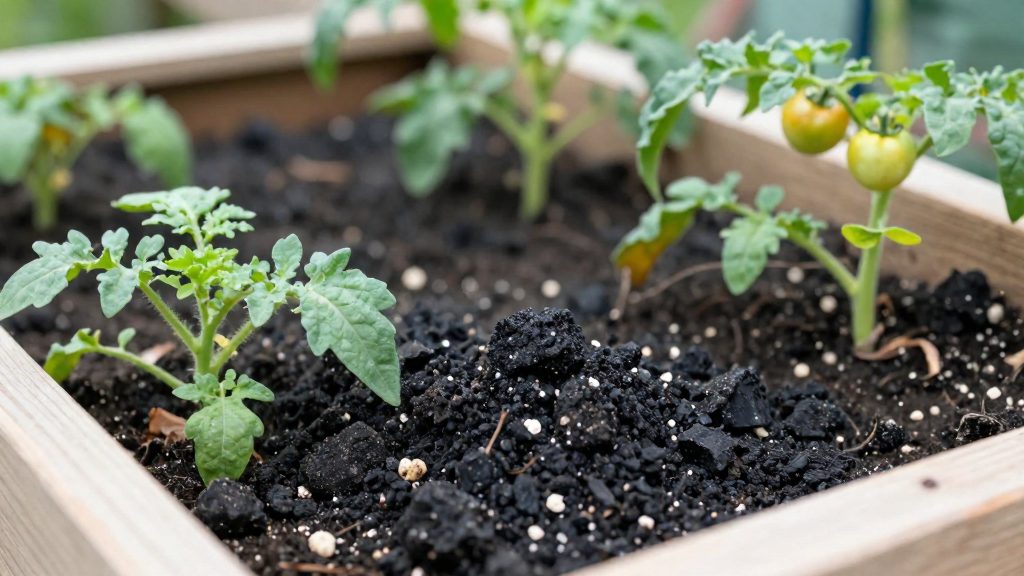
Biochar is thermally treated biomass made mostly of carbon. According to Penn State Extension (2022), it typically contains 50 to 80% carbon, and the production temperature determines its type: slow-pyrolysis char is made at 300–600°C (about 570–1,110°F). A meta-analysis cited by the same source found an average crop yield increase of about 10%, but results varied widely between studies and crops, so this figure is an average rather than a guaranteed outcome.
What is biochar and what does it do?
Carbon content and production temperature
Biochar is produced by heating organic material in a controlled thermal process. The most important variables are the carbon content of the finished material and the temperature at which it was made. Penn State Extension (2022) reports that biochar typically contains 50 to 80% carbon. The production temperature sets the category: slow-pyrolysis char, the type described in that source, is made at 300–600°C.
| Property | Reported value | Source |
|---|---|---|
| Carbon content | Typically 50 to 80% | Penn State Extension (2022) |
| Slow-pyrolysis production temperature | 300–600°C | Penn State Extension (2022) |
| Average crop yield change (meta-analysis) | About +10%, with wide variation between studies | Penn State Extension (2022) |
Because the carbon share and the production temperature both vary, two products sold under the same name can behave differently in the garden. A gardener comparing bags should check the stated carbon content and production conditions before buying.
What the yield data show
The yield figure is the most cited result, but it needs context. The meta-analysis reported by Penn State Extension (2022) found an average increase of about 10% across the studies it compiled. The same source notes that results differed widely between individual studies and between crops. A gain of about 10% on average therefore does not predict the result in any single bed.
Limits of the evidence
The official sources consulted do not give a single yield value that applies to all vegetables, fruit, or soil conditions. Gardeners should treat the 10% figure as a general indication of direction and record their own results over at least one growing season to judge the effect on their plants.
Is biochar right for your soil?
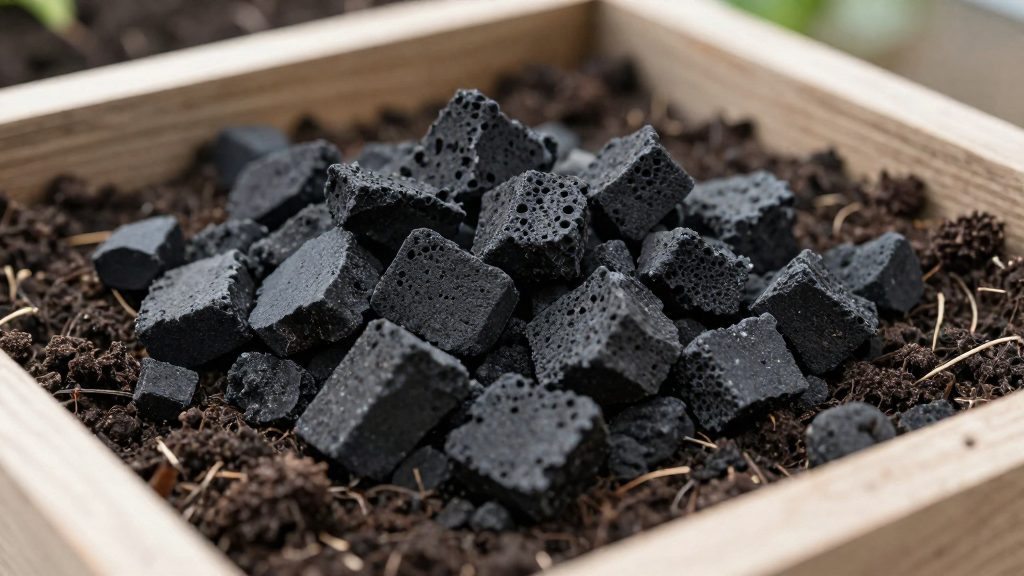
Biochar is most useful where the soil has a physical or chemical limitation it can correct. According to Washington State University Extension (2014), it helps most in compacted soils and in sandy, fast-draining soils, and it adds less value on silty soils and heavy clay. Penn State Extension (2022) reports that biochar is highly alkaline, which makes it useful on acidic ground. Identifying your soil type before buying or spreading any product is the first practical step.
| Soil type | Expected effect | Value |
|---|---|---|
| Compacted | Improved aeration and drainage | Good match |
| Sandy, fast-draining | Higher water-holding capacity, less nutrient leaching | Good match |
| Acidic | pH raised by its alkalinity (pH 10–11) | Useful |
| Heavy clay | Risk of waterlogging | Low value, check drainage first |
| Silty | Less effective | Low value |
Compacted soils
Compacted soil has few air spaces, which limits root growth and water movement. WSU Extension (2014) identifies biochar as helping most in compacted soils, where it improves aeration and drainage. Hard-packed vegetable beds and soil that puddles after rain are the situations where this benefit is most likely to be noticed.
Sandy soils
Sandy soils drain quickly and lose nutrients easily. WSU Extension (2014) notes that biochar increases the water-holding capacity of sandy soils and binds nutrients, which reduces nutrient leaching.
Acidic soils
Penn State Extension (2022) reports that biochar has a pH of 10–11 and raises the pH of the soil it is applied to. For acidic soils, this can be a benefit. Penn State suggests one liming equivalence: 3 tons of biochar to 1 ton of lime. The official sources consulted do not specify how long this buffering lasts. Test your soil pH before application, because the equivalence is a suggestion, not a precise substitute for lime. On soils that are already alkaline, the same property will push pH higher.
Where biochar adds little value
- Silty soils: WSU Extension (2014) states that biochar is less effective on them.
- Heavy clay: biochar can cause waterlogging, so drainage should be assessed before use.
- Soils without a matching limitation: if your soil is not compacted, sandy, or acidic, the expected benefits are small.
How do you charge biochar before using it?
Charging biochar means loading its porous structure with nutrients and moisture before it goes into the soil. According to Harvest to Table (2025), the core method is to mix biochar with compost, manure or a soil slurry first. This avoids nutrient drawdown, a loss of available nutrients that can occur when dry biochar is added directly to a bed. Pre-loaded biochar acts as a reservoir rather than competing with your plants for nutrients already in the soil.
Pre-loading with compost, manure or soil slurry
- Compost: Harvest to Table (2025) describes charging biochar in compost for a few weeks before adding it to raised beds.
- Manure: Combine biochar with well-rotted manure using the same principle, so the particles absorb nutrients before they reach the soil.
- Soil slurry: Mix biochar into a wet slurry of garden soil and water, then let the mixture sit before use.
- Nutrient solution: A liquid nutrient solution can serve as a carrier, but the official sources consulted do not specify concentrations, so follow the dilution on your fertiliser label.
The sources consulted do not give exact ratios of biochar to carrier material. Aim for a uniform, moist and crumbly mix, and avoid a soggy one.
Moistening biochar to reduce dust
Dry biochar is light and can rise into the air when you shovel, pour or mix it. Dampen it before handling: spray or sprinkle water over the heap and turn it until the surface darkens and dust no longer lifts. Moist biochar also blends more evenly with compost or manure. Wear gloves and a dust mask when handling dry material, especially in windy conditions.
Letting charged biochar rest before planting
Charged biochar needs time to integrate with its carrier. The few-week rest period described by Harvest to Table (2025) is the reference point for this step. Store the mix in a covered container or heap that stays moist, then spread it across the bed before you plant. Mix it into the soil rather than placing it in planting holes, and water it in so the pre-loaded material settles.
How much biochar should you add?
The published rate benchmarks come from extension services and use different units, so they cannot be compared directly. Utah Extension sets a maximum of 10 tons per acre, which Penn State Extension (2022) reports as a one-time application. Harvest to Table (2025) suggests starting at 5–10% of soil volume. The official sources consulted do not specify an application rate for Mid-Atlantic states, so gardeners in that region have no published regional figure to work from. Treat these numbers as upper limits and starting points, not targets.
| Source | Benchmark | Context |
|---|---|---|
| Utah Extension, cited by Penn State Extension (2022) | Maximum of 10 tons per acre | Framed as a one-time application |
| Harvest to Table (2025) | Start at 5–10% of soil volume | Mixed into beds before planting |
| Washington State University Extension (2014) | Above 2% of soil volume listed as a drawback | Concern about binding organic contaminants such as PAHs |
Working out the amount for your bed
Biochar rates are expressed as a share of soil volume or as tons per area, so you need the bed’s volume first:
- Measure the bed’s length, width and the depth you plan to work, in the same unit.
- Multiply length × width × depth to get the volume of soil.
- Harvest to Table (2025) suggests 5–10% of that volume as a starting amount, but WSU Extension (2014) lists anything above 2% of soil volume as a drawback because of binding of organic contaminants such as PAHs. The two benchmarks conflict, and even the low end of 5–10% is above the WSU threshold. Start with a small test bed at or below 2% of soil volume, watch the plants, and only then consider more. Convert the volume to weight using the product’s density from the supplier.
Use the lower end of the range for a first application, especially in a new or small bed, and observe the plants before adding more.
Limits to keep in mind
- Utah’s figure is a single application. It describes one dose over an area, not an amount to add every season. Repeated annual additions are not covered by that benchmark.
- Regional guidance is missing for the Mid-Atlantic. Gardeners there should rely on the general benchmarks above and keep records of what they add.
Mixing it into beds, containers and around plants
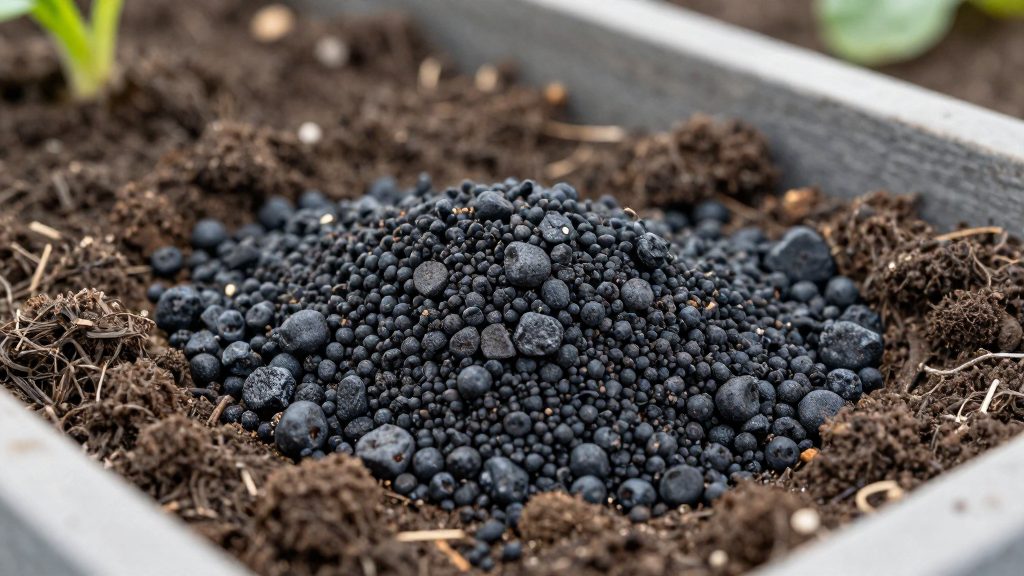
Three placement methods cover most garden situations: mixing biochar into bed topsoil before sowing, blending it into potting mix for containers, and top-dressing established plants that are already growing. In each case the aim is root contact, meaning the material should sit within the soil and root zone where water and nutrients move, not in a separate layer on the surface.
Incorporating into bed topsoil before sowing
Harvest to Table (2025) suggests mixing biochar into beds before planting. Work it into the top layer with a fork or hoe so the particles spread through the root zone.
- Spread the biochar evenly over the bed surface.
- Work it into the top soil layer, then rake the bed level.
- Sow or transplant after mixing, not into loose material left on top.
- Water the bed so the particles settle and stay in contact with the soil.
Blending into container potting mix
In containers, the goal is even distribution through the whole volume of mix. Blend the biochar into the potting mix in a bucket or tub before filling pots, so no concentrated pocket forms near the base or the surface. Fill the container, then water thoroughly to settle the mix.
Top-dressing around established plants
Harvest to Table (2025) describes sprinkling biochar lightly around established plants and watering it in. Spread it in a ring at the outer edge of the root area, keeping it away from stems and the crown. Water afterwards so the particles move down toward the roots.
Mistakes and risks to avoid
The sources describe three main risks with biochar in the garden: applying it at high rates so it binds soil-applied herbicides and pesticides, letting it cause a temporary nitrogen drawdown that shows up as yellow leaves, and overapplication that injures plants and earthworms. Each one comes from using too much biochar, or using it without checking what it contains.
Herbicide and pesticide binding at high rates
Biochar with a high specific surface area can bind soil-applied herbicides and pesticides, which reduces how well they work. According to Penn State Extension (2022), this risk rises with high application rates. Washington State University Extension (2014) lists application above 2% of soil volume as a drawback because of binding of organic contaminants such as PAHs.
Temporary nitrogen drop and leaf yellowing
Biochar can temporarily lower the nitrogen available to plants. Washington State University Extension (2014) advises watching for overall leaf yellowing during the first few months after application. If it appears, WSU Extension (2014) advises adding nitrogen fertilizer. Organic gardeners can use a nitrogen-rich amendment such as well-rotted manure, keeping in mind that its nitrogen content varies.
Overapplication: injury to plants and earthworms
Too much biochar can injure plants and beneficial soil organisms, including earthworms (Washington State University Extension, 2014). The official sources consulted do not specify exact symptoms of plant injury, so watch for poor growth and declining earthworm activity after application.
| Risk | What to watch for | Response |
|---|---|---|
| Herbicide or pesticide binding | Reduced control after treatment | Use only commercially produced biochar with known characteristics and keep rates low |
| Nitrogen drop | Overall leaf yellowing in the first few months | Add an organic nitrogen source such as compost |
| Overapplication | Plant injury, fewer earthworms, waterlogging in clay | Reduce the rate and avoid excess char |
Choosing safe, quality biochar
Buying good biochar depends less on the brand than on the details the supplier can document. Biochar is made by heating biomass, and the feedstock (the original material) and the process temperature together shape how the product behaves in soil. Penn State Extension (2022) notes that properties vary widely between products, so a gardener should know both before applying any biochar. Request these details in writing before you buy.
What to request from the supplier
- Feedstock: the specific material used, named precisely rather than described as “wood” or “organic waste.”
- Process temperature: the temperature at which the biochar was made. According to Penn State Extension (2022), slow-pyrolysis char is made at 300–600°C, so a supplier should state where its product falls in that range.
- Production method: confirmation that the product is commercially produced with well-defined characteristics. Washington State University Extension (2014) recommends this and advises against home-made biochar.
- Contaminant data: any available lab analysis. The official sources consulted do not specify which tests a home gardener can order or what threshold values apply.
Testing for trace hydrocarbons
Penn State Extension (2022) states that trace hydrocarbons can harm plants. The sources consulted do not describe a home test or a safe threshold, so the practical step is to ask the supplier for its hydrocarbon analysis. A supplier that cannot provide any documentation makes the product harder to assess, and a gardener should weigh that before buying.
Preferring untreated wood with a clear origin
Because feedstock determines properties, a product with a documented, traceable source is easier to evaluate than an unlabeled bag. Biochar made from untreated wood with a known origin is a sensible starting preference. The sources consulted do not address treated wood specifically, so ask the supplier to confirm in writing that the feedstock contains no treated material.
Quick purchase checklist
| Check | What to look for | Source |
|---|---|---|
| Feedstock | Named, traceable material | Penn State Extension (2022) |
| Process temperature | Stated value or range, such as 300–600°C for slow-pyrolysis char | Penn State Extension (2022) |
| Production | Commercial, with defined characteristics | Washington State University Extension (2014) |
| Trace hydrocarbons | Supplier analysis available on request | Penn State Extension (2022) |
Frequently asked questions
How much biochar should I add to a garden bed?
Harvest to Table (2025) suggests starting at 5–10% of soil volume, but Washington State University Extension (2014) lists application above 2% of soil volume as a drawback because of binding of organic contaminants such as PAHs. Start with a small test bed at or below 2%, watch the plants, and convert the volume to weight using the product’s density from the supplier.
Can biochar make my plants turn yellow?
Washington State University Extension (2014) notes that biochar can cause a temporary nitrogen drawdown, which shows as overall leaf yellowing in the first few months. If yellowing appears, WSU advises adding nitrogen fertilizer; an organic option is well-rotted compost or manure, though its nitrogen content varies and may not fully offset the drop.
Is homemade biochar safe to use in the garden?
Washington State University Extension (2014) recommends commercially produced biochar with well-defined characteristics and advises against home-made material. Check the stated carbon content, which Penn State Extension (2022) reports as typically 50 to 80%, and the process temperature, since slow-pyrolysis char is made at 300–600°C (about 570–1,110°F).