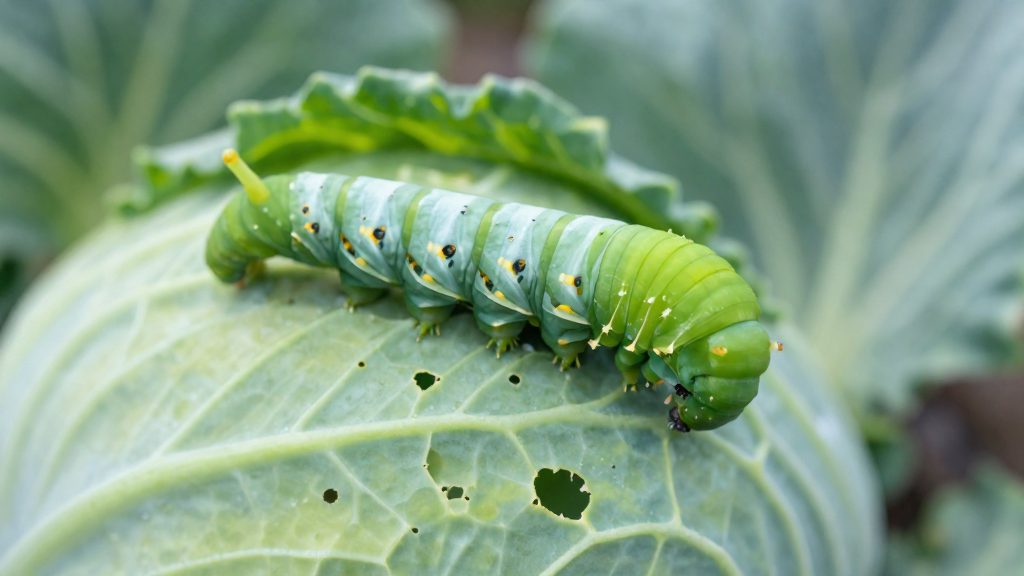
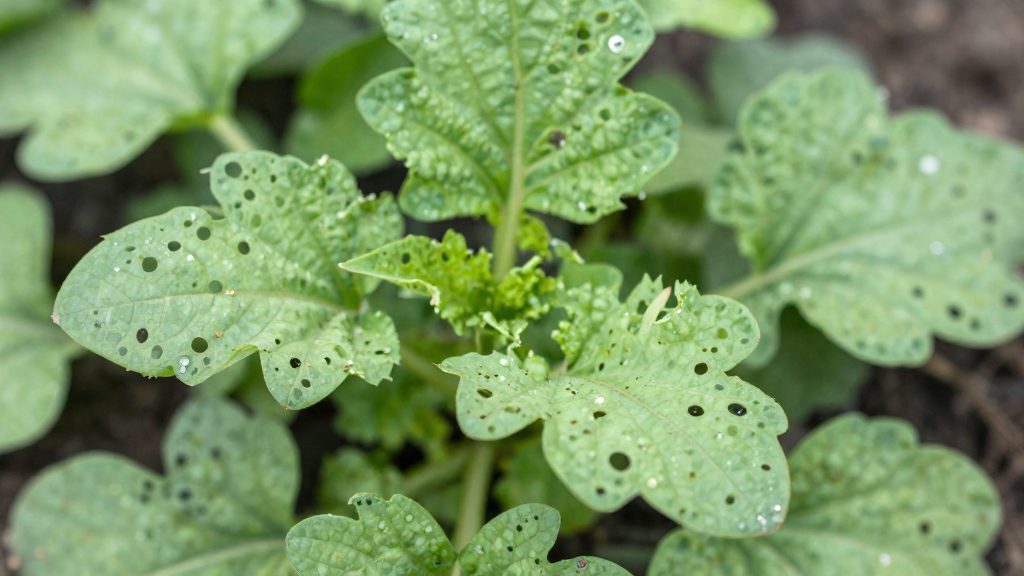
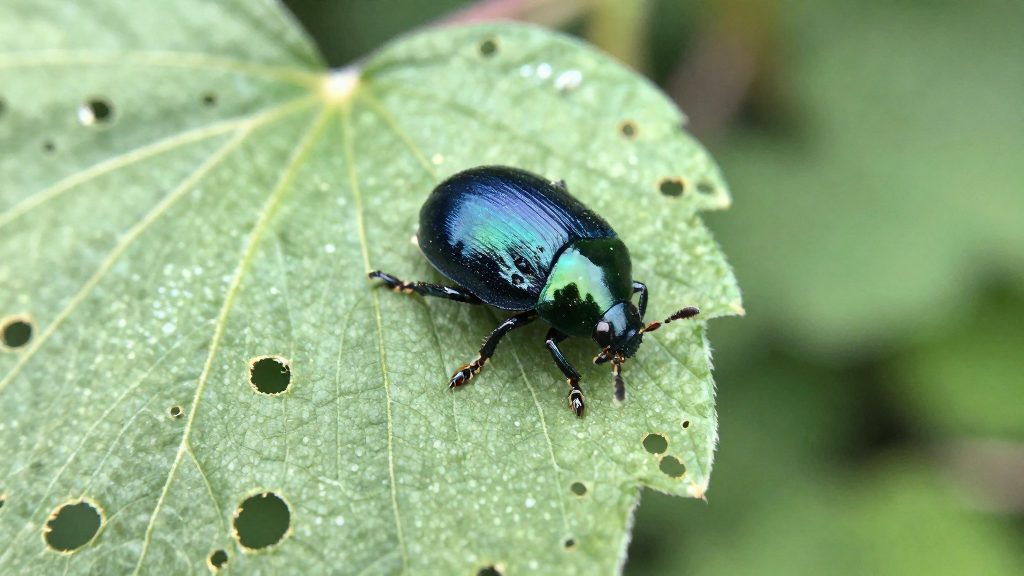
Flea beetles are identified by two signs: small adults that jump away when the plant is disturbed, and small holes or pits chewed into the leaves. According to the University of California Statewide IPM Program, flea beetles jump when disturbed and chew small holes or pits in vegetable leaves, and heavy feeding can stunt or kill seedlings. Confirming both signs before choosing any treatment helps you avoid acting on the wrong pest and gives you a clear baseline to monitor.
How Do You Identify Flea Beetles?
Jumping Adults
The adult beetle is small and dark, and its defining behaviour is jumping. Touch or brush the foliage and the beetles leap off the plant. This reflex makes them easy to miss when you look straight at a leaf, because they often leave before you can focus on them.
To confirm the insect, use this method:
- Hold a white sheet, tray or piece of paper under the plant.
- Tap or gently shake the stems and lower leaves.
- Look for small beetles landing on the pale surface.
Shot-Hole Pits and Small Holes
The characteristic damage is a pattern of small, round holes or pits, often described as shot-hole damage. The holes are chewed into the leaf surface, and the leaf often looks perforated rather than torn. Shot-hole pits on young plants deserve closer inspection than the same damage on established plants.
Look at the leaves in these places:
- Newly emerged leaves, which are often the most heavily damaged.
- Lower leaves near the soil, where beetles tend to be found when disturbed.
- Several plants across the bed, not just one.
Telling Flea Beetle Damage From Other Chewing Pests
Many insects chew leaves, so the holes alone do not confirm a flea beetle. Use these checks to narrow the cause:
- Hole size and shape: Flea beetle damage is made up of many small pits or holes. Larger notches along the leaf edge point to a different chewer.
- Presence of the insect: If the holes are present but no jumping adults appear when you tap the plant, the damage may come from a different source.
- Feeding pattern: Check whether the damage is spread across the leaf surface or concentrated in one area.
If you cannot decide between causes, bring a damaged leaf and a sample of the insects to your local extension service or a garden centre with plant health expertise for identification.
When Do Flea Beetles Need Control?
Flea beetles are most damaging to brassica seedlings and new transplants, so timing control around the plant’s stage matters more than a fixed calendar date. According to the University of California Statewide IPM Program, brassica seedlings and new transplants should be inspected for flea beetle damage twice weekly until they are well established. Regular checks let you spot an infestation while it is still small, before the plants have been fed on for days.
The Seedling Stage Is the Vulnerable Window
Young brassicas have little foliage to lose, so any damage falls on the tissue a young plant depends on most. The period after sowing or transplanting is when feeding is most likely to cause lasting harm.
Inspection Routine
- Check all brassica seedlings and transplants twice weekly.
- Keep the same two days each week so that no check gets skipped.
- Continue the routine until the plants are well established, not only for the first few days after planting.
- Inspect the whole bed, not just the plants nearest the edge, since the beetles jump when disturbed and can move between plants.
Stunting and Death From Severe Feeding
A stunted seedling falls behind the rest of the bed, and a seedling that dies must be resown or replanted, which costs time in the season. Catching feeding early during the twice-weekly checks is the most practical way to limit this outcome.
Shortening the Vulnerable Period
According to Colorado State University Extension, transplants and rapid seedling establishment can help crops withstand feeding. Strong, established transplants are less likely to be set back by the same amount of feeding than slow-growing young plants.
Protect Young Plants With Row Covers
Row covers are a physical barrier that keeps flea beetles off vulnerable plants. According to University of Maryland Extension, row covers can exclude flea beetles from vulnerable plants when they are installed correctly.
Correct installation depends on three points:
- Secure the edges. Cover the bed and fix every edge firmly to the ground, using soil, stones, or pegs. Any gap at the edge gives beetles a way in.
- Support tall crops with hoops. Place hoops over eggplant so the cover is held above the plants rather than lying directly on them.
- Remove covers before flowering. According to University of Minnesota Extension (2022), covers should come off before the plants flower so pollinating insects can reach them.
| Situation | Method |
|---|---|
| Low, vulnerable young plants | Lay the cover over the bed and secure all edges to the ground |
| Eggplant | Support the cover over hoops, and secure the edges to the ground |
| Plants approaching flowering | Remove the cover before flowering |
Row covers are one part of a protection strategy and work best when combined with other methods. Check the timing for your crop and local conditions, because no single planting date or removal date applies to every vegetable and every climate.
Reduce Weeds and Overwintering Sites
Flea beetles need shelter and food close to the garden to survive between crops. Clearing overwintering shelters and weed food sources before and between plantings reduces the number of beetles that can reach young seedlings. According to University of Minnesota Extension (2022), removing old crop debris reduces overwintering shelters, and controlling weeds near planting sites limits flea beetle food sources.
Remove Old Crop Debris
- After harvest, pull spent brassica plants and clear the leaves, stems and roots left on the bed.
- Compost healthy residues, or remove heavily damaged material from the garden.
- Clear debris from the bed margins as well as the bed itself, so there are fewer sheltered places nearby.
Control Weeds Near Planting Sites
- Weed the bed and its edges before sowing or transplanting, so beetles have fewer food sources close to young crops.
- Keep paths and borders trimmed during the season, especially around brassica beds.
- Colorado State University Extension notes that thick mulch may help protect isolated plantings. Results are not guaranteed across all crops and regions, so use mulch alongside the other measures in this section.
Keep Brassica Beds Clean Between Plantings
- Check the label or the manufacturer’s instructions before using any product on the bed.
Use Trap Crops and Strong Transplants
Two cultural measures can reduce pressure on your main crop. A trap crop draws beetles away from the brassicas you want to keep, and vigorous transplants help the crop reach a size where it can tolerate feeding. Neither works as a stand-alone control, but both fit alongside the other methods in this guide.
The goal is to draw the feeding onto a sacrificial plant and get the main crop past its most vulnerable stage quickly.
Radish or Daikon as Sacrificial Plantings
According to Colorado State University Extension, radish or daikon can protect other brassicas in some situations. The beetles feed on the trap plant instead of the crop you want to keep.
- Plant radish or daikon before the brassicas you want to protect, so the trap crop is established when the main crop is planted.
- Treat the trap plants as a sacrifice. Their leaves are expected to take the feeding.
- Keep watching the trap plants, because a trap crop only works while beetles prefer it.
Harvesting or Destroying the Trap Crop
Remove the trap crop only after the main crop is well established. Colorado State University Extension states that the trap crop can then be harvested or destroyed.
- Harvest the radish or daikon if you want to eat it.
- Destroy the plants if you do not need them. Do this once the main crop has taken hold, not before.
Growing Sturdy Transplants for Rapid Establishment
Rapid establishment can help plants withstand flea beetle feeding, but heavy infestations can still severely injure them.
- Start with healthy, well-grown transplants rather than weak or leggy ones.
- Choose a sunny planting site so the plants can grow vigorously.
- Water to keep the soil moist without waterlogging it, since saturated soil slows root growth.
- Plant out on time for your region and climate, so the transplants are not stressed while beetles are active.
Which Organic Treatments Actually Help?
Physical removal and soap-based products can reduce flea beetle numbers on some crops, but neither is established as complete control on its own. Their usefulness depends on three things: how often they are repeated, which crop is treated, and whether the product is accepted for organic production. The sections below compare the options on those points.
Portable vacuum removal
A portable vacuum can remove flea beetles from foliage, according to Colorado State University Extension. Beetles can reinvade quickly, so collection has to be repeated frequently rather than done once. Treat it as an ongoing step while plants are vulnerable. Because it applies no product, it raises no organic acceptability question.
Insecticidal soap at the cotyledon stage
According to University of California Statewide IPM Program, insecticidal soap may give partial control on brassicas when applied at the cotyledon stage. Partial control means expect reduced feeding, not elimination of the beetles. The cited guidance supports partial control at the cotyledon stage; follow the specific product label for permitted application timing.
Verifying organic status on the product label
Organic acceptability depends on the specific product, so the same active ingredient may not be accepted in every formulation. Check these points before buying:
| Option | Organic status | What to check on the label |
|---|---|---|
| Insecticidal soap | Depends on the product | Organic listing and crop use |
| Spinosad | Some formulations permitted in certified organic production | Crop listing and current instructions |
| Pyrethrin | Some formulations permitted in certified organic production | Crop listing and current instructions |
| Diatomaceous earth | Most products do not permit application to growing plants | Whether the label allows use on vegetables |
If the label is unclear, contact the product manufacturer or your local certification body before use.
Other options and their limits
- Kaolin: University of Maryland Extension describes greatly reduced feeding. University of Minnesota Extension reports mixed study results and grower experience. Do not expect reliable control.
- Neem: University of Maryland Extension recommends it for severe infestations, but its effectiveness has not been independently established.
- Homemade sprays using garlic, vinegar, essential oil or dish soap are not established as reliable flea beetle controls. Do not rely on them as a substitute for the measures above.
Prevent Flea Beetles Next Season
Preventing flea beetle damage in the following year starts with changing the conditions that favour them: where brassicas are planted, when seedlings go out, and how the season’s problems are recorded. A plan built on repeated observation is more reliable than a single reactive treatment.
Rotate Brassica Beds
Avoid planting brassicas in the same bed year after year. Repeated plantings in one location concentrate the pest pressure that builds up there. Move cabbage, kale, broccoli, radish and other brassicas to a different bed each season, and keep track of where each crop grew.
- Plan the rotation on a written or drawn map of the garden, not from memory.
Adjust Sowing and Transplant Dates
Timing matters because young plants are the most vulnerable. The goal is to get seedlings growing strongly before beetle activity peaks in your area.
- Check with your local extension service or regional gardening network to learn when flea beetles first appear in spring in your location. Emergence dates vary by region and climate, and no single planting date applies to every vegetable or every climate.
- Shift sowing or transplanting dates by a few weeks based on that local information, then note how the crop fared.
- Starting seedlings indoors and transplanting them when they are well established can give them a head start over direct-sown plants.
Keep a Dated Log of Damage
A written record turns each season into useful information for the next one. Note the date each time you observe damage, the crop affected, the bed location, the extent of the feeding, and the weather at the time.
- Record the date you first see flea beetle holes, and the date you inspect brassica seedlings.
- Note which beds and varieties showed the most damage, so you can avoid placing those crops in the same spot next year.
- Record your row cover installation and removal dates, along with any treatments used, so you can compare results across seasons.